



Turquoise Pearl Pendant
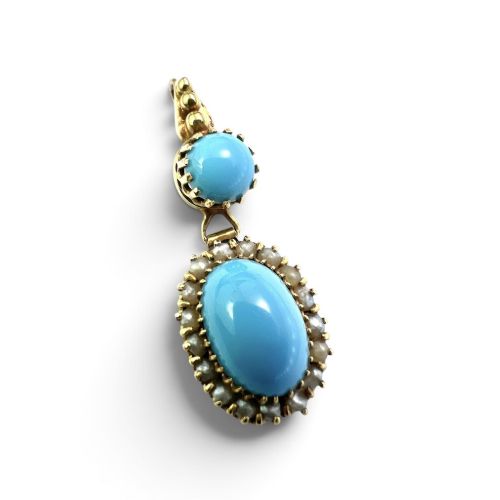
A turquoise pearl pendant brings together the vivid blue of hard stone and the soft lustre of organic gem in a historic frame.
Turquoise Pearl Pendant
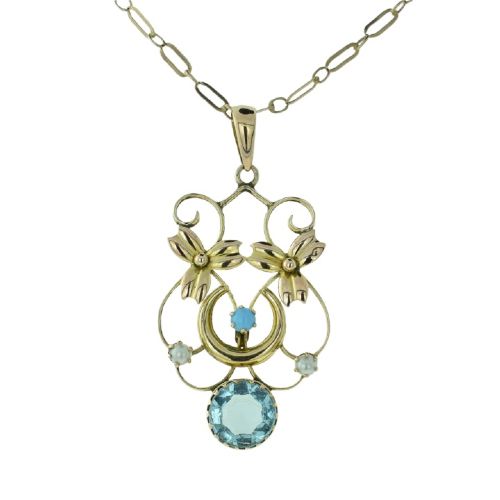
A turquoise pearl pendant is a small piece of historic jewellery designed to hang from a chain or ribbon around the neck. The pieces on this page span the Victorian, Edwardian, and Arts and Crafts periods, alongside later nineteenth and early twentieth century examples.
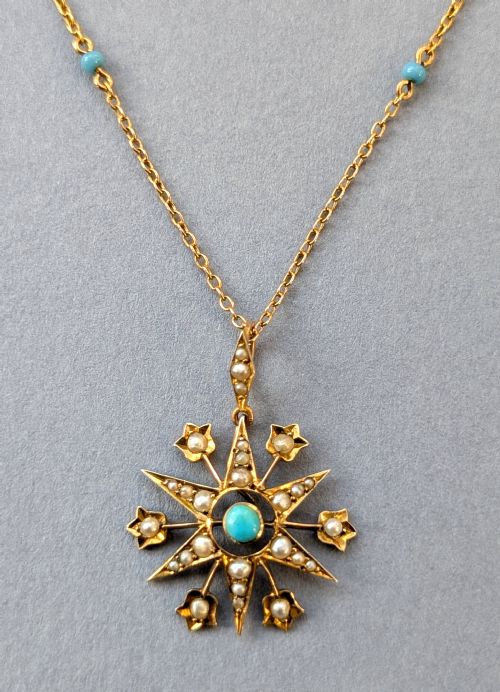
Most items combine turquoise cabochons or seed pearls with gold or silver settings, frequently taking the form of hearts, crosses, bows, or floral clusters. Pendant necklaces and convertible brooch pendants appear regularly across both current listings and archive records.
Victorian and Edwardian versions dominate the selection, showing distinct shifts from high carat yellow and rose gold towards silver and enamel work as the Arts and Crafts movement developed.
Materials and Construction
Goldsmiths and silversmiths constructed these mounts in 9ct, 15ct, and 18ct gold, as well as sterling silver and rolled gold. Stones were hand-set into collets, with seed pearls often strung on silk or secured with fine wire inside delicate floral or star motifs.
Enamel work and blister pearls appear alongside turquoise matrices in pieces from the turn of the twentieth century. Setting techniques relied heavily on hand-bezeling and grain setting to hold small turquoise cabochons and pearls secure.
Turquoise Pearl Pendant Retail Price Guide 2026
Typical asking prices for turquoise pearl pendant among the pieces listed under this phrase on Sellingantiques today, from the lower quarter to the upper quarter. They describe what is for sale here now, not the wider market.
A Victorian dove pendant shares shelf space with winged hearts and grape clusters, proving the Victorians turned almost anything into a love token.
Evaluating Quality
Quality rests in the integrity of the original gem setting and the weight of the precious metal used. Pieces manufactured in higher carat gold, such as 15ct or 18ct, display superior durability and richer colour tones compared to lighter 9ct or rolled gold equivalents.
The precision of the miniature handiwork distinguishes finer examples, particularly where seed pearls are uniformly matched in size and lustre, and turquoise stones retain an even robin's egg blue without extensive matrix cracking or discoloration.
Murrle Bennett·Liberty and Co
The Turquoise Pearl Pendant Glossary
- Cabochon
- A gemstone shaped and polished with a smooth convex surface rather than faceted. This cut preserves the natural opaque colour of the turquoise.
- Seed pearl
- A very small natural or saltwater pearl, frequently pierced and threaded onto wire or silk. They are typically arranged in dense clusters to form petals or borders.
- Parure
- A matching set of jewellery designed to be worn together, such as earrings and a pendant. Complete surviving sets are uncommon.
- Collet
- A band or collar of metal that holds a gemstone in place by its edge. It represents a traditional hand-setting technique.
- Witches heart
- A heart-shaped pendant with a twisted tail pointing to one side, popular during the Victorian era as a romantic token.
Turquoise Pearl Pendant: Frequently Asked Questions
What periods do these pendants come from?
The pieces span the Victorian, Edwardian, and Arts and Crafts eras, alongside early twentieth century designs.
Most items date from the late nineteenth century up to the 1930s.
Are turquoise and pearls fragile?
Turquoise is a softer porous stone that can absorb oils and discolour if exposed to water or cosmetics.
Seed pearls are similarly delicate and benefit from careful cleaning with a dry cloth rather than liquid immersion.
Can these pendants be worn as brooches?
Many examples on this page are convertible pieces fitted with both a suspension loop and a pin finding on the reverse.
This dual function allowed nineteenth-century wearers to pin the jewel to a bodice or hang it from a chain.
How do I tell gold purity on these?
British pieces often feature hallmarks stamped on the loop or reverse indicating the gold carat, such as 9ct, 15ct, or 18ct.
Unmarked items rely on testing or maker attribution to confirm the metal standard.