
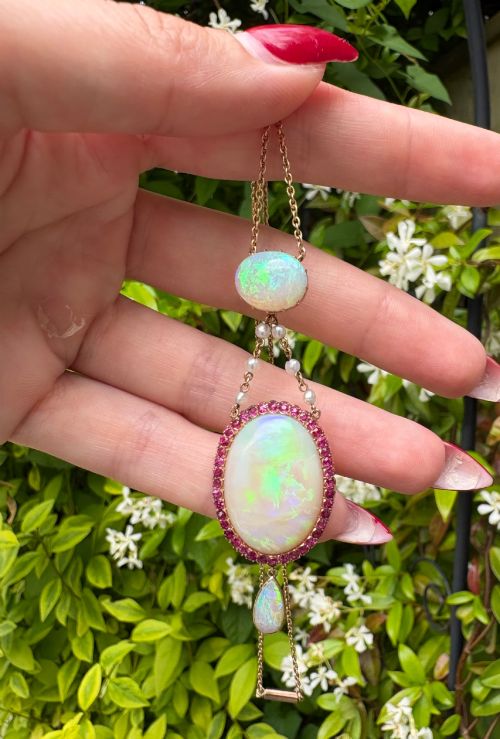


Victorian Lavalier Pendant
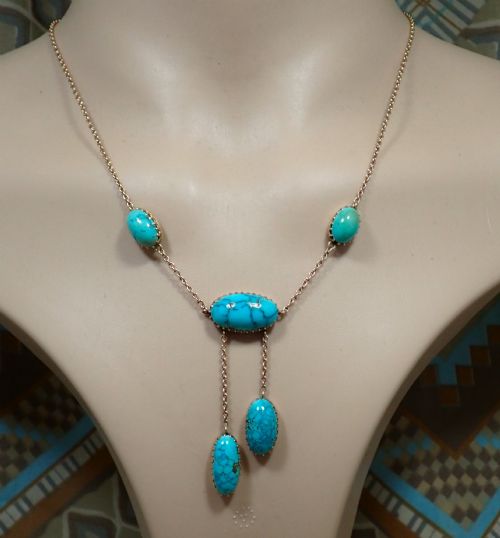
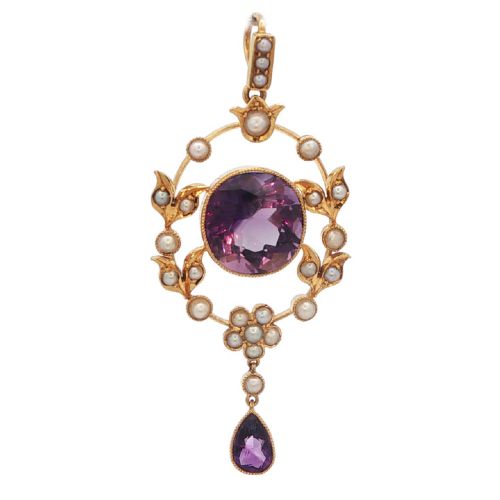
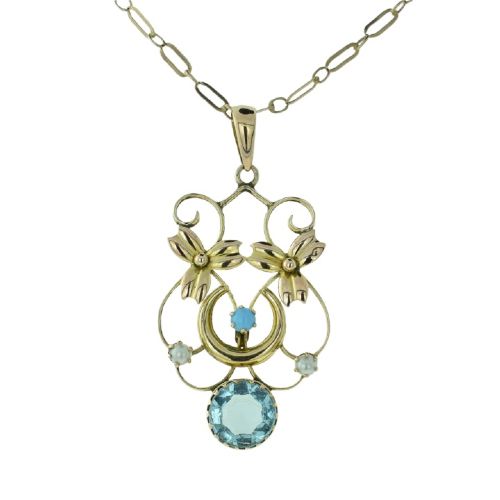
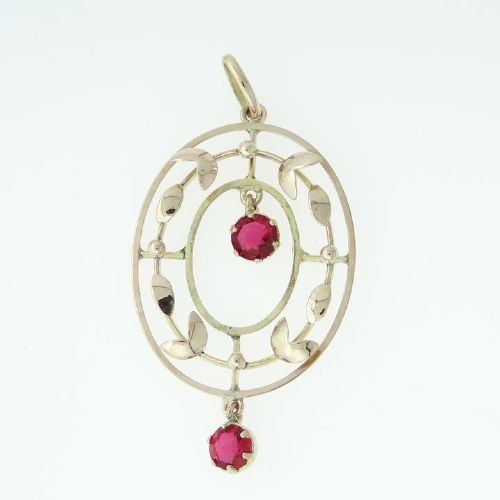
These delicate victorian lavalier pendant designs suspend gemstones and pearls on slender gold drops, offering graceful movement for everyday wear.
Victorian Lavalier Pendant
A victorian lavalier pendant is a pendant necklace featuring a central drop or suspended stone designed to sway gently with the wearer. The pieces seen here span the victorian, edwardian, and art nouveau periods, reaching from the nineteenth century into the early twentieth century.
Gold forms the foundation of these necklaces, utilising both nine carat and fifteen carat yellow and rose gold alloys. Makers suspended varied stones including amethysts, seed pearls, opals, turquoises, and garnets from these delicate chain mountings.
Necklaces and pendant necklaces appear frequently alongside convertible brooch and pendant combinations. Many pieces incorporate foliate motifs and characteristic art nouveau curves alongside traditional gem settings.
Materials and construction
Goldsmiths constructed these jewels primarily in nine carat and fifteen carat gold, occasionally employing silver or eighteen carat components. Metalwork involved handcrafting delicate wire frames, collet settings, and articulated drop links to allow free movement.
Seed pearls and natural pearls were threaded or pegged onto gold mountings alongside rubies, amethysts, opals, and turquoises. Craftsmen utilised foliate and linear designs to balance the weight of the suspended gems.
The surviving pieces combine victorian craftsmanship with art nouveau foliate designs.
Assessing quality and craftsmanship
The distinction between standard items and superior examples lies in the precision of the metalwork and the selection of the stones. Higher quality pieces display intricate pierced gold frames and well-matched natural pearls rather than uniform simulated gems.
Signed works from established makers demonstrate finer articulation in the drop elements and secure settings for delicate opals and seed pearls. The integrity of the original chain and the presence of maker marks elevate individual pieces.
Murrle Bennett·Hamilton & Co
The Victorian Lavalier Pendant Glossary
- Lavalier
- A pendant necklace featuring a small drop or suspended element that hangs below the main setting. This style gained popularity during the late nineteenth and early twentieth centuries.
- Seed Pearl
- A very small natural pearl, typically under two grains, often drilled and strung on silk or wire. These tiny pearls were clustered in floral and foliate configurations.
- Collet
- A band of metal that holds a gemstone in place by enclosing its girdle. This traditional setting method secures the stone while allowing light to pass through.
- Foliate
- Ornamentation shaped like leaves or foliage. This decorative style appears frequently in art nouveau and victorian jewellery designs.
- Art Nouveau
- An international art style prominent from the late nineteenth century until the First World War. It is characterised by organic, asymmetric lines and flowing plant motifs.
Victorian Lavalier Pendant: Frequently Asked Questions
What is a victorian lavalier pendant?
A victorian lavalier pendant is a necklace featuring a central drop stone suspended from a chain or fixed decorative bar. These pieces incorporate gemstones like amethyst, opal, and turquoise within gold settings.
Craftsmen produced these delicate ornaments throughout the nineteenth and early twentieth centuries, blending stylistic elements from the victorian, edwardian, and art nouveau periods.
How do I wear a pendant brooch?
Many nineteenth century pendants feature a concealed pin and safety catch on the reverse alongside a fixed loop for a chain. This dual construction allows the ornament to function as both a brooch and a necklace.
When wearing the piece as a necklace, ensure the pin is securely closed and fastened flat against the backing to prevent clothing snags.
Are seed pearls fragile?
Seed pearls require gentle care because organic material reacts sensitively to moisture, perfumes, and cosmetic products. The fine silk threads holding older necklaces can weaken with age and frequent wear.
Store these necklaces flat in a dry box and avoid submerging them in liquid cleaning solutions to protect both the pearls and the gold mountings.
How can I date my pendant?
Dating relies on examining the metal hallmarks, gemstone cuts, and stylistic motifs present in the design. Victorian pieces often feature nine carat or fifteen carat gold standards alongside hand-cut stones and foliate wirework.
The inclusion of sinuous curves typically points towards the art nouveau influence around nineteen hundred, while simpler geometric lines suggest later edwardian production.