


Amethyst Seed Pearl Pendant
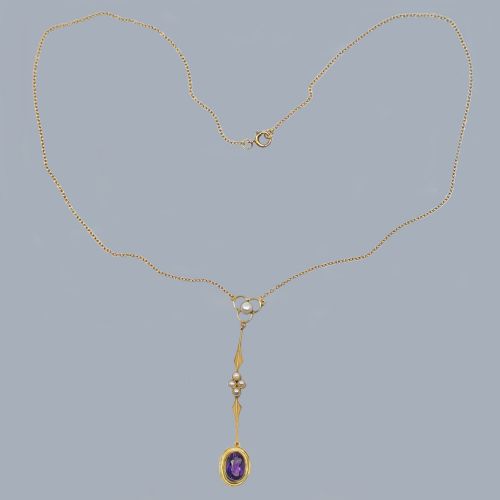
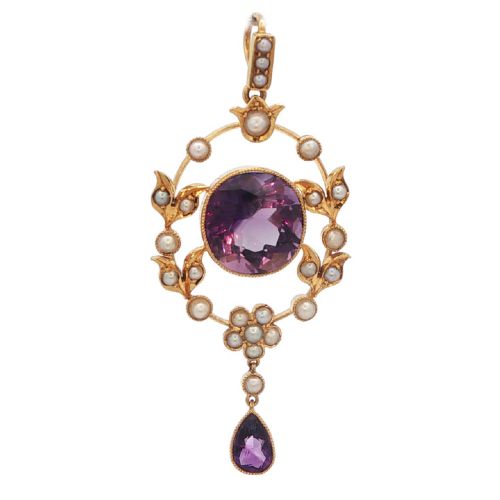
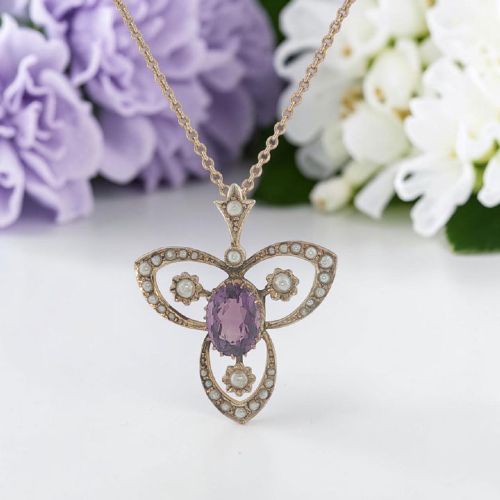
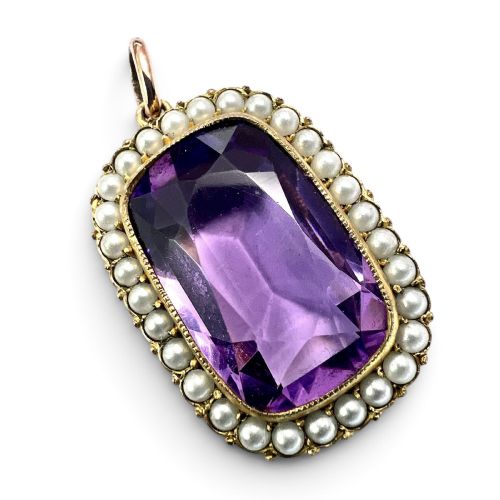
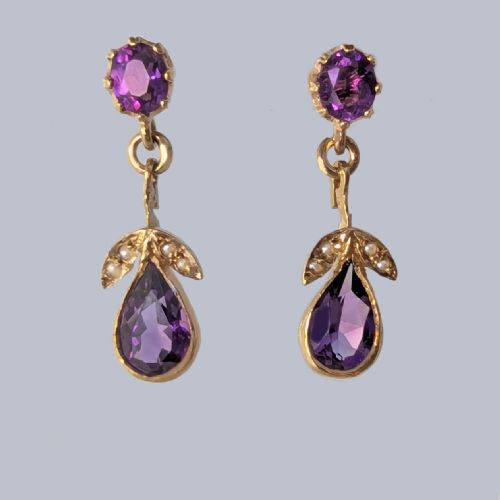
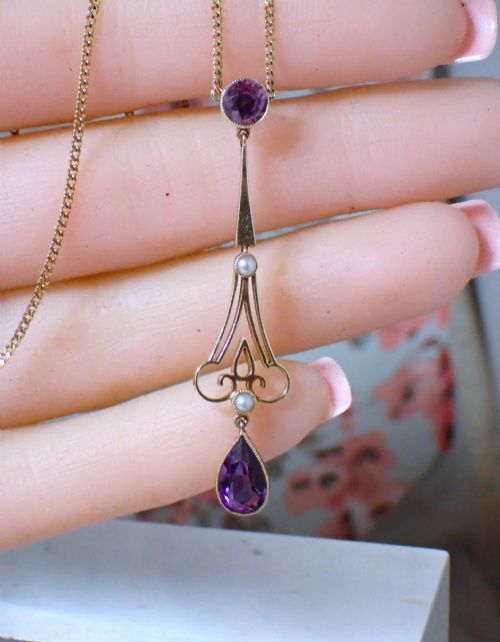
An amethyst seed pearl pendant brings together deep purple quartz and delicate marine pearls in gold settings designed to catch the candlelight.
Amethyst Seed Pearl Pendant
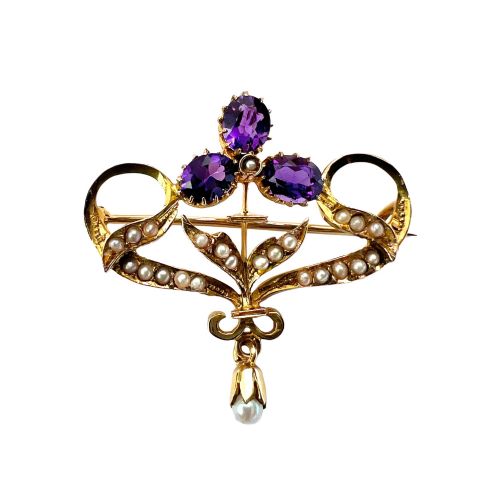
The selection ranges from simple halo mounts and convertible brooch-pendants to elaborate drop necklaces set with multiple stones. While primarily designed as chest pendants, many survive with dual pin fittings that allow them to be worn pinned to a lapel. The origin of these items spans British workshops of the Victorian era through to later twentieth-century revivals.
Materials and construction
Makers set amethysts and pearls into either 9ct or 15ct yellow gold, utilising collet settings, claw mounts, and delicate seed pearl wire-work. The pearls are typically half-drilled and glued or pegged onto tiny gold pins arranged in floral or foliate clusters around the central amethyst.
Art Nouveau examples employ cast and chased gold shaped into asymmetrical whiplash lines and organic curves, whilst earlier Victorian pieces favour symmetrical halo and cluster arrangements. Silver and paste are occasionally utilised alongside gold, though solid gold construction remains standard for the period.
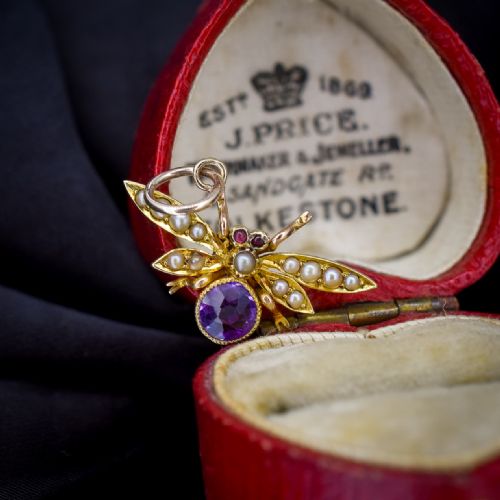
Some tiny winged insects managed to fly straight into the Edwardian era, landing permanently as golden charms.
Factors determining quality
The quality of an amethyst seed pearl pendant depends heavily on the saturation and clarity of the central amethyst and the uniformity of the surrounding pearls. Top-tier examples feature deeply coloured, clean quartz paired with pearls that retain their original lustre and match closely in size and cream tone.
Construction weight and subtlety of metalwork also separate fine pieces from standard production. Heavier 15ct gold mounts with hand-engraved details and secure, tightly spaced pearl settings represent superior craftsmanship compared to lighter 9ct equivalents.
S. Blanckensee & Son·Hamilton & Co
The Amethyst Seed Pearl Pendant Glossary
- Seed pearl
- A very small natural or cultured pearl, often measuring less than two millimetres in diameter. These tiny pearls were traditionally threaded onto fine silk or pegged onto gold wire to form intricate floral motifs.
- Lavalier
- A pendant featuring a central stone suspended from a shorter drop, which hangs further from a main necklace chain. This style gained immense popularity during the Edwardian period.
- Collet
- A band of metal that holds a gemstone in place by gripping its girdle. It forms a neat, polished edge around the stone.
- Paste
- Hand-cut and polished lead glass used to imitate gemstones. In period jewellery, high-quality paste provides brilliant light refraction.
- Whiplash line
- An asymmetrical, curving line that mimics natural plant stems and tendrils. It defines the organic aesthetic of the Art Nouveau movement.
Amethyst Seed Pearl Pendant: Frequently Asked Questions
How do I wear a convertible brooch pendant?
Many Edwardian and Victorian pieces feature a hinged pin and a separate loop, allowing them to function as both a brooch and a necklace. To wear it as a pendant, simply thread your chain through the top bail while ensuring the pin on the reverse is securely fastened back into its safety clasp.
When wearing the piece as a brooch, tuck any dangling drops carefully so they hang straight against fabric. The dual functionality makes these versatile items for different necklines and outfits.
What is the difference between Victorian and Edwardian styles?
Victorian designs tend to be heavier, more symmetrical, and often incorporate sentimental motifs like hearts, foliate clusters, or mourning compartments. They frequently utilise robust 15ct gold settings alongside rich, dark amethysts.
Edwardian pieces embrace the lighter, airier Art Nouveau aesthetic with whiplash lines, garlands, and lavalier drops. They frequently employ seed pearls in intricate lace-like patterns supported by finer 9ct gold frameworks.
How can I tell 9ct gold from 15ct gold?
Higher carat gold possesses a richer, warmer yellow hue due to the greater proportion of pure gold alloyed within the metal. You can often verify the purity by checking for tiny hallmarks stamped on the jump ring or the reverse of the frame.
Victorian and Edwardian items commonly display specific crown or numerical stamps denoting their exact gold standard. Lower carat 9ct gold items appear slightly paler in comparison to deep 15ct antique pieces.