


Turquoise Cabochon Pendant
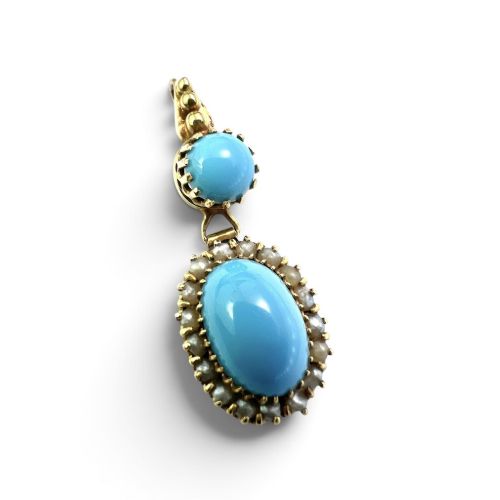
A turquoise cabochon pendant brings together smooth, domed turquoise stones and precious metals, offering a distinct ornamental focus for collectors of antique jewellery.
Turquoise Cabochon Pendant
A turquoise cabochon pendant is a wearable piece of jewellery featuring a polished, unfaceted turquoise stone mounted in silver or gold. When buyers search for a turquoise cabochon pendant, they encounter forms ranging from simple halo designs to complex Arts and Crafts creations.
The pieces on this page span the Victorian, Edwardian, and Art Nouveau periods, alongside Arts and Crafts and Egyptian Revival styles. Early Victorian examples often use pearls and gold, while later Edwardian and Arts and Crafts versions frequently pair turquoise matrix with silver.
Makers such as the Gaskins and Dorrie Nossiter appear in the records alongside unsigned works, showing both named studio output and traditional workshop production. Buyers find individual pendants, matched necklace sets, and complete parures including earrings and rings.
Materials and construction
Metals used in these pieces include silver, yellow gold in 9ct and 18ct forms, and rolled gold. Stones are shaped into smooth cabochons rather than faceted gems, sometimes incorporating turquoise matrix alongside pearls, opals, lapis lazuli, and diamonds.
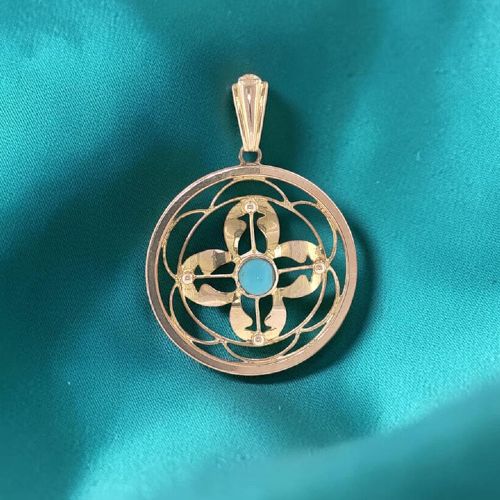
Techniques range from delicate filigree work in silver frames to secure claw or bezel settings in gold. Arts and Crafts pieces display hand-wrought silver elements, while Victorian and Edwardian examples often utilise halo arrangements and leafed foliage decoration.
Listings combine silver and gold with turquoise, pearls, and diamonds across Victorian and Edwardian periods.
Assessing quality and craftsmanship
Quality in a turquoise cabochon pendant rests on the stone's natural colour consistency, surface smoothness, and how securely it sits within its metal mount. Higher quality examples show careful matching of turquoise stones alongside complementary gems like pearls or diamonds.
The skill of the metalwork distinguishes standard production from notable studio pieces. Hand-beaten silver mountings, detailed filigree, and documented attribution to makers like the Gaskins or Dorrie Nossiter elevate the standing of a piece.
the Gaskins·Dorrie Nossiter
The Turquoise Cabochon Pendant Glossary
- Cabochon
- A gemstone shaped and polished with a smooth, rounded surface rather than faceted edges. This cut highlights the natural colour and texture of turquoise.
- Turquoise matrix
- Turquoise stone that retains portions of its host rock, showing web-like patterns or veining across the surface. This variety appears frequently in Arts and Crafts jewellery.
- Parure
- A matched set of jewellery designed to be worn together, typically including a necklace or pendant, earrings, and a ring or brooch. The evidence shows parures combining turquoise matrix with silver.
- Filigree
- Ornamental work consisting of fine wire twisted and soldered into intricate openwork patterns. It is commonly found on silver Art Nouveau pendants.
- Egyptian Revival
- A style of design drawing inspiration from ancient Egyptian motifs and iconography. This aesthetic influences specific gold pendants from the late nineteenth century.
Turquoise Cabochon Pendant: Frequently Asked Questions
How do I date a turquoise cabochon pendant?
Dating relies on stylistic clues, metal types, and manufacturing techniques evident in the piece. Victorian examples often feature yellow gold and pearl halos, while Arts and Crafts pieces from the early twentieth century typically use silver and turquoise matrix.
Maker attributions and hallmarks also help narrow down the period. Pieces associated with named designers or specific movements like Art Nouveau carry distinct aesthetic markers that align with production decades.
What is turquoise matrix?
Turquoise matrix refers to stone that retains portions of the parent rock, creating dark web-like veins across the blue or green surface. This natural variation is particularly characteristic of Arts and Crafts jewellery.
Unlike uniform turquoise stones, matrix stones showcase the organic origin of the material. Makers in the early twentieth century often preferred this textured look for silver settings.
Are these pendants sold with chains?
Listings describe various configurations, including pendants supplied on matching chains or integrated into broader necklace sets. Some historic pieces retain original elements such as a turquoise clasp set chain.
Buyers should examine individual item descriptions to confirm whether a chain accompanies the pendant. Many antique pendants are mounted on later or associated chains suitable for contemporary wear.
How should I care for antique turquoise?
Turquoise is a relatively soft and porous gemstone that absorbs oils, cosmetics, and water easily. Cleaning should involve only a soft, dry cloth without harsh chemical dips or ultrasonic cleaners.
Protecting the stone from prolonged direct sunlight and moisture preserves its colour over time. Removing the pendant before swimming or applying lotions prevents damage to both the stone and its metal setting.