


Gold Snake Ring
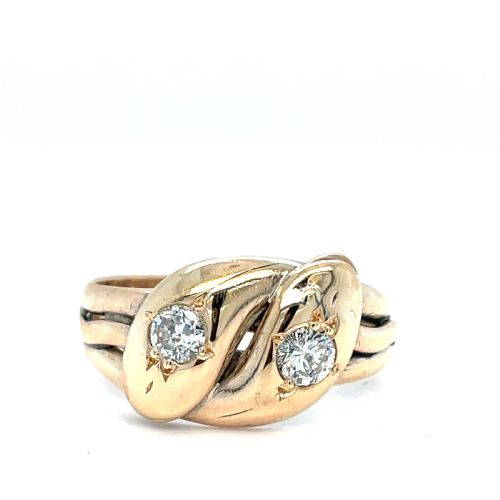
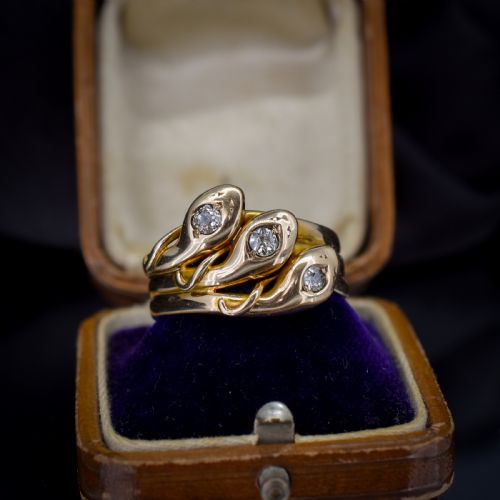
A gold snake ring coils around the finger with Victorian and Edwardian craftsmanship, bringing centuries of symbolic jewellery into daily wear.
Gold snake ring types and periods
A gold snake ring is an enduring form of antique jewellery, appearing most frequently in Victorian and Edwardian designs across single, double and triple coiled serpent bands. These pieces span the nineteenth and early twentieth centuries, featuring distinct regional hallmarks from London, Chester and Birmingham.
Buyers will encounter single coiled reptiles as well as twin serpent heads facing opposite directions or intertwined in continuous loops. The inventory ranges from substantial 18ct yellow and rose gold bands to lighter 9ct and 15ct iterations, often incorporating symbolic motifs like hearts or crown-like twists.
Materials and construction
Goldsmiths shaped these rings from solid 9ct, 15ct and 18ct gold, utilising both casting and hand-coiling techniques to render the undulating scales of a serpent. Heavier bands demonstrate considerable metal weight, while intricate engraving achieves the textural appearance of reptilian skin.
Gems were flush-set or claw-set into the serpent heads to serve as glowing eyes. Craftsmen utilised old-cut and rose-cut diamonds, alongside sapphires, rubies, garnets and green stones, occasionally accentuating the design with platinum or white enamel.
Retail Price Guide 2026
Typical UK retail prices for gold snake ring, calculated from the Sellingantiques database of over a million retail prices indexed since 2003. This retail price guide relies exclusively on Sellingantiques data; no external sources or auction records are used, so the figures do not describe the wider market.
Several Victorian serpents double up as twin-headed beasts, proving that two heads are indeed better when guarding your finger.
Assessing quality and craftsmanship
The selection and setting of the eye stones heavily influence the calibre of the piece. Finer rings feature well-matched old-cut diamonds or high-grade rubies and sapphires securely bezel-set into expressive, finely proportioned serpent heads.
Roberto Coin
The Gold Snake Ring Glossary
- Serpent
- A decorative motif depicting a snake, widely utilised in nineteenth-century jewellery to represent eternity and wisdom.
- Old-cut diamond
- A hand-faceted diamond cut before the advent of modern machinery, characterised by a high crown and small table.
- Rose-cut diamond
- A stone featuring a domed, faceted top and a flat underside, resembling an unopened rosebud.
- Hallmark
- An official stamp applied to precious metals indicating purity, origin assay office and year of manufacture.
Frequently Asked Questions
How do I care for a gold snake ring?
Clean your antique ring gently with a soft brush and warm soapy water, avoiding harsh ultrasonic cleaners that might dislodge old-cut stones.
Store the piece separately in a fabric-lined box to prevent the coiled gold tail from scratching other items in your collection.
What do snake rings symbolise?
Victorian snake rings primarily symbolised eternal love, fidelity and wisdom, making them popular choices for tokens of affection.
Queen Victoria popularised the motif after receiving a serpent engagement ring featuring an emerald-set head from Prince Albert.
How do I date a snake ring?
Examine the inner band for British assay office hallmarks, which decode the exact year of manufacture and the city where the piece was tested.
Stylistic cues such as rose-cut diamonds, heavy 18ct gold weights and specific gem combinations also point toward Victorian or Edwardian periods.
Are these rings suitable for daily wear?
Sturdy 18ct gold antique bands withstand daily wear well, provided the stone settings are checked periodically by a professional jeweller.
Lighter 9ct versions or hollow forms require more mindful handling to avoid bending the delicate coiled tail during everyday tasks.