


Antique Snake Ring
An antique snake ring is a coiled serpent band carrying gems and history, valued as a Victorian symbol of eternal devotion.
Antique Snake Ring
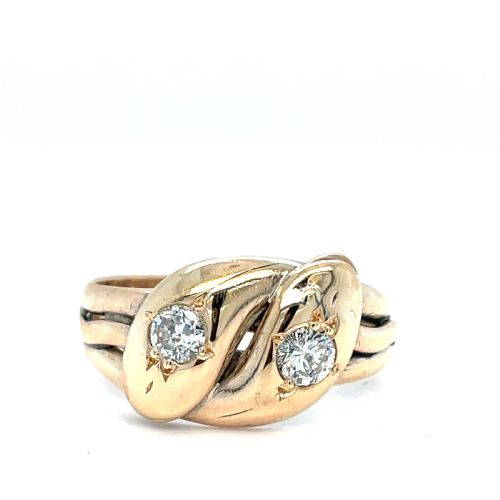
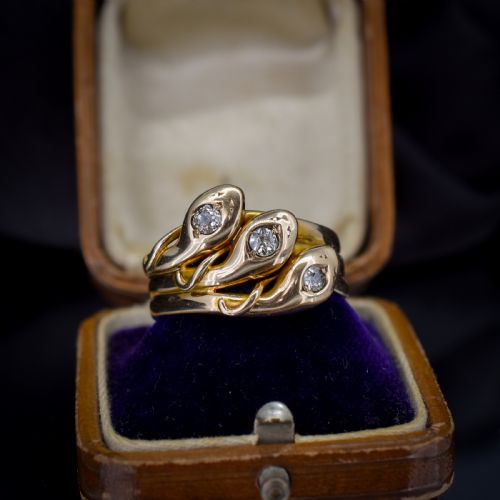
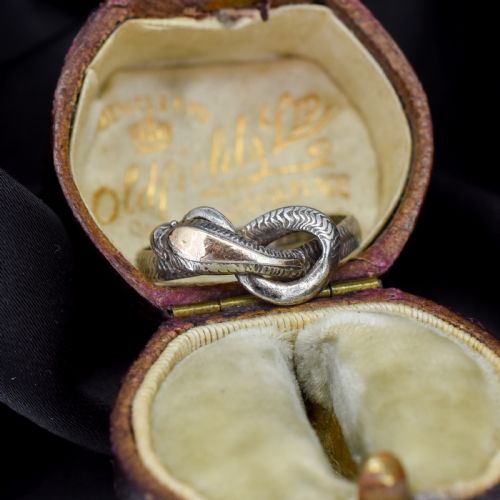
When you search for an antique snake ring, you encounter coiled serpent bands spanning Victorian, Edwardian and Georgian periods. These pieces take the form of single or double winding snakes, sometimes styled as an ouroboros, created to sit close to the finger.
The version you meet most often on this page is an 18ct gold band featuring old-cut diamond eyes, frequently bearing hallmarks from Chester or London between the late nineteenth century and the early twentieth century. Variations include sapphire, ruby or garnet set into the head, alongside simpler silver or 9ct gold iterations.
How they were made
Goldsmiths shaped these rings from 9ct and 18ct yellow gold, as well as silver, casting or hammering the metal to form the undulating scales and muscular coil of the serpent's body. Engraving tools defined the head and tail details, while split-ring or band constructions allowed the serpentine form to wrap securely around the finger.
Gemstones such as old-cut diamonds, rubies and sapphires were flush-set or star-set into the eyes to catch the light. Hallmarks stamped inside the band recorded the assay office, such as Chester or London, alongside the specific year of creation.
Listings feature yellow gold, silver, diamonds, rubies, sapphires and garnets across Victorian, Edwardian and Georgian periods.
What varies in quality
The distinction between a standard piece and a superior one rests upon the weight of the gold and the clarity of the engraved scale work. Heavier 18ct gold bands with substantial gram weights display a more pronounced presence on the hand.
Gemstone selection further separates the tiers, with larger old-cut diamonds or matched pairs of rubies and sapphires elevating the piece. Crisp, legible hallmarks from designated assay offices provide definitive validation of origin and period.
The Antique Snake Ring Glossary
- Ouroboros
- An ancient symbol depicting a serpent swallowing its own tail. This motif represents eternity and cyclical continuity in jewellery.
- Old-cut diamond
- A hand-faceted diamond cut before the modern brilliant standard was established. These stones possess smaller tables and open culets.
- Hallmark
- An official stamp applied to precious metals indicating purity and origin. British marks typically include assay office symbols and date letters.
- Rose-cut diamond
- A stone featuring a domed top covered in triangular facets and a flat base. This historic cut produces a soft, translucent gleam.
Antique Snake Ring: Frequently Asked Questions
What periods do these rings come from?
The pieces span the Georgian, Victorian and Edwardian eras, stretching from the nineteenth century into the early twentieth century. Hallmarks and stylistic traits help establish these specific historical windows.
Craftsmanship shifted slightly across these decades, moving from early engraved designs toward diamond and sapphire set gold serpents hallmarked in Chester and London.
How were antique snake rings worn?
Victorians wore these serpent bands as daily tokens of eternal love and commitment. The coiled body allowed the ring to wrap comfortably around the finger.
Many examples were given as sentimental gifts, carrying symbolic meaning embedded within the engraved scales and gemstone eyes.
What metals are used in these rings?
Goldsmiths utilised 18ct yellow gold and 9ct gold alongside silver for these serpentine designs. The gold weight varied significantly from lighter bands to heavier fifteen or nineteen gram statements.
Assay marks stamped inside the hoop verify the specific metal purity and point to British offices like London and Chester.
How do I identify the gemstone eyes?
Jewellers utilised old-cut diamonds, rubies, sapphires and garnets to form the piercing eyes of the serpent. These stones were typically gypsy-set or star-set directly into the gold head.
Examining the facets under magnification reveals the hand-cut nature of the stones, distinguishing antique gems from modern replacements.