


Diamond Serpent Ring
A diamond serpent ring coils around the finger with Victorian and Edwardian symbolism, offering a tactile piece of historic jewellery.
Diamond Serpent Ring
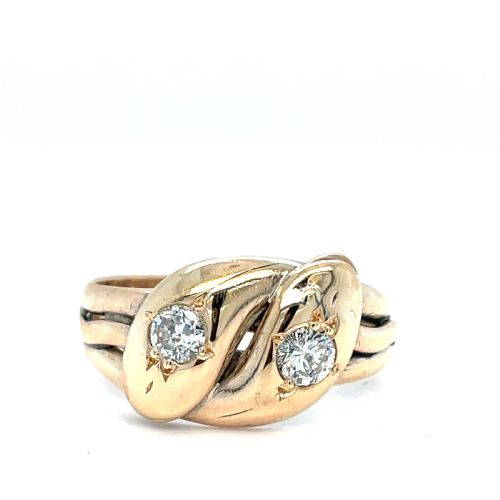
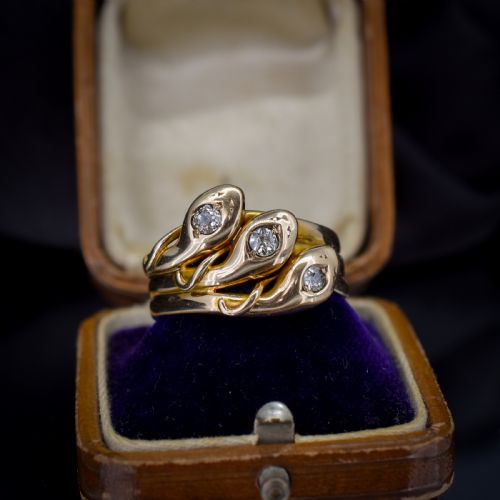
A diamond serpent ring takes the form of a coiled snake, representing eternal love and protection in nineteenth and early twentieth century jewellery. You encounter single and double snake bands most often, fashioned during the Victorian and Edwardian eras.
The pieces on this page span the late nineteenth century through to the early twentieth century, including pieces hallmarked in Chester, London and Birmingham. They combine rich yellow gold with shimmering old cut diamonds and occasional sapphires.
Makers utilised coiling bodies to wrap the finger securely, sometimes featuring twin heads facing in opposite directions. These serpent designs range from slender everyday bands to substantial statement rings carrying significant weight.
Materials and construction
Goldsmiths worked primarily in eighteen carat and nine carat yellow gold, occasionally employing fifteen carat variations to form the articulated or coiled bodies. These gold bands house flush or claw set stones that form the eyes or head motifs.
Jewellers set old cut diamonds, rose-cut diamonds, and sapphires into the serpent heads to create sparkling focal points. Hallmarks stamped inside the bands record the assay office and date letter, revealing the exact year of creation.
Assay offices in London, Chester, and Birmingham stamped these serpent rings between eighteen ninety and nineteen twenty.
Defining quality in antique serpent rings
Quality rests in the crispness of the chased scale engraving and the substantial weight of the gold band. Superior examples retain deep, legible hallmarks and secure stone settings that hold the old cut diamonds firmly in place.
The presence of matched sapphires alongside well-proportioned diamonds elevates a piece. Finer rings demonstrate careful articulation in the coiled tail and head, ensuring comfortable wear upon the hand.
The Diamond Serpent Ring Glossary
- Old cut diamond
- A hand-faceted diamond shape common in nineteenth century jewellery, featuring a small table and high crown that produces a distinctive candlelight sparkle. These stones were shaped individually before modern standardisation.
- Rose-cut diamond
- A vintage stone cut with a flat base and a domed, faceted top resembling an unopened rosebud. This historic style allows a soft luminescence.
- Hallmark
- An official stamp applied to precious metals indicating the standard of purity, the assay office, and the year of manufacture. These tiny marks provide a secure anchor for dating.
- Double snake ring
- A serpent ring featuring two intertwined bodies or two heads facing opposite directions. This specific formation often incorporates contrasting gemstones like sapphires.
- Chased
- A metalworking technique where a craftsman uses hammer and punches to push the surface into decorative patterns without removing material. This method defines the scales upon the serpent.
Diamond Serpent Ring: Frequently Asked Questions
What do snake rings symbolise?
Serpents in Victorian jewellery represent eternal love, wisdom, and rebirth. Prince Albert gave Queen Victoria an engagement ring featuring a snake with an emerald set head, which popularised the motif across Britain.
Wearers embraced this symbolism throughout the nineteenth and early twentieth centuries, commissioning bands to mark commitments and personal devotion.
How do I know if my ring is Victorian or Edwardian?
Assay office hallmarks stamped inside the band provide the definitive date of creation. London, Chester, and Birmingham hallmarks correspond to specific date letters recorded in registry tables.
Stylistic shifts also help distinguish the eras, as Victorian pieces often display heavier gold work while Edwardian examples favour lighter, refined stone settings.
Are these rings comfortable for daily wear?
The coiled bands distribute weight evenly around the finger, though substantial antique rings require consideration during manual tasks. Low-set diamond eyes prevent snagging on fabrics.
Checking the security of the claws and the integrity of the gold coil ensures safe, long-term enjoyment.
What stones accompany the diamonds?
Sapphires and rubies appear frequently alongside diamonds in these serpent designs. Jewellers set these coloured stones into the eyes or crown of the snake to provide contrast against the yellow gold.
Blue sapphires and deep red rubies remain the most common accent gems found in nineteenth century pieces.