



Gold Repeating Clock
A gold repeating clock is a portable timepiece designed to sound the time on demand, bringing mechanical ingenuity and ornate domestic style together.
Gold Repeating Clock
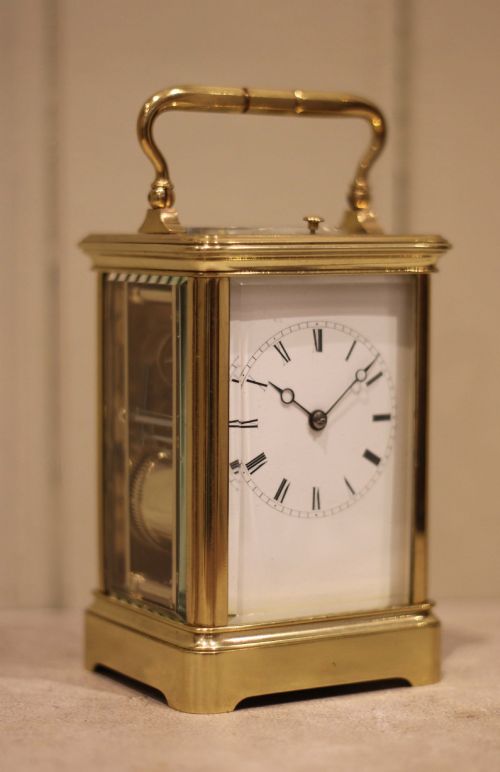
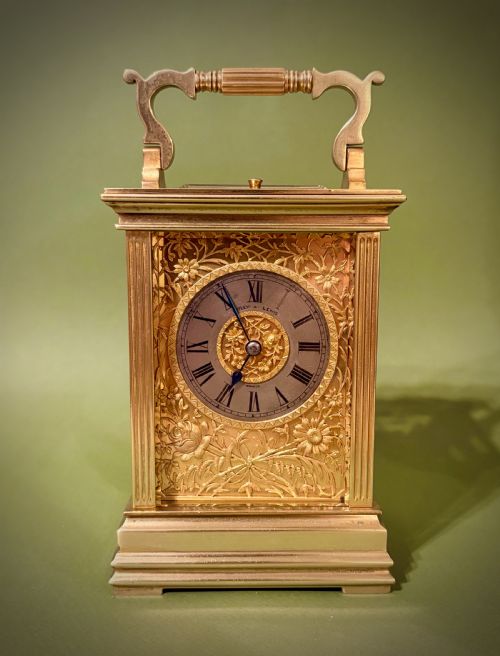
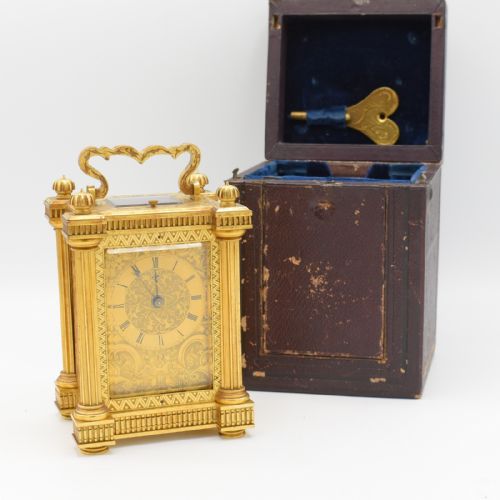
A gold repeating clock combines precision horology with portable convenience, most frequently appearing here as a carriage clock housed in a brass, gilt brass, or gilt bronze case. These pieces originate predominantly from nineteenth century French makers or British retailers, spanning periods from the eighteen fifties to nineteen hundred.
The objects typically take the form of carriage clocks featuring glass panels that reveal the internal movement and enamel dials. Many incorporate specialised striking mechanisms such as bell strikes, gong strikes, or grand sonnerie functions alongside the core repeating capability.
How They Were Made
Construction relies heavily on brass and gilt brass or bronze frameworks fitted with bevelled glass panels to enclose the complex mechanical movements. Cases often receive surface treatments such as fire gold plating or standard gilding, complemented by intricate hand engraving on dials, masks, or platforms.
Internal engineering utilises steel components alongside brass plates and wheels to drive the timekeeping, striking, alarm, and repeating functions. Enamel is applied to the dials for the numbers and chapter rings, creating a sharp contrast against the metallic cases.
Gold Repeating Clock Retail Price Guide 2026
Typical asking prices for gold repeating clock among the pieces listed under this phrase on Sellingantiques today, from the lower quarter to the upper quarter. They describe what is for sale here now, not the wider market.
Object forms span standard carriage clocks, alarm clocks, and specialised pieces incorporating date work and engraved platforms.
What Varies In Quality
The calibre of a gold repeating clock depends significantly on the complexity of its movement, ranging from basic hour repeaters to sophisticated grand sonnerie, quarter-repeating, and alarm systems. Maker attribution heavily influences standing, with pieces bearing signatures from respected workshops commanding greater interest.
Case execution and detailing also determine distinction, distinguishing standard brass housings from finely gilt bronze or fire gold plated examples with engraved masks and gorge cases. The completeness of original components and the survival of gilding elevate the overall execution.
Howell And James London·Bishop Bournemouth·DROCOURT·Moser·Henry Jacot·L Epee·Dent·John Walker·Captain Henry
The Gold Repeating Clock Glossary
- Repeating clock
- A timepiece that sounds the last hour or quarters upon pressing a button or pulling a cord. This complication was essential before artificial night illumination became common.
- Carriage clock
- A small, spring-driven clock designed for travel during the nineteenth century. They usually feature a swinging handle on top and glass panels on all sides.
- Gorge case
- A distinct rectangular carriage clock case style characterised by stepped mouldings at the top and base. It remains one of the most desirable housing shapes for collectors.
- Grand Sonnerie
- A complex striking train that chimes the hours and quarters automatically on the passage of time as well as repeating them on demand. It represents the height of carriage clock mechanics.
- Platform escapement
- The small, self-contained assembly holding the balance wheel and escapement at the top of the movement. Visible through the top glass panel, it regulates the timekeeping.
Gold Repeating Clock: Frequently Asked Questions
What is a gold repeating clock?
A gold repeating clock is a mechanical timepiece enclosed in a gilt or gold-plated case that sounds the hours and quarters when a lever or button is activated.
These devices were engineered for portability during travel, allowing owners to check the time in darkness without striking a match.
How do you use the repeater function?
The repeating mechanism is operated by pressing a button on top of the case or pulling a small cord, which causes the internal ghouls and hammers to strike the correct time.
This action winds nothing, instead releasing a secondary gear train powered by a separate spring dedicated entirely to acoustic time telling.
Where were these clocks made?
The vast majority of these pieces were manufactured in France, particularly in Paris workshops during the nineteenth century, and subsequently exported to British retailers.
Many examples carry retailer signatures from London, Bournemouth, or Ripon alongside the original French maker marks hidden on the movement plates.
How do you date a nineteenth century carriage clock?
Dating relies on stylistic shifts in the brass case design, the shape of the handle, the complexity of the escapement, and any engraved signatures or serial numbers.
Simpler one-piece cases often point towards the middle decades of the nineteenth century, while heavily engraved gorge cases and advanced complications typically indicate the later Victorian era.