
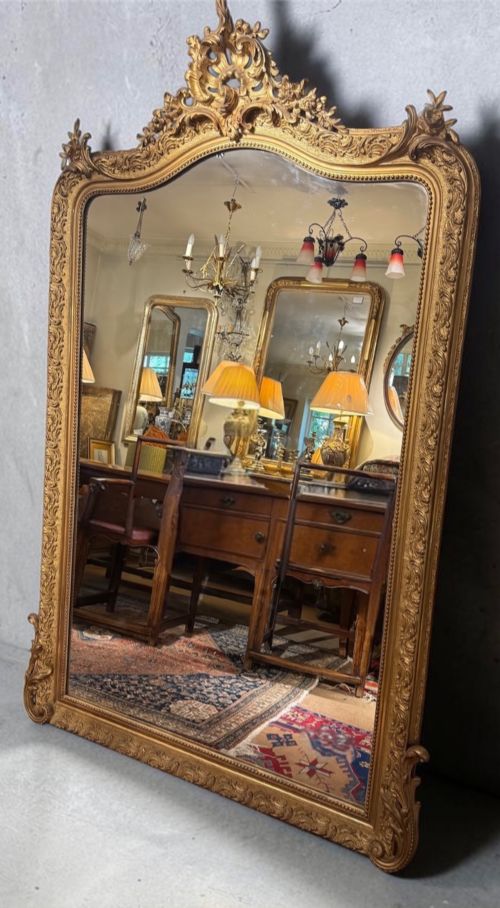


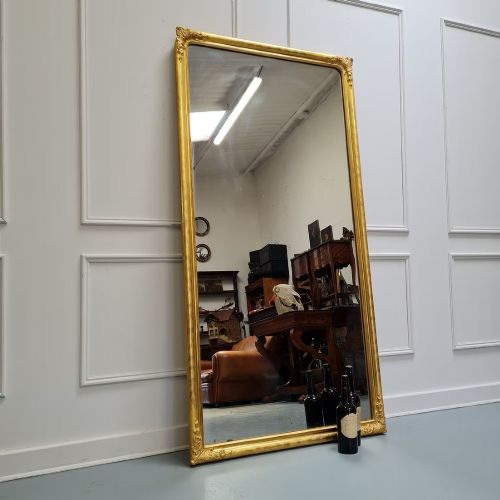


Gold Leaning Mirror
A gold leaning mirror brings scale and reflection to a room, drawing light across French and Victorian interiors.
Gold Leaning Mirror
When you search for a gold leaning mirror, you encounter tall wall mirrors, overmantles, and dressing mirrors designed to rest against a room's perimeter. These objects serve both functional reflection and architectural presence within domestic spaces.
The pieces on this page span the nineteenth century, including Victorian, Edwardian, Louis Philippe, and French Rococo Revival styles. Large formats dominate, frequently taking the form of full height floor wall dressing mirrors or arched top overmantles.
How they were made
Maker construction relies on carved wood, pine, and plaster foundations that receive layers of gesso before finishing. Craftsmen then apply gold leaf or gilding to achieve the bright reflective surface characteristic of these large frames.
Glass is set within these heavy wooden structures, often featuring shaped or arched tops suited to pier, console, and cheval placements. The combination of carved wood and applied gesso allows for ornate decorative detailing along the frame edges.
Listings feature items from the nineteenth century, incorporating French Rococo Revival, Louis Philippe, and Victorian design vocabulary.
What varies in quality
Quality differentiates through the depth and crispness of the carved wood and gesso ornamentation. Highly regarded examples display intricate moulded detail that remains sharp across large expanses of the frame.
The integrity of the original gilding and the preservation of the glass plate further separate pieces. Original silver and gilt finishes carry greater historical continuity than later interventions.
The Gold Leaning Mirror Glossary
- Giltwood
- Wood that has been covered with a thin layer of gold leaf. This material defines the bright appearance of nineteenth-century frames.
- Gesso
- A plaster-like mixture applied to wooden frame bases to create a smooth surface for carving and gilding. It enables high-relief ornamentation.
- Overmantle
- A large mirror designed to hang or lean directly above a fireplace mantel. These pieces often feature arched tops to fit architectural proportions.
- Louis Philippe
- A mid-nineteenth-century French style characterised by restrained curves and subtle decorative motifs. It appears frequently in large wall mirror formats.
Gold Leaning Mirror: Frequently Asked Questions
How do I safely lean a heavy mirror?
Large mirrors require secure placement against a solid wall to support their substantial weight. Floor-standing formats distribute gravity through their base.
Additional wall anchoring prevents accidental tipping in busy rooms or high-traffic hallways.
Where should I place a floor mirror?
Tall dressing mirrors suit bedrooms, dressing rooms, and grand living spaces where they amplify natural daylight. Their vertical format draws the eye upward.
Placing them opposite windows maximises the reflection of light across the interior.
What defines a French Rococo Revival mirror?
This style draws on eighteenth-century ornamentation with flowing curves and naturalistic carved motifs. The frames emphasise asymmetrical scrollwork and deep relief.
Nineteenth-century makers reinterpreted these designs on a grand scale for domestic interiors.
How do I identify a nineteenth-century frame?
Nineteenth-century examples utilise timber foundations like pine combined with thick gesso and gold leaf applications. Construction methods reflect period joinery.
Stylistic cues such as Louis Philippe shaping or Victorian proportions help date the object.