



Gold Floral Pin
A gold floral pin captures botanical forms in precious metal, offering a wearable piece of history that brings enduring elegance to modern attire.
Gold Floral Pin
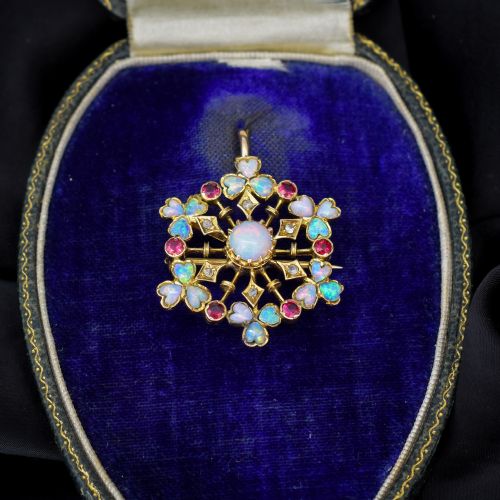
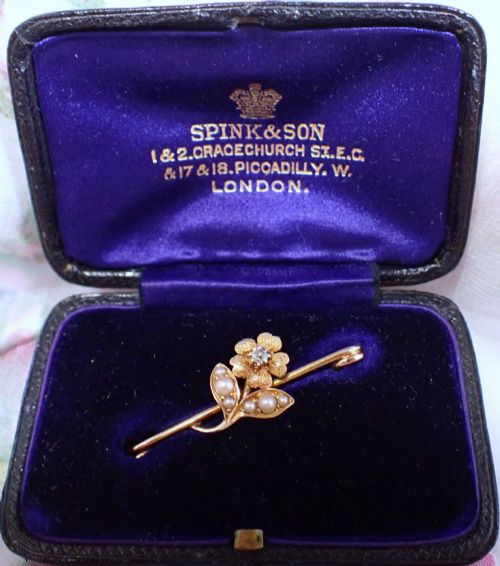
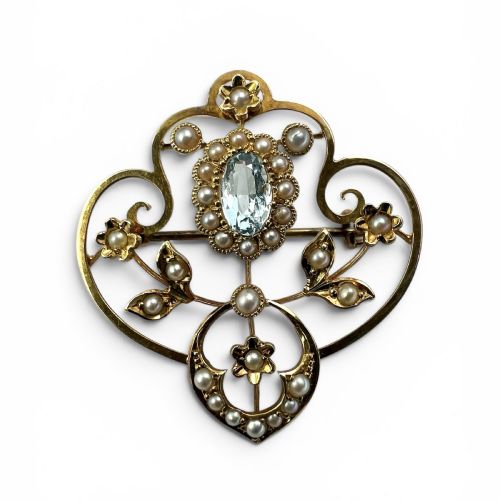
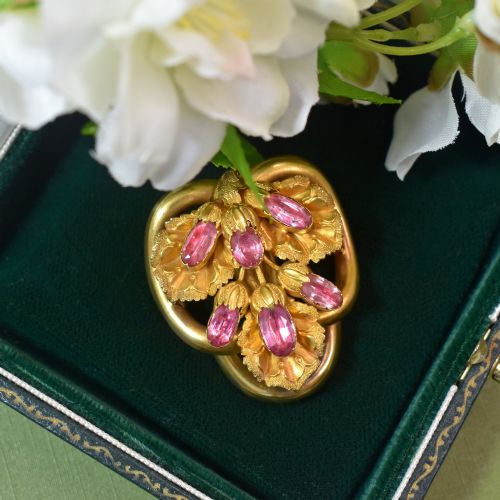
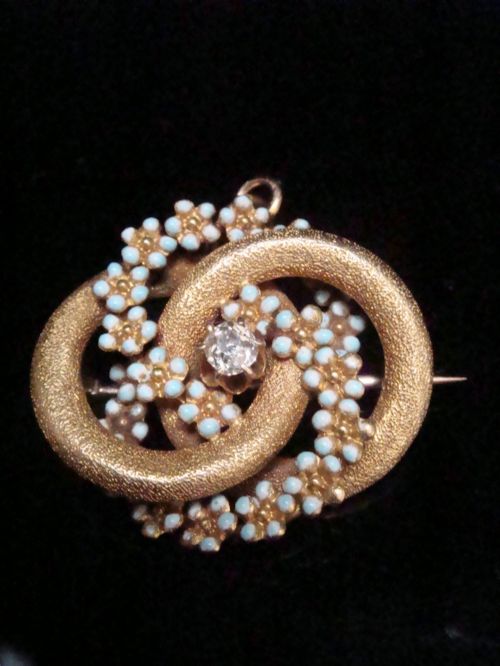
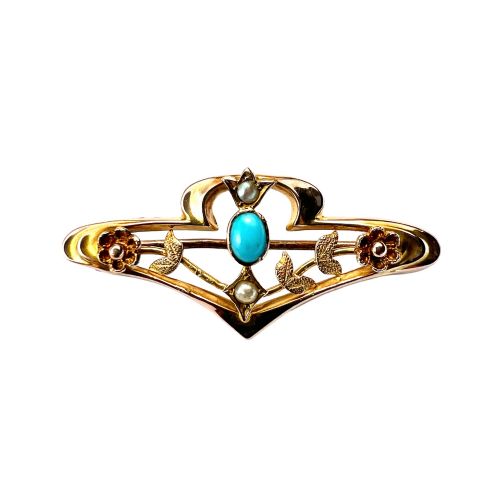
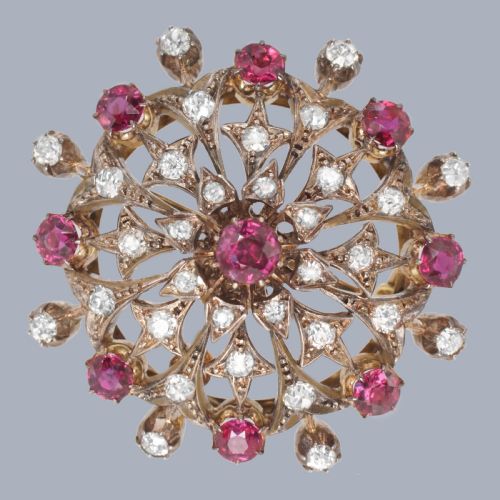
The selection ranges from early Victorian pieces featuring pink foil-backed topaz and paste giardinetti settings to Edwardian aquamarine and turquoise floral arrangements. Art Nouveau variations bring plique-a-jour enamel and flowing lines, while later 1930s and 1950s interpretations utilise substantial diamond and gemstone clusters set in white and yellow gold.
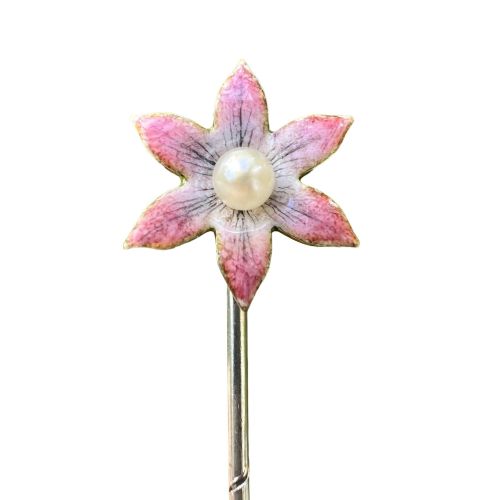
Beyond standard brooches, the category encompasses convertible pendant brooches and stick pins, demonstrating how makers adapted floral motifs for different functions. Pieces from the late 19th and early 20th centuries dominate the offerings, providing a clear window into period goldsmithing and gemstone arrangement.
Materials and Techniques
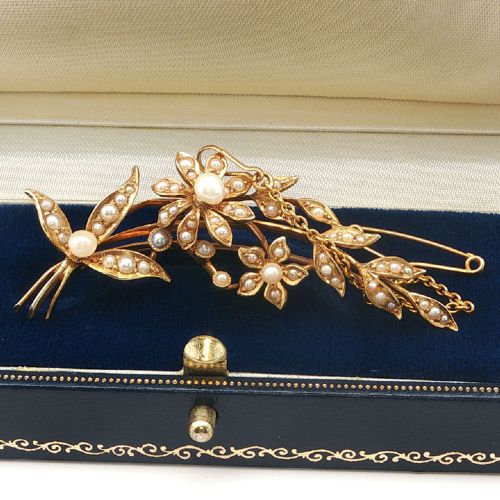
Makers fashioned these pieces primarily using 9ct, 15ct, and 18ct gold, often combining yellow and white gold settings to highlight specific stones. The structural metalwork supports intricate floral sprays, wreaths, and forget-me-knot designs executed by period artisans.
Gemstones form the heart of these pieces, with diamonds, rubies, pearls, sapphires, and emeralds set alongside seed pearls, turquoise, and aquamarine. Enamel work, including plique-a-jour techniques, adds vibrant colour to petals and leaves in Art Nouveau and later designs.
Some Victorian makers hid tiny hair compartments behind floral clusters, turning a bright bouquet into a secret keepsake.
Assessing Quality and Execution
Quality rests in the precision of the stone setting and the naturalism of the botanical carving, where superior examples exhibit meticulous detail in every petal and leaf. The choice of materials dictates the tier of the piece, with finer items incorporating untreated rubies, substantial diamonds, or complex enamel work rather than simpler pastes.
Construction methods also separate standard production from exceptional studio work, evident in how securely stones are held and how seamlessly convertible mechanisms function. The integration of high-carat gold and well-matched natural gemstones elevates an ordinary brooch into a work of fine jewellery.
Gubelin
The Gold Floral Pin Glossary
- Brooch
- An ornamental piece of jewellery fastened to clothing with a hinged pin and catch. Many examples in this category double as pendants.
- Plique-a-jour
- A enamelling technique where enamel is applied in cells without a backing, resembling miniature stained glass. This method appears notably in Art Nouveau pieces.
- Giardinetti
- A style of jewellery depicting a small garden or vase of flowers, popular in antique pieces using coloured stones and paste.
- Stick Pin
- A long pin with a decorative head, worn upright in a lapel or cravat. They frequently feature floral motifs from the Edwardian era.
- Seed Pearl
- Very small natural or cultured pearls used in tight clusters to form delicate flower petals in Victorian and Edwardian jewellery.
Gold Floral Pin: Frequently Asked Questions
How do I date a gold floral pin?
Dating relies on the stylistic markers of periods such as Victorian, Edwardian, and Art Nouveau, alongside the materials and hallmarks present on the metal. Specific gemstone cuts and mounting techniques also help narrow the decade of production.
Examining the pin stem and clasp mechanism offers further clues, as manufacturing methods evolved significantly from the mid-nineteenth century through the mid-twentieth century.
Can these pins be worn as pendants?
Many pieces in this category were designed as convertible brooch pendants, featuring a hidden or hinged loop on the reverse for a chain. This dual functionality was particularly popular during the Victorian and Edwardian eras.
When a loop is absent, conversion should only be undertaken by a professional jeweller to avoid altering the structural integrity of the antique mount.
What is a stick pin used for?
Historically, a stick pin secured cravats, ties, or lapels in place, serving both a functional and decorative purpose for the wearer. Today, they are frequently worn on lapels, hats, or scarves.
The long pin stem is typically secured with a protective cap or clutch at the reverse.
How should I care for antique gemstone jewellery?
Cleaning requires gentle methods suitable for fragile elements like seed pearls, turquoise, and enamel, which can be damaged by harsh ultrasonic cleaners or chemical dips. Warm water and a soft cloth are generally safest for maintaining the metal and stones.
Store each piece individually in a lined box to prevent scratching between harder diamonds and softer gems.