


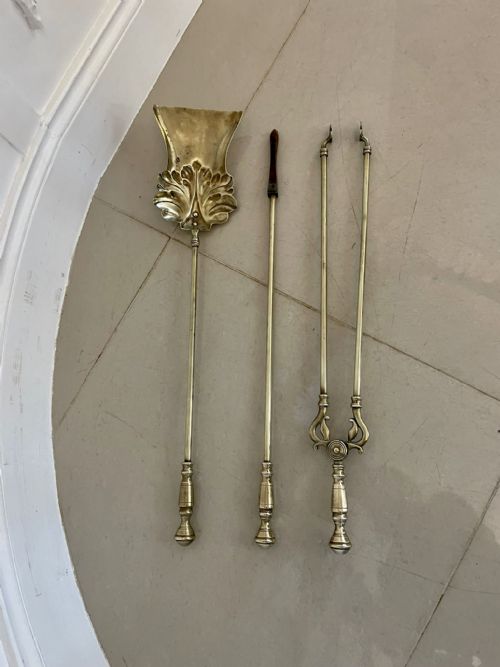

Gold Fireplace Tools
Gold fireplace tools bring polished warmth to a hearth, offering both practical utility and decorative gleam for the mantel.
Gold Fireplace Tools
These pieces are hearth accessories finished in brass, bronze, gilt bronze, or gilded brass, designed to tend a fire while catching the eye. When searching for gold fireplace tools, buyers encounter companion sets, fire dogs, and chenets dating from the nineteenth and twentieth centuries.
The most common versions met on this page are Victorian and Edwardian brass sets, alongside later Art Deco and Rococo Revival examples. They include individual fire irons, triple companion sets, and pairs of fire dogs used to support logs.
How they were made
Metalworkers utilised brass, iron, and bronze, shaping them through casting and forging to create durable hearth implements. Gilt bronze and gilded brass surfaces were applied to provide the distinctive golden sheen seen across these Victorian and Edwardian pieces.
Styles range from the ornate curves of French Rococo and Rococo Revival to the clean geometric lines of Art Deco. Makers combined functional iron cores with decorative brass mounts and figural castings, such as the child and lamb motif.
Gold Fireplace Tools Retail Price Guide 2026
Typical asking prices for gold fireplace tools among the pieces listed under this phrase on Sellingantiques today, from the lower quarter to the upper quarter. They describe what is for sale here now, not the wider market.
One twenty-century companion set charmingly incorporates a cast figure of a child and a lamb beside the hearth.
What varies in quality
Quality rests in the crispness of the casting and the durability of the metalwork, distinguishing heavy, well-balanced fire irons from lighter, purely decorative alternatives. Pieces from established makers or specific guilds demonstrate superior detailing in handles and figural elements.
The preservation of the gilded or polished brass surface also marks the difference between standard production items and finer period companions. Complete sets retaining their original companion stands or matching fire dogs hold greater cohesion than assembled groups.
THE BIRMINGHAM GUILD
The Gold Fireplace Tools Glossary
- Companion set
- A collection of fireplace tools, such as tongs, pokers, and shovels, usually housed on a matching stand. These sets keep hearth maintenance equipment organised and accessible.
- Fire dogs
- Metal supports placed horizontally in a hearth to raise logs off the floor for better airflow. They often feature decorative front pillars that match the companion set.
- Chenets
- French term for firedogs or ornamental irons placed at the front of a hearth. They frequently display elaborate Rococo style casting and gilding.
- Gilt bronze
- Bronze object treated with a thin layer of gold or gold-coloured alloy. This technique imparts a rich metallic lustre resistant to tarnishing.
Gold Fireplace Tools: Frequently Asked Questions
What is included in a companion set?
A companion set typically groups essential hearth implements together on a dedicated stand for daily use.
These collections commonly feature tools like pokers, tongs, and shovels designed to manage burning logs and clear ash.
How do fire dogs work?
Fire dogs sit inside the hearth to elevate firewood above the floor. This elevation improves air circulation beneath the logs for a steadier burn.
They often pair visually with the companion set to create a unified hearth arrangement.
What materials make up these tools?
The pieces utilise durable metals such as iron for strength alongside brass and bronze for the exterior finish. Gilded brass and gilt bronze provide the golden appearance characteristic of these accessories.
Combining these materials ensures both structural reliability during fires and decorative appeal.
How are different periods identified?
Periods are recognised through distinct stylistic shifts, ranging from mid-nineteenth-century Victorian designs to early twentieth-century Art Deco forms. Rococo Revival pieces show heavy ornamentation and curved lines.
Examining the manufacturing techniques and material choices helps place an item within its historical era.