




Gold Candelabra Garniture
A gold candelabra garniture brings classical symmetry to a mantelpiece, pairing a central clock with matching candleholders for a grand decorative scheme.
Gold Candelabra Garniture
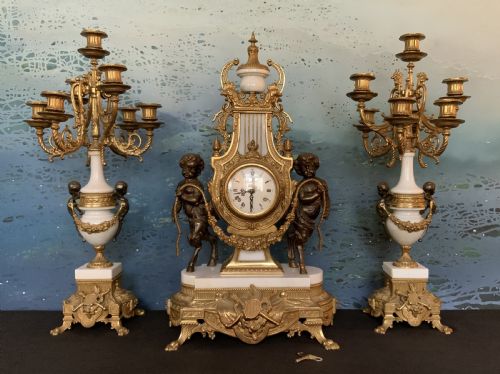
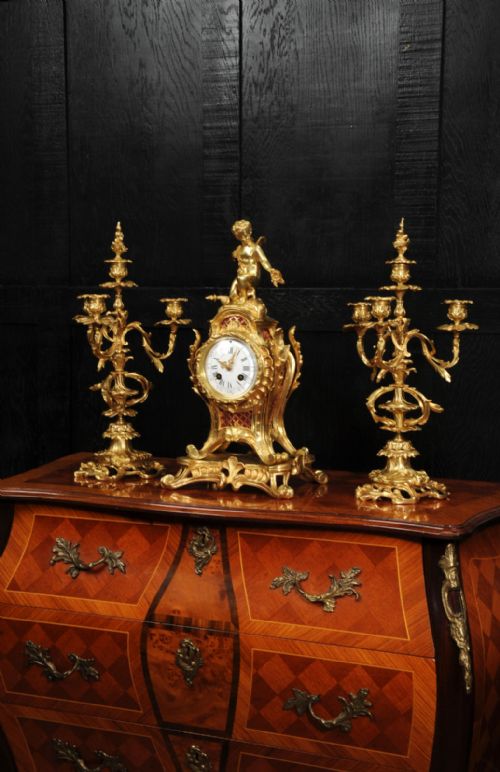
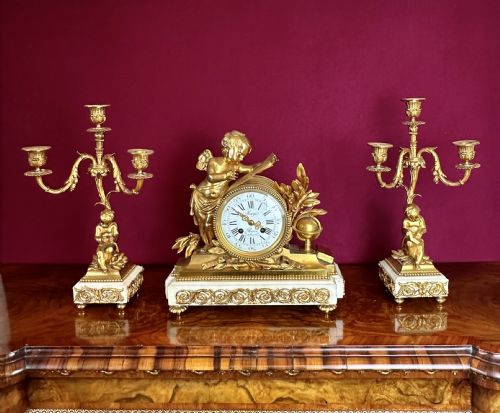
A gold candelabra garniture comprises a central clock flanked by matching candleholders, designed as a unified three-piece or multi-piece display for a mantelpiece or console. These sets originate primarily from the nineteenth century, spanning periods from the Second Empire and Victorian eras into Louis XVI and Louis XV revival styles. French workshops dominate the available selection, often pairing monumental scale with intricate sculptural detail.
Buyers encounter complete sets featuring architectural marble bases, patinated bronze figures, and multi-arm candelabra that echo the ornamentation of the central timepiece. The most common configurations combine gilded bronze or ormolu with contrasting white or coloured marble, populated by cherubs, cupids, or neoclassical motifs. Sets range from intimate boudoir timepieces to huge ten-light candelabra arrangements.
The aesthetic draws heavily on French neoclassical and rococo vocabularies, utilising scrolling foliage, urns, and classical symmetry to create an imposing visual impact. Such arrangements served as centrepieces in nineteenth-century salons, functioning both as precision timekeepers and as statements of household wealth.
How they were made
Makers utilised cast bronze as the primary structural metal, applying mercury gilding or electroplating to achieve the characteristic gold-toned ormolu finish. This gilded surface contrasts frequently with patinated bronze elements, such as figurative cherubs or classical deities.
Marble forms the substantial base and body for many clock housings and candelabra shafts, requiring precision stonemasonry to support heavy metal mounts. White marble and variegated types provide solid foundations that anchor the elaborate bronze castings.
Enamel feature dials, visible pendulums, and eight-day mechanical movements represent the horological core of the clock sets. Skilled artisans assembled these components by hand, integrating the clockmaker's movement with the founder's decorative bronze mounts.
Cupid and cherubs frequently linger among the gilt bronze branches, keeping watch over the mantelpiece.
What varies in quality
The choice and density of materials influence the overall hierarchy, with dense natural marble bases and heavy fire-gilt ormolu marking the upper tier. Lighter gilt metal finishes and simpler turned components occupy the more utilitarian end of the spectrum.
Henry Dasson·Raingo Fres Paris·Deniere Paris·Vincenti
The Gold Candelabra Garniture Glossary
- Garniture
- A set of ornamental objects designed to match and be displayed together, typically comprising a clock and matching candelabra or urns.
- Ormolu
- Gilded bronze, where finely ground gold is applied to a bronze base using mercury or electroplating to create a rich, durable golden surface.
- Candelabra
- Branching candleholders designed to hold multiple candles, forming the matching side pieces of a clock garniture set.
- Patinated Bronze
- Bronze treated with chemicals or heat to produce a dark, protective, or decorative surface coating that contrasts with bright gilding.
- Louis XVI Style
- A neoclassical design aesthetic characterised by straight lines, symmetry, classical motifs, and restrained ornamentation popular in nineteenth-century revivals.
Gold Candelabra Garniture: Frequently Asked Questions
What is a gold candelabra garniture?
A gold candelabra garniture is a matching set of decorative objects for a mantelpiece, consisting of a central clock accompanied by two or more matching candelabra.
These sets were designed to create visual harmony and symmetry in nineteenth-century reception rooms, combining functional timekeeping with sculptural bronze and marble artistry.
How do I identify the period?
Dating relies on stylistic clues such as the presence of Louis XVI neoclassical symmetry, Rococo asymmetry, or Second Empire monumentality, alongside material combinations like white marble and ormolu.
Maker signatures stamped on the bronze mounts or clock movements also provide definitive evidence of nineteenth-century production dates.
Where should I display a garniture set?
These sets suit large mantelpieces, console tables, or deep sideboards where the full length of the clock and matching candelabra can be appreciated together.
Because of their substantial weight and monumental scale, they require sturdy furniture surfaces that can support dense marble and bronze components.
How do mechanical clock movements work?
Most garniture clocks feature eight-day mechanical movements powered by springs or weights, requiring a key to wind the gear train periodically.
Many examples include visible pendulums or striking mechanisms that mark the hours and half-hours with a bell or gong.