
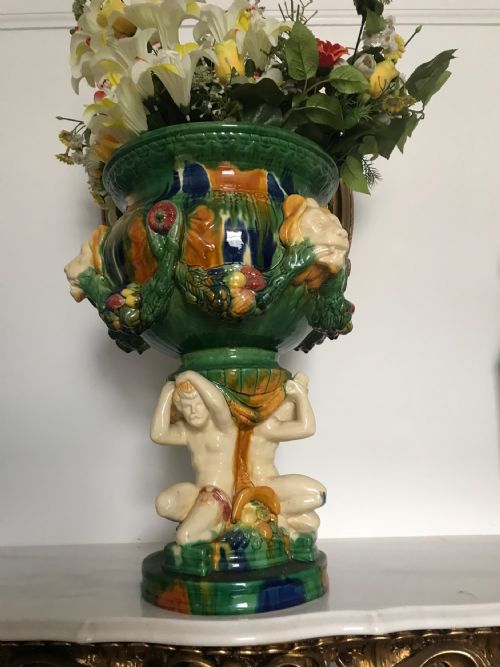


Glazed Earthenware Pedestal
These glazed earthenware pedestals range from Victorian majolica to Arts and Crafts pottery, bringing architectural weight and rich colour to plant displays and interior spaces.
Glazed Earthenware Pedestal
A glazed earthenware pedestal combines a display stand with a matching jardiniere, plant stand, or urn, often created as an integrated architectural unit. The selection draws heavily on nineteenth-century Victorian production, alongside Edwardian examples and later twentieth-century studio pottery.
Forms span tall botanical stands with figural or animal bases, monumental majolica vases, and compound planter sets. Buyers will encounter both unified pairs and separate component pieces designed to elevate foliage or floral arrangements within a conservatory or drawing room.
Origins stretch from English manufactories like Burmantofts and Minton to continental workshops in Italy and France, notably including Florence and the works of Clement Massier and Julius Dressler.
Materials and production methods
Potters shaped the earthenware body using moulds or throwing techniques, applying lead glaze, tin glaze, or high-fired lustre finishes to seal the porous clay and create brilliant reflective surfaces. Faience and majolica techniques allowed makers to apply opaque coloured tin glazes directly over raw or fired bodies.
Makers utilised sculptural modelling to incorporate detailed reliefs, such as lion heads, griffins, and botanical motifs like begonia leaves, into the structural columns of the stands. Subsequent firing fixed the polychrome enamels and metallic lustre effects onto the glazed earthenware surfaces.
Listings feature earthenware pedestals spanning the nineteenth century through the Edwardian era, incorporating styles from the Italian Renaissance Revival to Arts and Crafts.
Evaluating quality and execution
The distinction between standard commercial output and superior work rests on the crispness of the modelled relief and the depth of the coloured glaze. Finely executed pieces display precise control over runny tin glazes and metallic lustre applications, avoiding muddy pooling in the recessed details.
Artistic ambition dictates the standing of a piece, separating straightforward utilitarian plant holders from sculptural masterworks bearing figural bases or attribution to notable pottery studios and modellers.
Burmantofts Art Pottery·Ulisse Cantagalli·Clement Massier·Minton·Julius Dressler·Woodlesford Art Pottery·Moorcroft·Albert Carrier
The Glazed Earthenware Pedestal Glossary
- Majolica
- Earthenware covered with an opaque tin-lead glaze and painted with metallic oxide colours before firing. This technique produces vibrant polychrome surfaces with deep gloss.
- Faience
- Tin-glazed earthenware originating in Europe, sharing technical characteristics with majolica. The term covers a broad range of decorative European pottery from various periods.
- Jardiniere
- An ornamental ceramic pot or stand designed to hold growing plants or floral arrangements. They frequently accompany tall pedestals to elevate greenery.
- Comport
- A decorative footed bowl or dish used for serving fruit or as a table centrepiece. Examples appear in glazed earthenware alongside standard plant stands.
- Lustre glaze
- A metallic film applied to pottery to create an iridescent, shimmering surface effect. Makers achieved this through specialised kiln reductions during firing.
Glazed Earthenware Pedestal: Frequently Asked Questions
How do I use a glazed earthenware pedestal at home?
These tall stands support heavy potted plants, ferns, or large floral arrangements in hallways and conservatories. They function as architectural focal points that lift greenery to eye level.
Ensure the weight of the planted vessel matches the stability and footprint of the supporting pedestal base. Placing them away from heavy foot traffic protects the projecting ceramic details from accidental impacts.
How do I distinguish Victorian pieces from Edwardian ones?
Victorian examples lean towards naturalistic leaf motifs, rich polychrome majolica glazes, and heavy classical or Renaissance revival styling. They often display ornate sculptural elements like griffins and figures.
Edwardian and later pieces frequently adopt cleaner Arts and Crafts lines or simpler modernist forms. The palette shifts towards more restrained tones or specialised lustre glazes.
Are jardiniere stands and pedestals always sold together as pairs?
Many surviving examples were originally manufactured as matching pairs or integrated sets consisting of a separate base and bowl. Over time, components frequently become separated through domestic use.
Collectors often search for matched sets, but single pedestals or planters still function effectively as standalone decorative elements. Checking the fit and glaze consistency helps confirm if elements belong together.
What is the difference between majolica and faience?
Majolica specifically describes nineteenth-century British and European earthenware glazed with coloured tin-lead enamels over moulded relief decoration. The term emphasises vibrant polychrome visual effects.
Faience broadly references tin-glazed earthenware traditions across continental Europe, often linked to distinct regional pottery centres. Both share similar clay bodies and glazing principles.