
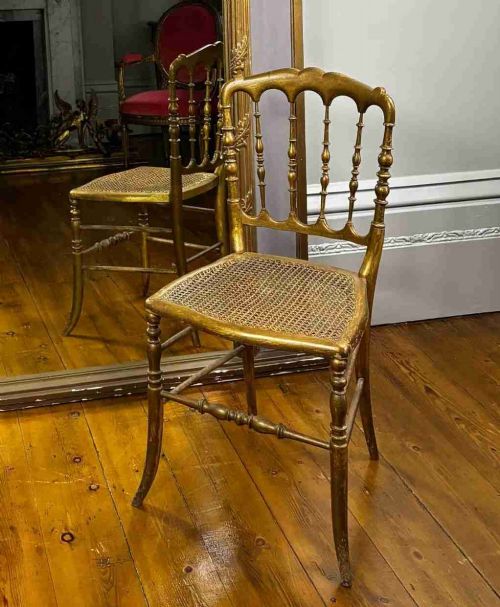
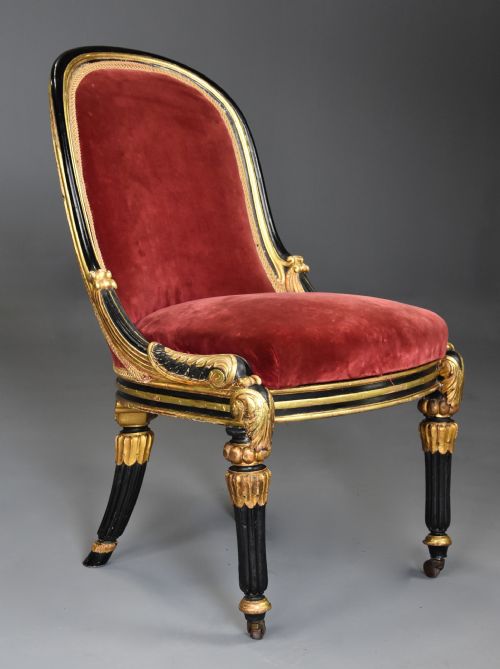
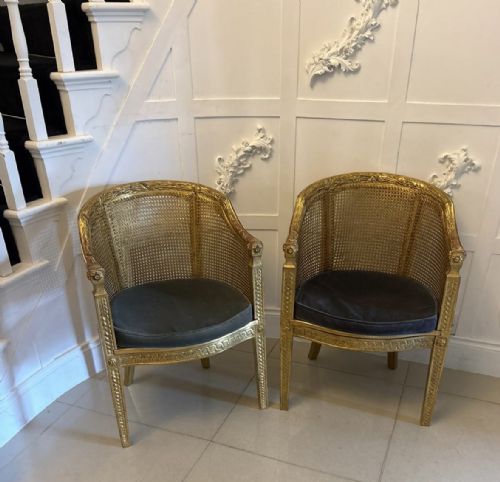
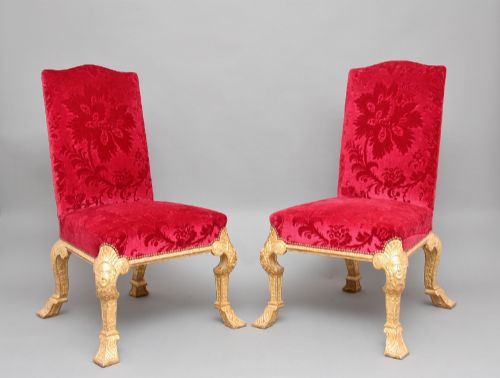
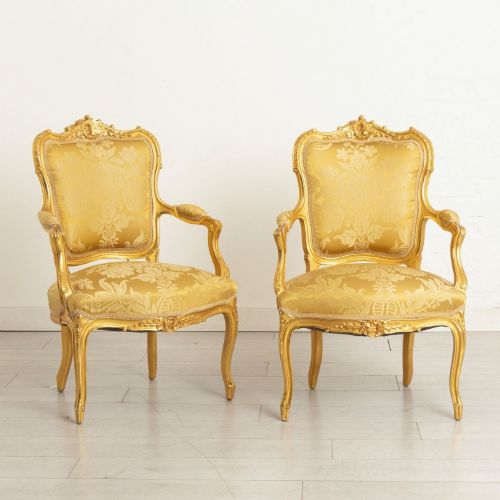


Giltwood Side Chairs
Giltwood side chairs bring instant architectural presence and French style to a room, offering grand metallic reflection and decorative carving.
What these pieces are
When you search for giltwood side chairs, you are looking at decorative seating designed primarily for grand salons, drawing rooms and formal dining spaces rather than daily heavy lounging. The examples you meet on this page run from the nineteenth century through the Edwardian period, capturing both English and Continental tastes.
The forms span side chairs, salon chairs and dining chairs, frequently appearing in pairs or sets of four. Their silhouettes lean heavily into historical revivals, most notably Louis XVI style, Louis XVI revival, George I style, French Rococo and Rococo revival.
Originating largely from French or broader Continental and English workshops, these chairs utilise gold leaf or gold paint over a wooden base. They function as accent seating that catches natural light and anchors a traditional interior scheme.
How they were made
Makers constructed the primary frames of these chairs from wood, shaping them into elaborate curves and straight fluted legs depending on the chosen historical style. Artisans then applied delicate layers of gold leaf or gold paint to achieve that distinctive metallic sheen.
Upholstery formed a vital part of the construction, with periods incorporating velvet, silk, textile and leather pads. Additional structural integrity and decorative flair occasionally involved brass components secured to the wooden frames.
Retail Price Guide 2026
Typical UK retail prices for giltwood side chairs, calculated from the Sellingantiques database of over a million retail prices indexed since 2003. This retail price guide relies exclusively on Sellingantiques data; no external sources or auction records are used, so the figures do not describe the wider market.
The inventory records distinct revivals, ranging from early eighteenth-century George I interpretations to mid-nineteenth-century Rococo revivals.
What varies in quality
The distinction between tiers of quality rests in the application of the surface finish and the crispness of the woodwork. Hand-applied gold leaf demonstrates a depth and longevity that flat gold paint simply cannot replicate.
Carving detail dictates the higher end of the range, where floral motifs, scrolls and fluting are executed with deep relief and sharp edges. Frames that remain rigid and tight at the joints after over a century of existence indicate superior initial joinery.
The Giltwood Side Chairs Glossary
- Giltwood
- Wood that has been coated with gold leaf or gold powder. This surface finish creates the luminous, reflective quality characteristic of formal antique seating.
- Side chair
- A chair without arms designed primarily for dining or occasional use around the perimeter of a room. These pieces fit easily against walls when not gathered around a table.
- Louis XVI style
- A neoclassical aesthetic defined by straight tapered legs, geometric symmetry and restrained classical ornament. It stands in direct contrast to the curved exuberance of Rococo.
- Salon chair
- An upholstered seat intended for formal reception rooms and social gatherings. They prioritise decorative impact and upright posture over deep relaxation.
- Rococo revival
- A nineteenth-century artistic movement that resurrected the asymmetrical curves, naturalistic leaf scrolls and shell motifs of the eighteenth century. This style yields highly ornate, flowing wooden frames.
Frequently Asked Questions
Where should I place giltwood side chairs?
These chairs work best in formal reception spaces, hallways or bedrooms where they act as decorative accents rather than heavy-use seating. Their reflective surfaces catch light near windows or beneath mirrors.
Because of their delicate gilded finishes, keep them away from direct sunlight and areas of heavy physical traffic to preserve the surface.
Are these chairs comfortable for daily dining?
Most of these pieces are upright salon or side chairs built with firm padding and rigid supportive backs suited to formal occasions. They encourage an upright posture rather than lounging.
If you plan to use them around a dining table, pair them with supportive cushions and consider the seat height relative to your table.
How do I clean gilded wooden frames?
Dust the carved wooden surfaces gently with a dry, soft feather duster or a clean microfibre cloth. Avoid all liquid cleaners, polishes and abrasive cloths, which can strip or dull the gold leaf.
If moisture is necessary, consult a professional restorer, as harsh rubbing will quickly expose the underlying wood base.
How do I distinguish Louis XVI style from Rococo?
Louis XVI style relies on straight lines, symmetry, fluted columns and neoclassical geometry. It projects an orderly and architectural elegance.
Rococo embraces asymmetrical curves, C-scrolls and naturalistic floral motifs. Its frames twist and flow without straight architectural constraints.