
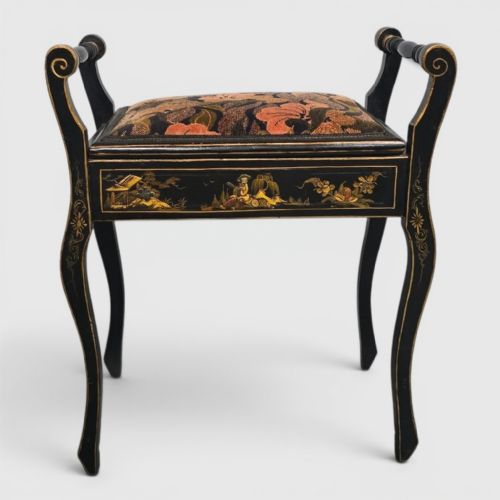
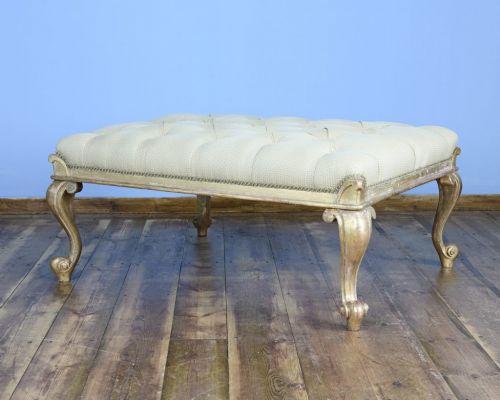
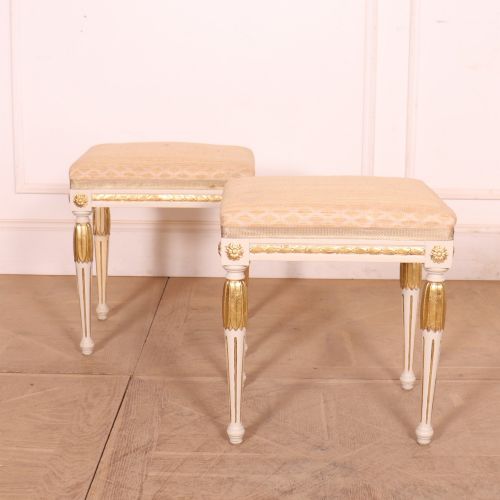
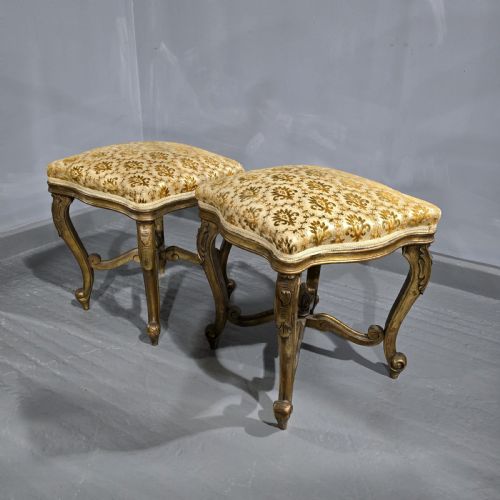
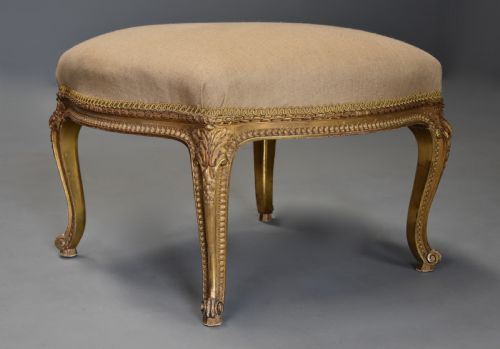


Gilt Upholstered Stool
These gilt upholstered stool selections range from grand French revival seats to modest Victorian footstools, offering both decorative presence and comfortable utility.

Gilt Upholstered Stool
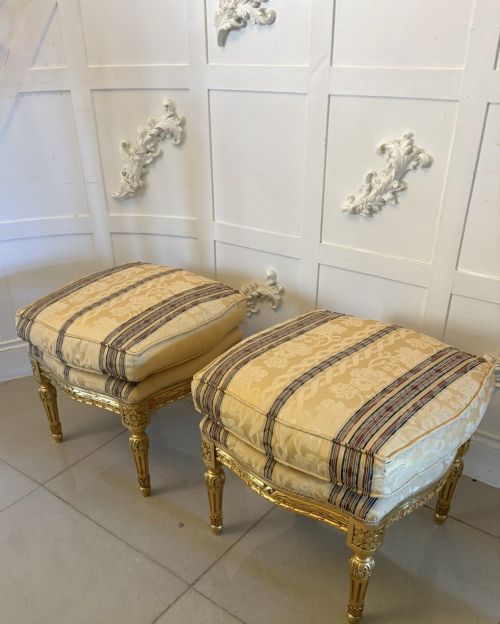
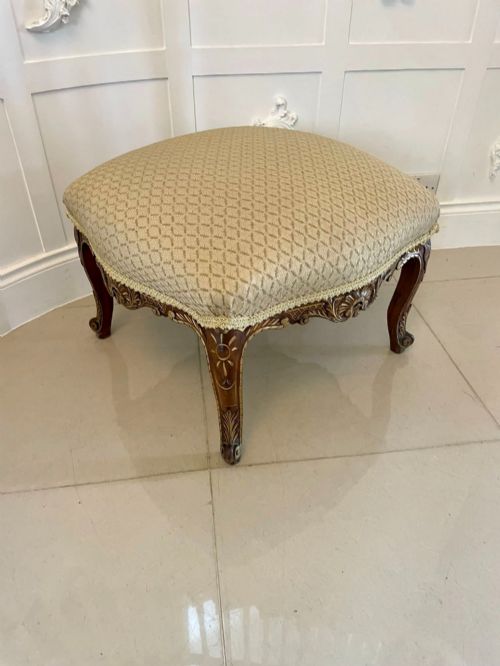
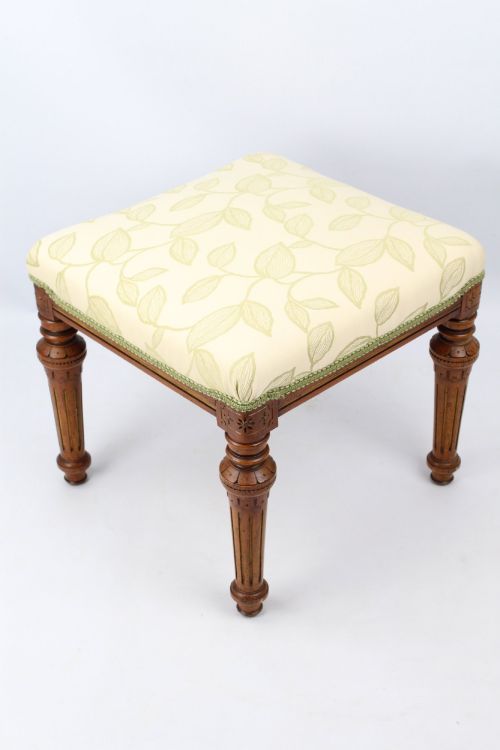
When you search for a gilt upholstered stool, you encounter a variety of seating forms spanning the nineteenth century, including dressing table seats, piano stools, window benches, and small footstools. The Victorian period and later decades of the nineteenth century supply the largest share of these pieces, alongside Regency, Edwardian, and Continental examples.
Forms shift from compact square footstools and curule X-frames to long benches and window seats designed for specific domestic spaces. Many of these pieces display distinct stylistic influences, particularly Louis XV and Louis XVI revivals, alongside Gustavian and Chinoiserie aesthetics.
Materials and construction
Carved wooden frames form the core of these pieces, utilising woods such as oak, walnut, rosewood, and beech beneath decorative surface treatments. Makers applied gold leaf and parcel gilt finishes directly onto the timber, or painted the wooden frames before applying gilding.
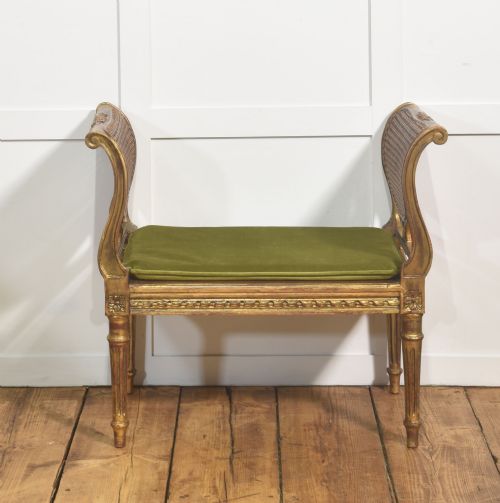
Upholstery relies on supportive internal structures paired with fabric coverings, velvet, and silk. Brass components occasionally appear in hardware or structural bracing, while cane panels feature in specific window stool designs.
Listings feature periods from the Georgian era through the Victorian period, Edwardian years, and early twentieth-century revivals.
Qualities of distinction
The refinement of the wood carving dictates much of the distinction between pieces, where crisp acanthus leaves, reeding, and moulded details separate hand-carved frames from simpler productions. The application of gold leaf shows varying levels of skill, with burnished surfaces reflecting superior craftsmanship over flat painted gold finishes.
Structural integrity and original upholstery materials also influence the standing of a piece, particularly when maker stamps or attribution details remain intact on the frame.
Miles & Edwards·Charles Nosotti·Loidrault Freres Paris·A.M.E. Fournier·John Tesch
The Gilt Upholstered Stool Glossary
- Giltwood
- Timber that has been coated with gold leaf or powder over a prepared gesso ground. This finish provides a bright metallic sheen characteristic of formal nineteenth-century seating.
- Curule stool
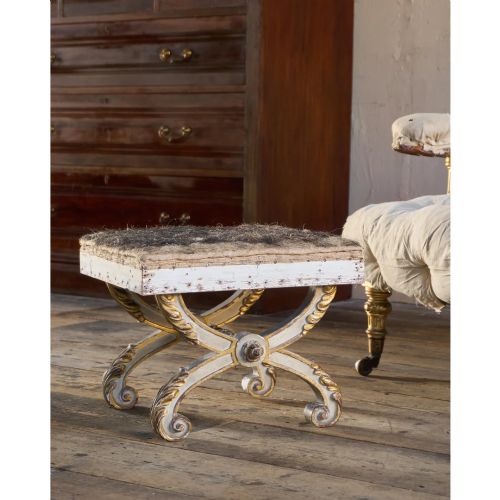
- An ancient Roman magistrate seat form featuring intersecting curved legs that form an X-shape. Nineteenth-century revival versions adapt this cross-frame design for domestic footstools.
- Parcel gilt
- A decorative technique where only specific raised portions or carved details of a wooden frame are gilded, leaving the underlying wood or painted surface visible elsewhere.
- Duet stool
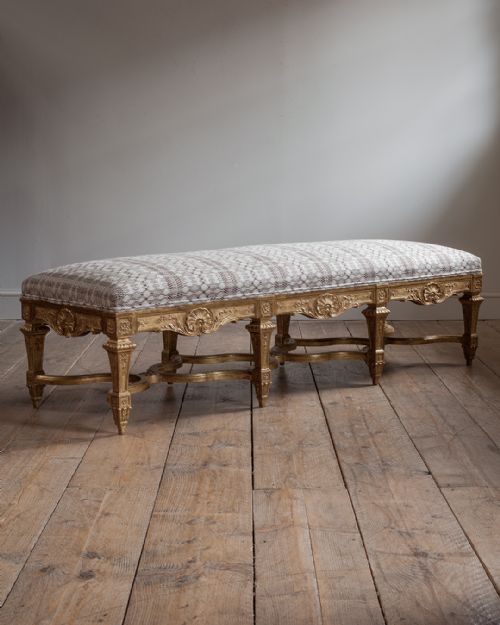
- An elongated piano seat built to accommodate two musicians side by side. These upholstered forms frequently date from the mid to late nineteenth century.
- Gustavian
- The Swedish interpretation of French neoclassical design promoted under King Gustav III. These pieces favour restrained carved detail, pale painted wood finishes, and balanced proportions.
Gilt Upholstered Stool: Frequently Asked Questions
How were these stools used originally?
These pieces served multiple domestic functions across nineteenth-century drawing rooms, dressing rooms, and music rooms. Smaller versions supported feet before armchairs, while long benches and window seats provided occasional seating near casements.
Specialised forms like piano and music stools accommodated players during practice, and duet versions allowed two performers to sit together at larger instruments.
How do I distinguish French styles from English ones?
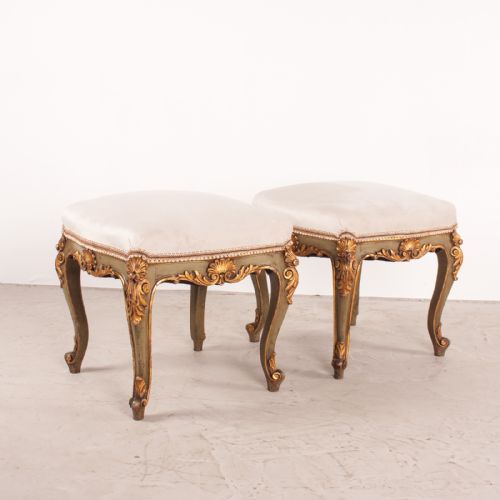
French revival pieces, particularly those in the Louis XV and Louis XVI styles, typically exhibit flowing asymmetrical curves, cabriole legs, and elaborate carved foliage. English examples from the Regency and Victorian periods often lean toward classical symmetry, parcel gilt details, and architectural forms.
Swedish Gustavian pieces offer another distinct visual path, combining French neoclassical restraint with lighter painted wood surfaces and minimal ornamentation.
What is an X-frame or curule stool?
An X-frame stool utilises intersecting curved or straight supports that cross beneath the upholstered seat to form an X shape. This ancient form was revived during the nineteenth century in Empire and Regency designs.
These pieces often feature giltwood frames and sometimes include folding mechanisms or fixed cross-braces for stability.
How should I care for antique giltwood?
Giltwood surfaces require gentle handling to protect the delicate layer of gold leaf applied over the wood and gesso ground. Dusting should be performed softly with a dry, lint-free cloth without applying chemical polishes.
Keep these pieces away from direct sunlight and moisture fluctuations to prevent the underlying wood from expanding and cracking the gesso finish.