


Gilt Mounted Armchairs
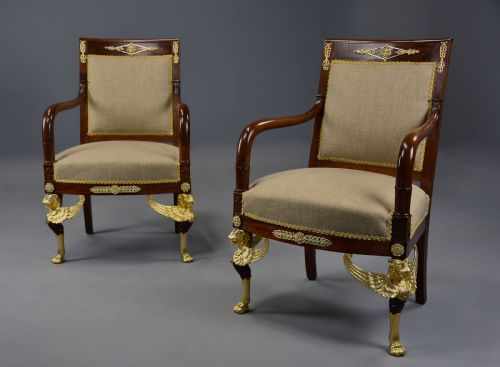
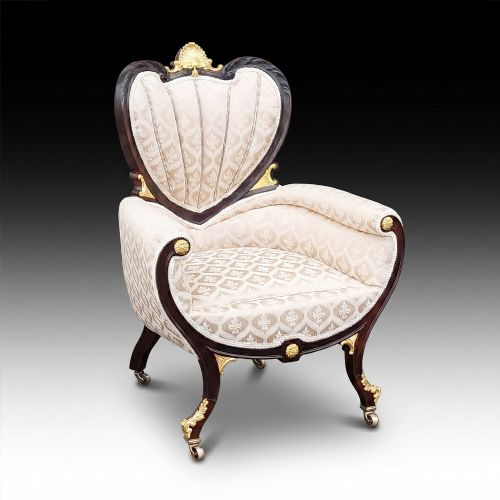
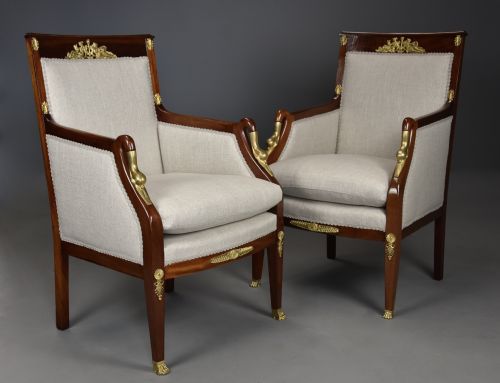
Gilt mounted armchairs bring unmistakable presence to a room through rich mahogany and gleaming metal mounts.
Gilt Mounted Armchairs
Gilt mounted armchairs combine sturdy timber frames with decorative metal mounts, spanning periods from the middle of the nineteenth century through the early twentieth century. You will frequently encounter French Empire and revival styles, alongside Swedish neoclassical interpretations.
The forms range from single open armchairs to matched pairs and larger lounge suites complete with footstools. Mahogany forms the primary timber backbone, often paired with walnut in specific regional variants.
How they were made
Cabinetmakers shaped dense mahogany and walnut into classical silhouettes, joining structural elements with traditional cabinetmaking techniques. Artisans then applied cast or chased ormolu and gilt bronze mounts directly to the wooden framework.
Upholstery completed the construction, utilising durable materials such as leather, velvet, linen, and standard fabric over padded seats and backs.
The listings span from the mid-nineteenth century through the early twentieth century, incorporating French Empire and Swedish neoclassical revivals.
What varies in quality
The refinement of the cast metal mounts dictates much of the visual distinction between examples, where sharply chased detailing outshines softer, simpler casting. Timber selection also plays a role, with rich grain patterns elevating the presence of the mahogany structure.
Cohesion between the upholstery fabric and the underlying period style separates standard seating from more convincing decorative statements.
The Gilt Mounted Armchairs Glossary
- Ormolu
- A technique of applying finely ground high-carat gold to a bronze object. It provides a bright golden finish that resists tarnishing.
- Fauteuil
- An open-armed upholstered armchair with exposed wooden sides. This traditional French seating form became popular during the seventeenth century.
- Empire style
- A neoclassical design movement originating in early nineteenth-century France. It draws heavy inspiration from ancient Roman and Greek archetypes.
- Neoclassical
- A style reviving classical antiquity through symmetry and restrained ornament. It dominated European furniture design across the eighteenth and nineteenth centuries.
Gilt Mounted Armchairs: Frequently Asked Questions
How do I clean gilt mounts?
Dust the metal gently with a soft dry cloth to prevent the accumulation of grit. Avoid harsh chemical cleaners that might strip the delicate gilding from the bronze.
Keep moisture away from the mounted surfaces and consult a specialist if tarnish requires more than simple surface maintenance.
Where should I place these armchairs?
These substantial chairs suit formal sitting rooms, libraries, or spacious studies where their architectural lines can be appreciated. Position them away from direct sunlight to protect sensitive fabrics like velvet and linen.
Ensure adequate clearance around the arms so the gilt mounts remain safe from accidental knocks.
Are these chairs comfortable for daily use?
Most period examples prioritize upright posture and formal sitting over deep lounging. The padded seats and upholstered backs offer firm support for conversation or reading.
Consider pairing an armchair with a matching footstool if you prefer a more relaxed seating posture.
How do I identify the Empire style?
Empire style pieces feature strong architectural lines, dark mahogany timbers, and classical bronze mounts. They often incorporate motifs drawn from ancient military campaigns and classical mythology.
Look for symmetrical forms and restrained carving that lets the metal mounts provide the primary decoration.