
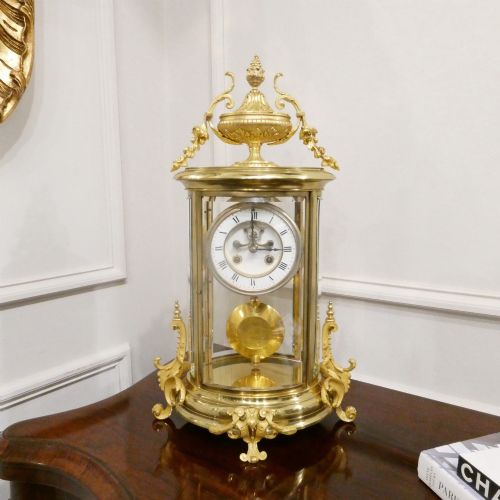
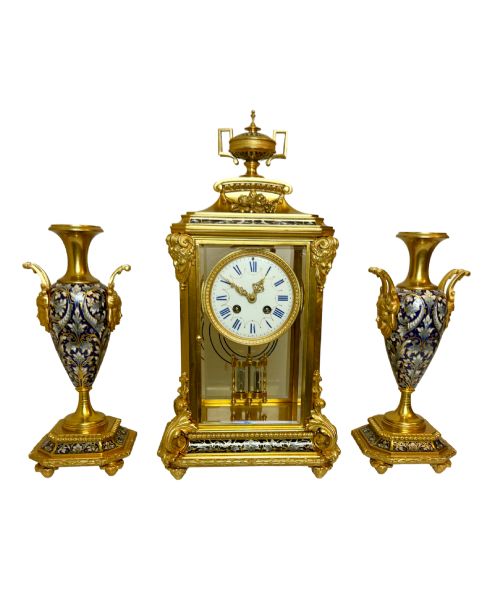


Gilt Bronze Urn Clock
A gilt bronze urn clock brings sculptural French grandeur and precision timekeeping into a room, combining heavy metalwork with porcelain panels and classic vessel forms.
Gilt Bronze Urn Clock
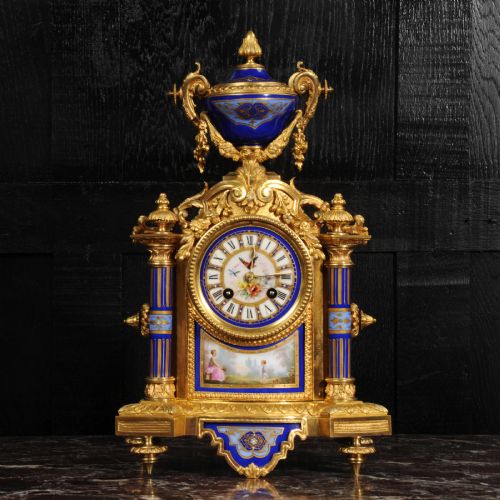
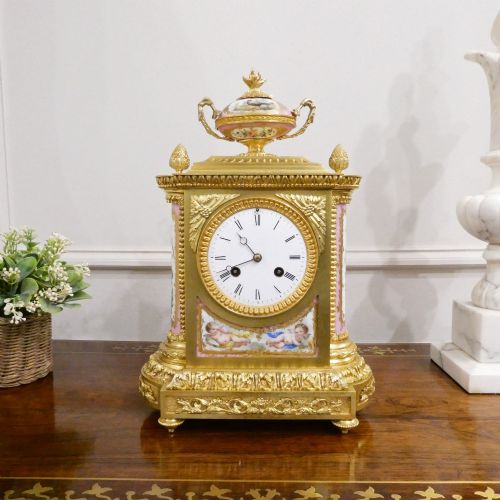
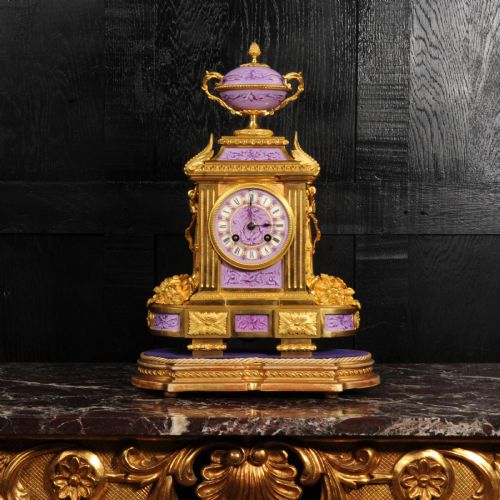
A gilt bronze urn clock sits within the broader tradition of French mantel clocks and clock garnitures spanning the eighteenth and nineteenth centuries. These pieces take the physical form of classical urns or vases mounted on architectural bases, frequently accompanied by matching side pieces in garniture sets.
The versions most commonly met on this page date from the Victorian era and the later decades of the nineteenth century, reflecting revivalist tastes such as Louis XVI, Rococo, and French Empire styles. Makers housed movements inside cast metal vessels adorned with porcelain panels, glass domes, and marble plinths.
Materials and Technique
The construction relies on heavy castings of bronze and brass, finished with fire gilding or ormolu to create a durable, lustrous surface. Metal mounts combine with carved white marble, rouge marble, onyx, and slate to form substantial architectural housings.
Clockmakers integrated hand-painted porcelain plaques, frequently styled after Sèvres, alongside champlevé enamel and glass panels. Mechanical movements by notable French makers powered the eight-day striking trains housed within these decorative vessels.
Several clocks hide their ticking hearts behind delicate glass domes or inside porcelain urns, transforming measurement into decorative sculpture.
Craftsmanship and Detail
The standard of a gilt bronze urn clock depends on the crispness of the original metal chasing and the depth of the gilding. Finer examples display deeply carved foliage, sharp cast ornamentation, and heavy bronze gauge rather than light stamped brass.
Artistic execution in the subsidiary elements separates superior pieces from standard workshop output. Hand-painted porcelain panels with detailed pastoral scenes or floral reserves, paired with original matching garniture vases and undamaged marble bases, elevate the stature of the piece.
Japy Freres·Jean-Baptiste Delettrez·Achille Brocot·Samuel Marti·Louis Goret·Pons De Paul·A.D Mougin·Vincenti of Paris·James Ritchie and Son
The Gilt Bronze Urn Clock Glossary
- Ormolu
- Gilded bronze produced by applying a mercury and gold amalgam to a bronze base and heating it until the mercury vaporised. This historic technique leaves a rich, warm yellow lustre.
- Garniture set
- A decorative centrepiece clock flanked by matching side ornaments such as vases, candelabra, or urns. These sets were designed to sit symmetrically on a mantelpiece.
- Champlevé
- An enamelling technique where troughs or cells are hollowed out of the metal surface and filled with coloured glass paste before firing. The piece is then polished flat.
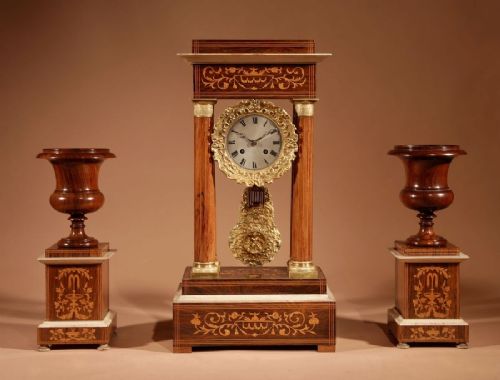
- Portico clock
- A mantel clock featuring a structural case supported by four distinct columns, resembling a miniature classical portico. The pendulum often swings visibly between the pillars.
- Japy Frères
- A prominent nineteenth-century French clockmaking dynasty known for producing reliable machine-stamped movements utilised across the horological trade.
Gilt Bronze Urn Clock: Frequently Asked Questions
How do I wind a nineteenth-century French clock?
Use the matching winding key to turn the arbors located on the dial face, taking care not to overwind the mainspring. Most of these movements operate on an eight-day cycle.
Ensure you move the hands only in the correct direction and set the pendulum to beat evenly to maintain accurate timekeeping.
What is included in a clock garniture set?
A complete garniture set consists of a central mantel clock accompanied by two matching side pieces, often shaped as urns, vases, or candelabra. These items share identical materials, gilding styles, and decorative motifs.
They were intended to create a balanced display across a fireplace mantel or console table in nineteenth-century interiors.
How do I distinguish Louis XVI style from Rococo?
Louis XVI style pieces exhibit strict symmetry, straight architectural lines, classical urns, ribbons, and fluted columns derived from ancient Roman designs.
In contrast, Rococo revival pieces embrace asymmetry, flowing C-scrolls, naturalistic foliage, and elaborate shell motifs without rigid geometric framing.
Where should I place a heavy marble and bronze clock?
Position the clock on a stable, level surface capable of supporting considerable weight, such as a sturdy mantelpiece or a heavy wooden sideboard. Avoid locations exposed to direct sunlight or damp conditions that could harm the enamel dials and gilding.
Securing the base ensures the pendulum hangs freely without rubbing against the back of the case.