
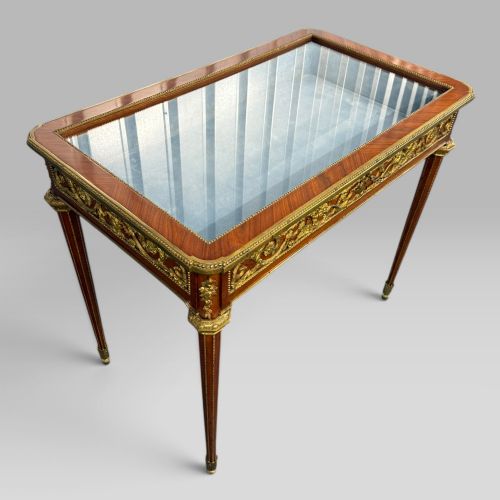


Gilt Bronze Bijouterie Table
A gilt bronze bijouterie table brings a touch of French display elegance into a room to showcase small treasures.
Gilt Bronze Bijouterie Table
When you search for a gilt bronze bijouterie table, you enter a world of nineteenth century French display furniture designed to hold precious ornaments, medals, and small curiosities. These pieces combine glazed top sections with slender legs and gilt bronze or ormolu mounts, often following Louis XV and Louis XVI revival styles.
The versions you are most likely to meet on this page hail from the Victorian era and the latter decades of the nineteenth century, alongside later mid twentieth century interpretations. They appear in forms ranging from rectangular vitrines to heart-shaped display tables, executed in woods such as kingwood, mahogany, rosewood, and walnut.
Makers and workshops drew heavily upon eighteenth century French prototypes, occasionally referencing master cabinetmakers like François Linke. The underlying function remains constant across the centuries: to elevate modest trinkets into a visible spectacle through glass and metal.
How they were made
Cabinetmakers constructed these display surfaces using a timber carcase of mahogany, walnut, kingwood, or rosewood, frequently veneered to create patterned surfaces. Glazed panels formed the viewing area for the contents housed within the interior compartment.
Cast gilt bronze and ormolu mounts were meticulously chased and applied to corners, legs, and borders to accentuate the structural lines. Silk, velvet, or fabric linings were traditionally fitted to the interior base to cushion the displayed items.
Listings feature Victorian and Edwardian examples utilising kingwood, mahogany, rosewood, walnut, and ormolu.
What varies in quality
The crispness of the gilt bronze chasing dictates much of the visual success, separating sharply detailed mounts from soft, shallow castings. Quality also resides in the selection of cabinet timbers and the fidelity of the revival styling.
Joinery execution and the weight of the glass panels determine the structural integrity of the display case. Finer examples exhibit balanced proportions and harmonious integration between the timber carcase and the metal mounts.
François Linke
The Gilt Bronze Bijouterie Table Glossary
- Bijouterie table
- A display table with a glass top and sides intended for small valuable items. These pieces often feature hinged lids.
- Ormolu
- Gilded bronze ornamentation applied to furniture. This technique involves amalgamating gold and mercury.
- Vitrine
- A glass-fronted cabinet or display case for exhibiting fine objects. The term derives from the French word for glass.
- Louis XV Revival
- A nineteenth century decorative style imitating the asymmetry and curves of the French Rococo period. This aesthetic prioritises natural motifs and serpentine forms.
- Kingwood
- A dense, richly grained exotic timber utilised in high-end cabinetmaking. It frequently appears in contrasting veneers.
Gilt Bronze Bijouterie Table: Frequently Asked Questions
What is a gilt bronze bijouterie table?
A gilt bronze bijouterie table is a glazed display piece created to showcase small valuables, medals, and personal ornaments under glass.
These tables typically feature ornate metal mounts and fine timber carcases rooted in nineteenth century French revival design.
How were these tables used originally?
Originally placed in drawing rooms and salons, owners used them to exhibit their collections of pocket watches, jewels, and miniatures to visiting guests.
The glass top protected the delicate contents from dust while allowing full visibility.
How do I care for the interior fabric?
Original velvet, silk, or fabric linings require gentle maintenance to avoid deterioration from light and moisture.
Vacuuming with a soft attachment on low power helps remove surface dust without disturbing the textile.
How can I tell a nineteenth century piece apart?
Nineteenth century examples often display hand-chased gilt bronze mounts and traditional timber construction methods typical of French cabinetmaking.
Styles lean heavily into Louis XV and Louis XVI revival vocabulary with characteristic veneers and glass panels.