
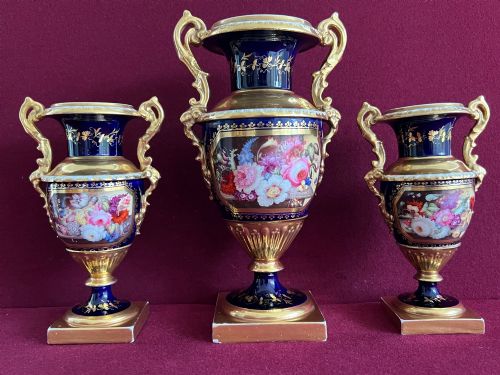
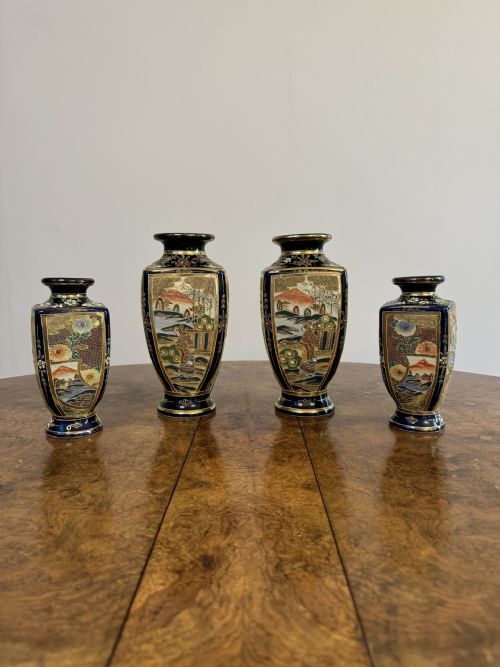
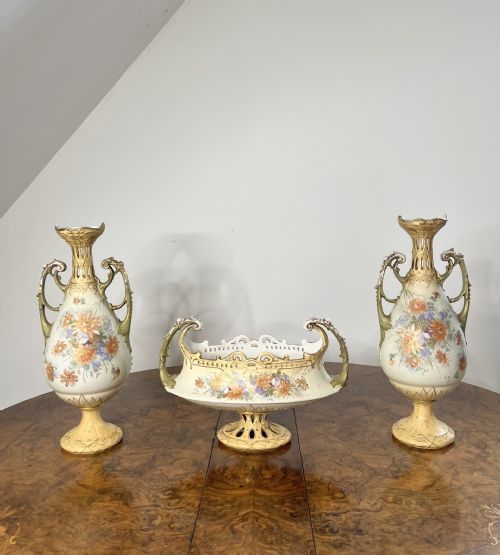


Gilded Urn Garniture Set
A gilded urn garniture set brings matching grandeur to a mantelpiece, pairing a central clock or centrepiece with flanking side vases.
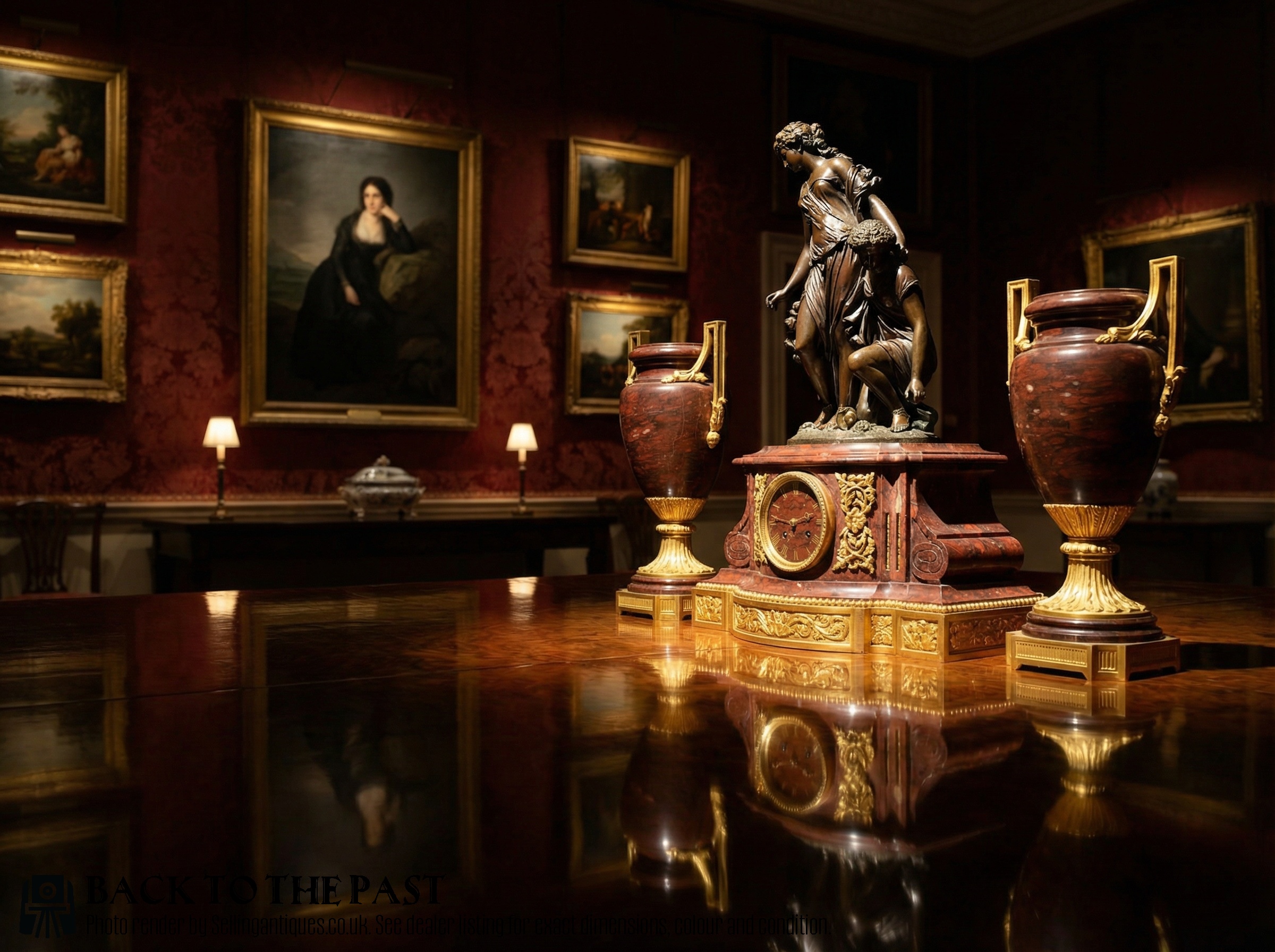
Gilded Urn Garniture Set
A gilded urn garniture set consists of matching decorative vessels and clocks designed to display in a unified arrangement across a mantelpiece or console. These multi-piece decorative suites include sets of three or four vases, centrepieces paired with side vases, and clock sets flanked by matching vases.
The pieces appearing on this page span the eighteenth, nineteenth, and early twentieth centuries, drawing on Victorian, Louis XVI, Rococo Revival, and Meiji period aesthetics. Buyers encounter Continental porcelain, Satsuma earthenware, Bohemian glass, and French enamel alongside traditional clockwork sets.
The most common configurations are three-piece and four-piece sets comprising a central focal point accompanied by symmetrical side pieces. Makers from Britain, France, Germany, Japan, and Austria produced these elaborate groupings for formal nineteenth-century interiors.
How they were made
Makers utilised porcelain, earthenware, glass, and brass, applying gold leaf, ormolu, and gilt bronze to highlight the surfaces. Ceramic bodies were shaped, glazed, and hand-painted in palettes ranging from Imari colours to rich enamel tones.
Metal components involved cast brass and bronze, finished with fire-gilding or ormolu mounts that framed the ceramic or glass bodies. Clock movements were integrated into the central urns or dedicated clock cases, driven by mechanical brass gear trains.
Listings feature materials including porcelain, ormolu, enamel, and glass across periods from the eighteenth century to the early twentieth century.
What varies in quality
The refinement of the hand-painting and gilding separates standard production from finer work, seen in the precision of floral motifs, portraiture, and over-gilt detailing. Superior sets display crisp cast mounts in ormolu or gilt bronze that fit the ceramic bodies precisely without excess gaps.
The integrity of the matching elements defines the cohesion of a set, as genuine suites share uniform wear, matching palettes, and consistent manufacture across all constituent pieces. Complete sets with original clock movements and matching side vases command greater interest than assembled groups.
The Gilded Urn Garniture Set Glossary
- Garniture set
- A matched group of three or more decorative objects, typically a clock flanked by two urns or a centrepiece paired with side vases, designed to be displayed together on a mantelpiece.
- Ormolu
- Finely ground high-carat gold applied to a bronze base using a mercury amalgamation process, or cast brass finished with a bright gold-coloured wash. It provides durable metallic enrichment to nineteenth-century decorative objects.
- Imari palette
- A traditional decorative colour scheme featuring underglaze blue, iron red, and gold, originating in Japanese porcelain and later copied by European factories. It creates a distinctive high-contrast surface pattern.
- Centrepiece
- The primary central object in a garniture arrangement, often a large urn, lidded vase, or mantel clock that anchors the symmetrical side pieces. It forms the visual focal point of the display.
Gilded Urn Garniture Set: Frequently Asked Questions
What is a garniture set?
A garniture set is a coordinated grouping of decorative vessels and clocks designed to sit together as a matched display. They typically feature a central piece flanked by two or more matching side pieces.
These suites were traditionally arranged on mantelpieces, credenzas, or pier tables in formal nineteenth-century reception rooms. The matching pieces create a sense of symmetry and balance in the interior.
How do I date a clock set?
Dating a clock set involves examining the style of the case, the materials used, and any maker marks stamped on the movement. Nineteenth-century pieces often reflect Revival styles such as Louis XVI or Neo-Classical.
Movements by known makers or specific regional signatures help narrow the decade of manufacture. Comparing the ceramic body and gilding style to documented periods provides further chronological context.
Where were these sets placed?
These sets were placed on mantelpieces above fireplaces, where the central clock or urn sat flanked by symmetrical side vases. They also decorated large console tables and credenzas in drawing rooms.
The arrangement was intended to draw the eye and demonstrate the taste and means of the household through coordinated display.
How do I care for gilt bronze?
Gilt bronze and ormolu require gentle dusting with a soft, dry brush to prevent the accumulation of abrasive particles. Moisture and chemical cleaners should be avoided to protect the delicate metallic surface.
Preserving the original gilt finish maintains the visual depth and historical integrity of the metal mounts on these nineteenth-century pieces.