

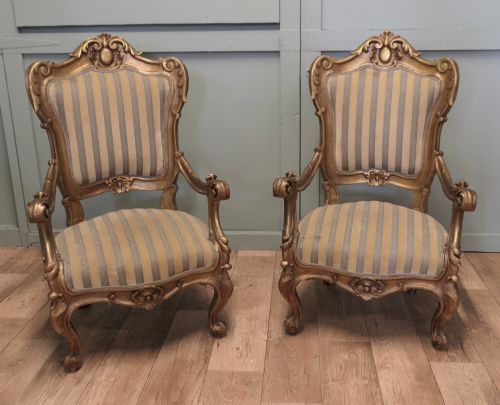
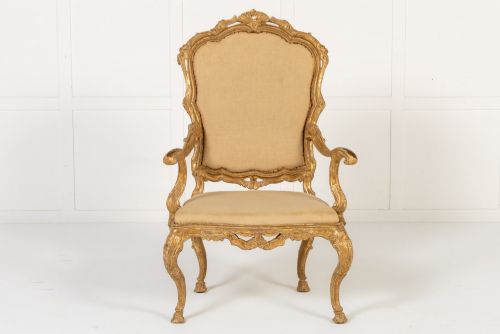


Gilded Throne Chair
These gilded throne chair pieces bring grand presence and opulent seating into a room, offering historic style and dramatic carved detail.
Gilded Throne Chair
A gilded throne chair commands attention in any interior, drawing the eye with imposing scale and decorative presence. Buyers searching for a gilded throne chair seek statement seating that carries centuries of stylistic heritage.
The selections on this page predominantly feature armchairs originating from the eighteenth and nineteenth centuries. Examples range from Italian Rococo and Baroque Revival forms to French Empire and William and Mary style interpretations.
Most pieces appear as matched pairs rather than single items, upholstered in materials such as fabric, linen, and leather. The forms utilise carved wood foundations finished with gold leaf, silver gilt, paint, and gesso.
How they were made
Makers constructed these frames from solid timber, including walnut, before applying delicate layers of gesso to create smooth surfaces for gilding. Artisans then applied gold leaf or silver gilt by hand to achieve the characteristic metallic sheen.
Upholstery techniques involved securing fabrics like tapestry and leather to the wooden framework using traditional brass tacks. Carved details were chiselled directly into the wood prior to the finishing process.
Gilded Throne Chair Retail Price Guide 2026
Typical asking prices for gilded throne chair among the pieces listed under this phrase on Sellingantiques today, from the lower quarter to the upper quarter. They describe what is for sale here now, not the wider market.
What varies in quality
The distinction between standard examples and superior pieces lies in the depth and precision of the carved woodwork. Finer items display crisp, deeply undercut foliage and scrollwork executed by skilled hands.
The application and retention of the gold leaf or silver gilt also determine quality, with better pieces showing harmonious ageing and intact metallic surfaces. Scale and the presence of matched pairs elevate the desirability of the seating.
The Gilded Throne Chair Glossary
- Giltwood
- Wood that has been covered with a thin layer of gold leaf. This finish defines the reflective surface of many antique chairs.
- Gesso
- A plaster mixture applied to wood surfaces as a base for gilding. It provides a smooth ground for the gold leaf.
- Silver Gilt
- Silver applied to a wooden surface and treated to resemble gold or left in its silvery tone. It creates a cooler metallic appearance than standard gold leaf.
- Brass Tacks
- Small metal fasteners used to secure upholstery edges to the wooden frame. They often provide a decorative border along the fabric.
- Tapestry
- A heavy textile featuring woven designs used for upholstery. It adds texture and colour to historic armchair seats and backs.
Gilded Throne Chair: Frequently Asked Questions
What is a gilded throne chair?
A gilded throne chair is a large, ornate armchair finished with gold leaf or silver gilt. These pieces date primarily from the eighteenth and nineteenth centuries.
They were designed to project status and authority within grand interiors. Today, buyers use them as focal points in large living spaces or studies.
How were these armchairs used historically?
Historically, such chairs served as seating for prominent individuals during formal occasions or daily life in chateaux and palazzos. Their elevated height and imposing armrests emphasised the importance of the sitter.
Over time, they transitioned from functional seats of authority to decorative statements of historic taste. Their grand scale meant they occupied prominent positions in reception rooms.
How do I live with a gilded throne chair?
Living with these chairs involves placing them where their scale and metallic finish can be appreciated without obstruction. They function well as standalone statement pieces in spacious rooms.
Care should be taken to protect delicate giltwood surfaces and historic upholstery from direct sunlight and heavy wear. Gentle dusting helps preserve the integrity of the gold leaf and gesso.
How do I tell different styles apart?
Styles range from the flowing, asymmetric curves of Italian Rococo to the stricter symmetry of the French Empire and William and Mary periods. Examining the carved motifs reveals the design vocabulary of each era.
For instance, Baroque Revival pieces often feature heavy, dramatic scrolling, while Louis XVI Revival examples display more restrained classical geometry.