



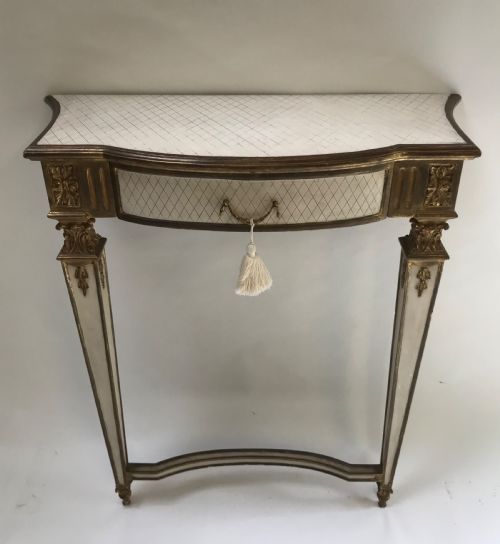


Gilded Entryway Console
These gilded entryway console tables bring dramatic architectural presence to a hallway, offering a surface for lamps and mirrors.
Gilded Entryway Console
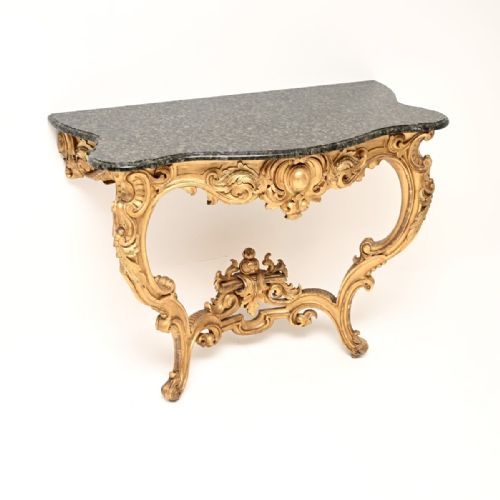
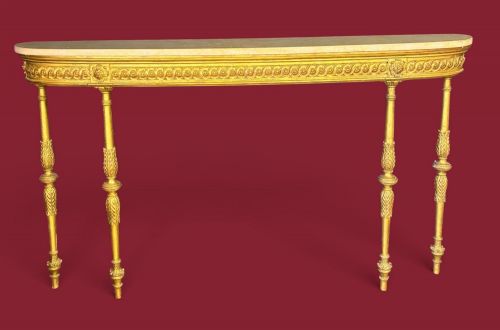
A gilded entryway console is designed to anchor a hallway or reception space, frequently paired with a matching wall mirror above. These tables display formal forms ranging from half-moon demi-lune shapes to serpentine outlines and rectangular hall tables.
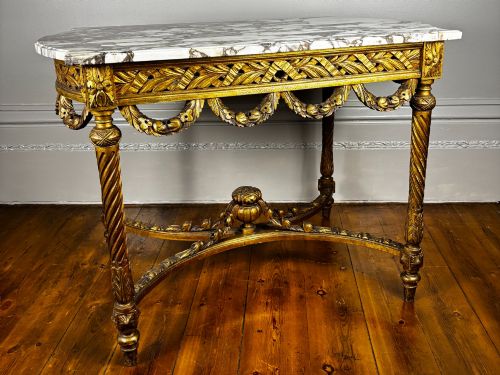
Buyers browsing this selection encounter pieces spanning the seventeenth century through to the early twentieth century. The most common survivals on this page date from the nineteenth century, reflecting revival tastes in French Neoclassical, Italian Baroque, and Louis XVI styles.
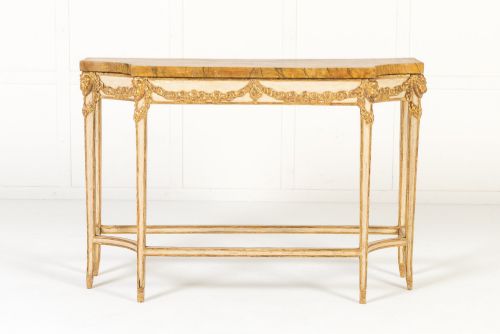
Makers and workshops of these periods adopted distinct regional aesthetics, from British George III satinwood pieces to ornate Italian Baroque Revival tables supported by carved lion's paws. French Chateau and Victorian examples further populate the category with heavy gilding and marble surfaces.
Materials and construction methods
Construction relies heavily on carved wood and gesso foundations before the application of gold leaf or paint finishes. Artisans built structural carcasses from solid timber, often utilising satinwood for specific regional British pieces while framing continental European tables in softer woods prepared for heavy surface ornamentation.
Surface decoration combines traditional water gilding or oil gilding with polychrome paintwork. Heavy gesso layers were built up over carved wooden substrates to receive delicate tool work and leaf application, creating the characteristic reflective metallic sheen.
Tops are predominantly formed from heavy stone, featuring marble surfaces such as Breccia marble that contrast with the reflective giltwood frames below. Wall mirrors in the category utilise comparable carved wooden and gilt gesso frames designed to hang directly above the console tables.
Gilded Entryway Console Retail Price Guide 2026
Typical asking prices for gilded entryway console among the pieces listed under this phrase on Sellingantiques today, from the lower quarter to the upper quarter. They describe what is for sale here now, not the wider market.
Current listings feature pieces spanning the seventeenth to the twentieth centuries, utilising materials like Breccia marble, giltwood, satinwood, and gesso.
Assessing quality and execution
The distinction between standard production and exceptional execution lies in the crispness of the hand-carved gesso and wood details. Superior pieces display deep, undercut carving on motifs like lion's paw supports and scrolling foliage rather than shallow, moulded composition ornament.
The integrity of the original gilt surface and the quality of the fitted marble top dictate the standing of an individual table. Finer examples retain their original gold leaf and heavy natural stone slabs with minimal structural replacement to the underlying wooden frame.
The Gilded Entryway Console Glossary
- Giltwood
- Timber that has been coated with gold leaf over a prepared gesso ground. This finish provides the characteristic metallic brilliance seen on historical frame mouldings.
- Gesso
- A plaster-like mixture applied to wood substrates to create a smooth surface for carving and gilding. It allows artisans to achieve sharp relief details before applying gold leaf.
- Demi-lune
- A half-moon shape used for console tables designed to sit flush against a wall. This form saves valuable floor space in narrow hallways.
- Breccia marble
- A decorative natural stone composed of angular rock fragments cemented together in a matrix. It provides a heavy, variegated surface for high-end table tops.
- Serpentine outline
- A table edge or front that curves outward in the centre and inward at the sides. This rhythmic contour creates movement across the furniture facade.
Gilded Entryway Console: Frequently Asked Questions
Where should I place a gilded console?
These tables fit naturally in entrance halls, long corridors, or reception rooms where they create an immediate focal point. They are typically positioned against a flat wall beneath a complementary wall mirror.
Because of their shallow depths, particularly half-moon and demi-lune formats, they occupy minimal floor space while providing a functional display surface.
How do I care for antique giltwood?
Giltwood requires gentle maintenance to protect the delicate gold leaf and underlying gesso layers from moisture and abrasion. Dusting should be done lightly with a dry, soft brush rather than a cloth that might snag on raised carved details.
Avoid using liquid cleaners, polishes, or chemical sprays directly on the gilded surfaces, as these can permanently dissolve or dull the historical finish.
Are these tables sturdy enough for daily use?
Console tables are primarily designed as decorative architectural furniture rather than heavy utility pieces. While they easily support lamps, decorative bowls, and mail, they are often stabilised by being placed against a wall or secured with brackets.
Larger nineteenth-century examples with heavy marble tops rely on solid construction and substantial carved supports to bear the weight of the stone safely.
How do I identify a Louis XVI style console?
Louis XVI style tables generally exhibit straighter architectural lines, symmetrical neoclassical motifs, and fluted legs compared to the more flamboyant curves of earlier Baroque or Rococo pieces. Look for decorative elements such as beaded mouldings, ribbon twists, and classical urns.
Twentieth-century revivals and nineteenth-century interpretations both frequently adopted these restrained French royal design characteristics.