


Gilded Ceramic Candle Holders
These gilded ceramic candle holders combine porcelain bodies with rich metallic leaf and enamel work to bring light and decorative elegance to a room.
Gilded Ceramic Candle Holders
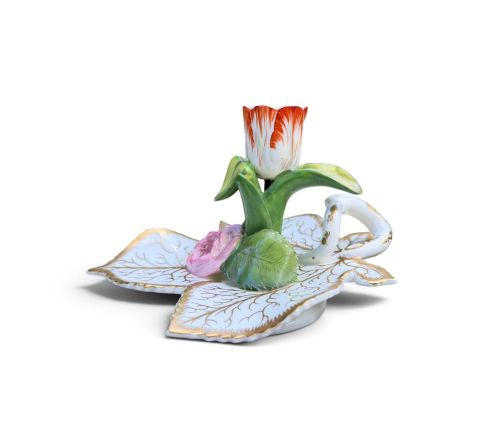
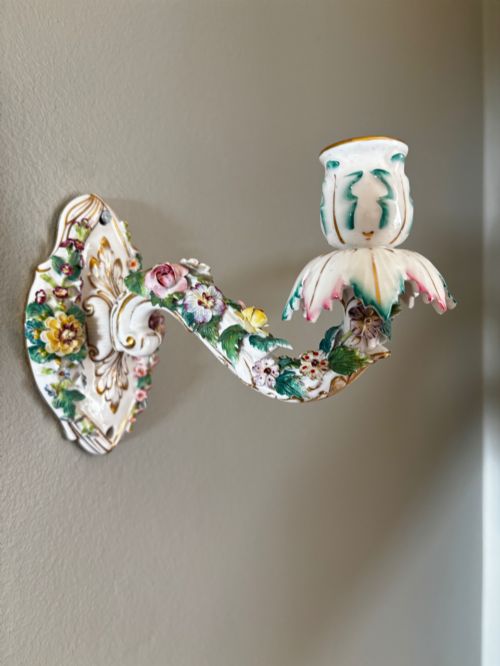
Gilded ceramic candle holders span several centuries of European ceramic production, taking the form of single candlesticks, multi-branched candelabra, chambersticks with handle pans, and wall sconces designed to mount directly onto vertical surfaces.
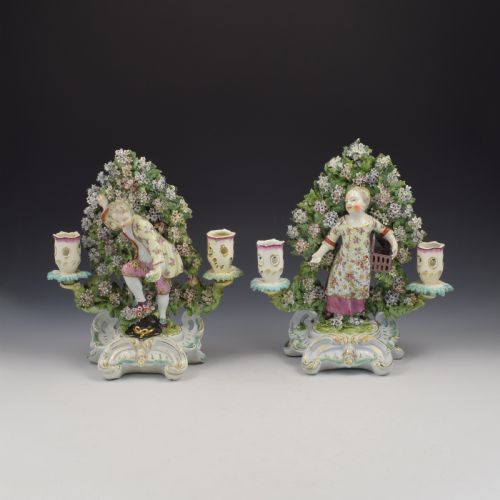
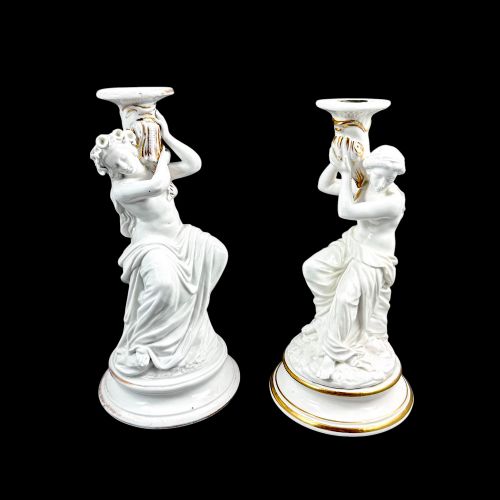
The pieces appearing on this page encompass various configurations such as figural bocage designs featuring children or allegorical figures amidst foliage, alongside simpler geometric or classical forms.
Origins stretch across English and continental European factories, moving from eighteenth-century soft-paste bodies through nineteenth-century hard-paste formulations and Victorian revivals.
What varies in quality
Quality rests in the crispness of the modelled detail, particularly in intricate bocage foliage and figural facial expressions, where superior examples retain sharp definition rather than soft, blurred contours.
The application of gold leaf and enamel decoration creates distinction, with finer pieces displaying precise hand-painting and substantial gilding that resists rubbing and wear over time.
Listings feature hard-paste and soft-paste porcelain pieces spanning Georgian, Victorian, and nineteenth-century periods.
Meissen·Derby·Spode·Chelsea·Bow·Minton·Royal Worcester·James Hadley·Helena Wolfsohn·Volkstedt·Sutherland & Sons
The Gilded Ceramic Candle Holders Glossary
- Bocage
- A decorative background of applied porcelain leaves and flowers that surrounds figures on eighteenth and nineteenth century candlesticks. This leafy screen is particularly characteristic of English porcelain factories.
- Candelabra
- A candle holder with multiple arms branching from a central stem to support several candles at once. These larger forms often feature elaborate figural or floral modelling.
- Chamberstick
- A low portable candlestick fitted with a pan to catch dripping wax and a loop handle for carrying from room to room. English examples frequently incorporate floral or shell motifs.
- Hard-paste porcelain
- A durable ceramic material composed of kaolin and petuntse fired at high temperatures to produce a dense, vitreous body. It forms the foundation for many continental European pieces.
- Soft-paste porcelain
- An artificial ceramic paste used primarily by early European factories before the discovery of local kaolin deposits. It possesses a warmer tone and a softer glaze than hard-paste porcelain.
Gilded Ceramic Candle Holders: Frequently Asked Questions
How do I clean them?
Dust gently with a soft dry brush to protect the delicate porcelain bocage and the applied gold leaf. Avoid liquid cleaners or harsh chemicals which can damage the enamel and gilding.
Keep them away from direct heat sources and moisture to preserve the ceramic body and prevent any degradation of the historical materials.
Were they used daily?
Many of these pieces served as functional lighting in domestic interiors before gas and electric lighting became widespread. Chambersticks were specifically designed for carrying down dark hallways.
More elaborate figural candelabra often functioned primarily as decorative garniture on mantelpieces rather than everyday lighting.
How do I identify periods?
Examine the style of modelling, such as Rococo curves or Victorian classical revival motifs, alongside the characteristics of the porcelain paste itself. Early pieces often show softer glazes and hand-modelled flower work.
Makers' marks, where present on the underside, provide crucial reference points for dating against known factory production periods.
What is bocage?
Bocage refers to the applied background of leaves, branches, and flowers that frames porcelain figures. It became particularly popular in eighteenth-century English manufactories.
This intricate foliage requires careful handling because the delicate ceramic branches are vulnerable to knocks and chips.