

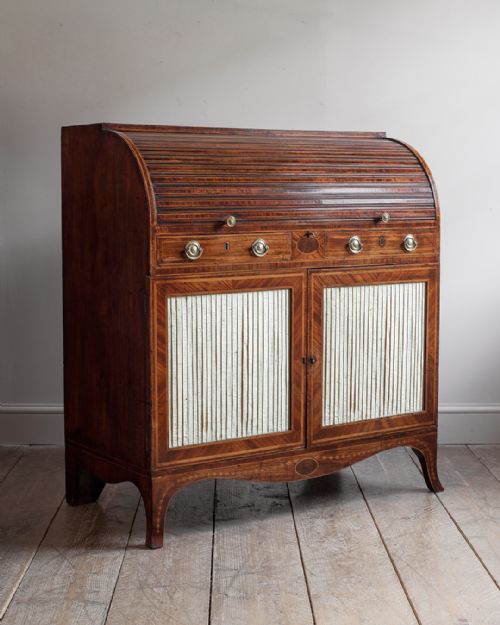
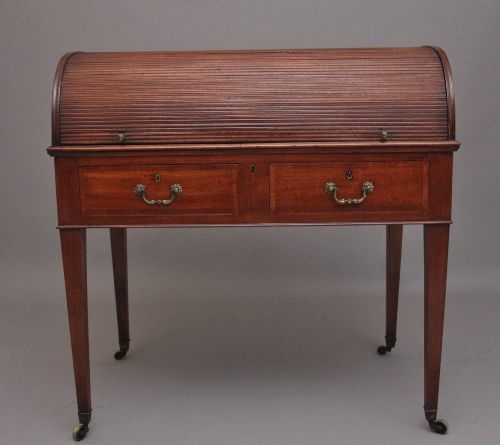
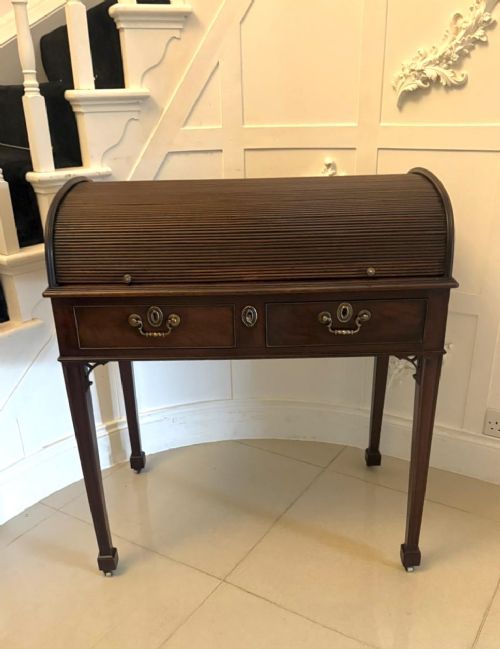


Georgian Tambour Front Desk
A georgian tambour front desk brings ingenious slatted roll-tops and refined timber work together for the discerning study.
Georgian Tambour Front Desk
A georgian tambour front desk is a sophisticated form of writing furniture designed to conceal the working surface and compartments beneath a flexible wooden shutter. These pieces date across the eighteenth and nineteenth centuries, spanning George III, Sheraton, and English Regency styles.
Buyers will most commonly encounter mahogany examples constructed as writing desks, bureaux, and cylinder desks. Some variants include pull-out writing slides, satinwood inlay, or combination dressing table formats from around eighteen hundred.
The form prioritises clever concealment, allowing correspondence and paperwork to be tucked away quickly while maintaining an immaculate exterior in a parlour or study.
Materials and construction
Cabinet makers utilised dense timbers such as mahogany and oak for the primary carcase, complemented by decorative veneers including satinwood and partridgewood. Fine stringing and contrasting inlay feature prominently across these pieces.
The characteristic tambour shutter consists of narrow wooden slats glued to a canvas or textile backing, allowing the flexible panel to slide smoothly along grooved tracks in the desk frame. Brass fittings and leather writing surfaces complete the construction.
Georgian Tambour Front Desk Retail Price Guide 2026
Typical asking prices for georgian tambour front desk among the pieces listed under this phrase on Sellingantiques today, from the lower quarter to the upper quarter. They describe what is for sale here now, not the wider market.
Secret drawers often hide behind innocent-looking pigeonholes, waiting for someone to discover the tiny wooden spring catch.
Judging quality
The distinction between standard examples and superior pieces rests on the precision of the tambour mechanism and the crispness of the timber selection. Smooth operation of the sliding slats without binding indicates meticulous historical joinery.
Secondary woods, the fineness of the satinwood or mahogany grain, and the restraint of the inlay work determine the overall standing of the desk. Coarser examples lack the refined proportions and tight tolerances found at the top of the range.
The Georgian Tambour Front Desk Glossary
- Tambour
- A flexible shutter made from narrow strips of wood glued to a fabric backing. This allows the cover to curve around a drum and slide open or closed.
- Cylinder desk
- A writing desk featuring a quarter-circle rotating wooden cylinder that covers the writing surface and pigeonholes. It operates on a similar principle to the tambour.
- Satinwood
- A lustrous, hard timber native to Ceylon and the West Indies, displaying a yellowish hue and satiny sheen. It was widely utilised for fine marquetry and stringing during the Georgian period.
- Bonheur du jour
- A small ladies writing table featuring a set of drawers and shelves above the main writing surface. These dainty pieces gained popularity in the late eighteenth century.
Georgian Tambour Front Desk: Frequently Asked Questions
How does a tambour mechanism work?
The tambour consists of many small vertical wooden strips fastened to a strong textile backing. This flexible mat travels along concealed curved grooves cut into the sides of the desk.
When pushed, the slats glide neatly out of sight into the body of the furniture, revealing the inner compartments and writing slide.
Where were these desks used?
Georgian writing furniture was primarily housed in private studies, libraries, or withdrawing rooms of grand houses. They served as personal workspaces for managing estate accounts and writing correspondence.
Their compact forms also suited the private chambers of ladies for letter-writing and toilet duties.
How do I distinguish George III from Regency styles?
George III pieces often display classical proportions, delicate satinwood inlay, and refined bracket feet. The decorative vocabulary leans towards restrained neoclassical motifs.
Regency pieces tend toward bolder architectural lines, darker woods, and sometimes brass mounts or reeded legs reflecting a later aesthetic.
Are these desks suitable for daily use?
These historical pieces accommodate modern laptop use and writing quite comfortably when selected with appropriate dimensions. The pull-out slides and internal drawers remain as practical today as they were centuries ago.
Care should be taken to maintain stable room humidity to protect the vintage timbers and the textile backing of the tambour shutter.