




Georgian Tambour Front Cabinet
A georgian tambour front cabinet brings sliding slatted wooden doors together with mahogany craftsmanship for discreet storage.
Georgian Tambour Front Cabinet
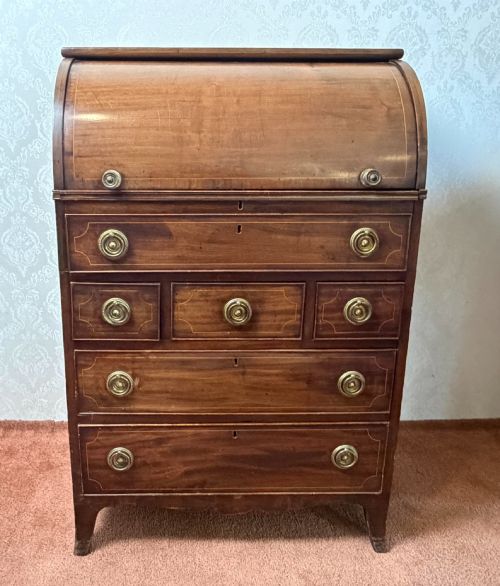
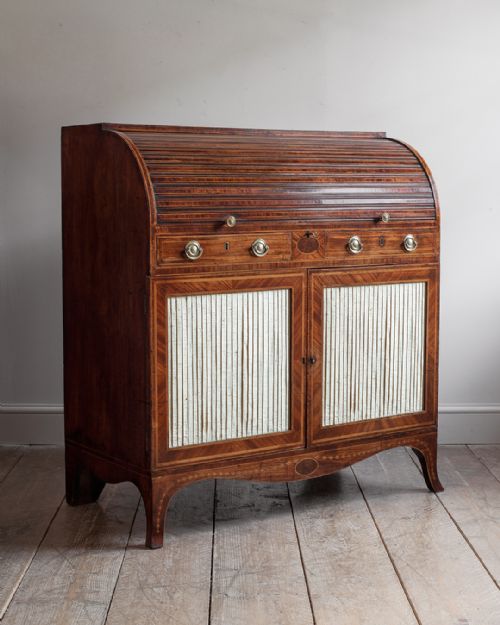
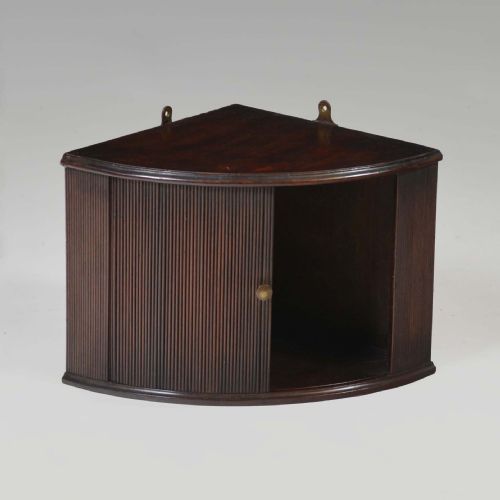
A georgian tambour front cabinet is an antique piece designed with flexible slatted doors that slide around a track to conceal interior compartments or shelves. The examples seen on this page span the eighteenth and nineteenth centuries, incorporating styles from George III and Regency periods alongside Dutch Neoclassical pieces.
Most pieces meeting this search phrase take the form of bedside tables, commodes, night stands, and compact desks. These smaller case forms dominate the selection, offering functional enclosed storage for domestic spaces while retaining period character.
Materials and construction
Makers relied primarily on mahogany as the main structural timber, often enhanced with satinwood, walnut, and contrasting boxwood inlay. Textiles and brass hardware frequently complement the primary wood surfaces on drawers and handles.
The defining mechanical technique involves joining narrow vertical wooden strips onto a flexible canvas or linen backing. This allows the door to curve smoothly around the internal corners of the cabinet without jamming.
Listings feature mahogany, satinwood, walnut, and boxwood inlay across the Georgian, Regency, and Victorian periods.
Evaluating craftsmanship and proportion
Quality rests heavily on how smoothly the slatted wooden tracks operate and how tightly the individual strips align when closed. Superior examples demonstrate precise joinery that conceals the mechanism while allowing effortless movement.
The choice of secondary timbers and the crispness of any boxwood inlay or marquetry separate standard utilitarian furniture from finer decorative commissions. Proportions and the retention of original brass fittings further distinguish the best examples.
The Georgian Tambour Front Cabinet Glossary
- Tambour
- A flexible door constructed from narrow vertical strips of wood glued to a fabric backing. It slides along a concealed track to open and close.
- Commode
- A decorative low cabinet or chest of drawers originating in the eighteenth century. These pieces often feature enclosed cupboard space beneath a top surface.
- Bureaux
- A slant-front desk that opens to reveal a writing surface and small interior compartments. Some examples combine this form with sliding tambour closures.
- Boxwood inlay
- Contrasting light-coloured wood inserted into the primary timber surface to create decorative lines or geometric patterns. It provides a sharp visual border.
- Tray top
- A raised edge or gallery surrounding the upper surface of a bedside table or commode. This design prevents items from rolling off the top.
Georgian Tambour Front Cabinet: Frequently Asked Questions
What is a tambour door?
A tambour door consists of thin wooden slats attached to a flexible fabric backing that moves along a curved track.
This ingenious mechanism allows the door to slide open around corners, saving exterior space compared to traditional swinging doors.
How do I use one today?
These compact cabinets function well as bedside tables, hallway storage, or small living room accent pieces.
The enclosed shelving keeps modern clutter hidden while adding period warmth to an interior.
Are these pieces made of solid mahogany?
Cabinet makers used solid mahogany for primary structural elements, drawer linings, and carved details.
Secondary woods and mahogany veneers were frequently applied to larger flat surfaces like tabletops and sides.
How do I tell George III from Regency?
George III furniture typically displays classical proportions with restrained carving and fine inlay work.
Regency pieces often introduce bolder classical motifs, darker timbers, and heavier brass mounts influenced by French design.