


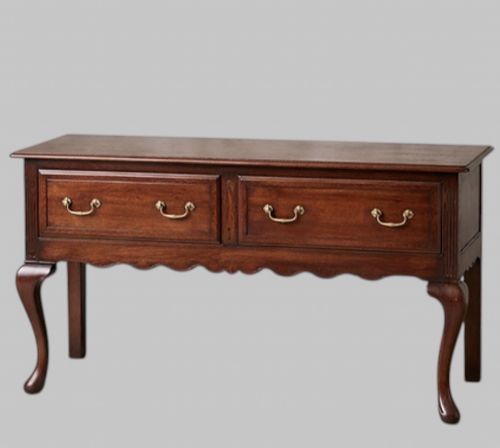
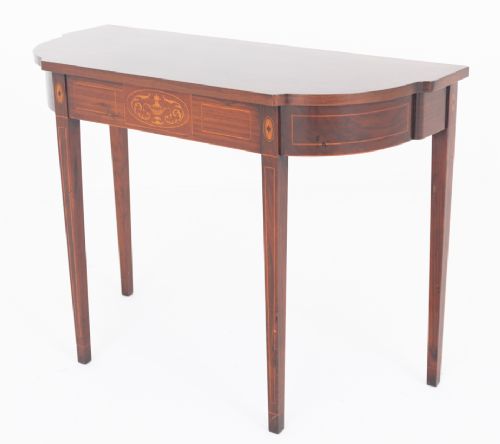


Georgian Style Entry Table
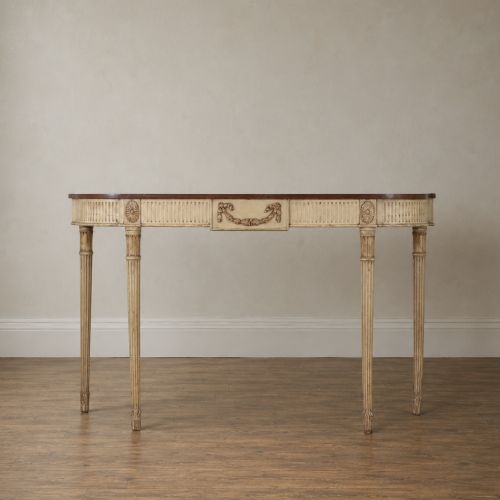
A georgian style entry table brings structured elegance to a hallway, offering a surface of rich mahogany or burr walnut designed to anchor an interior space.
Georgian Style Entry Table
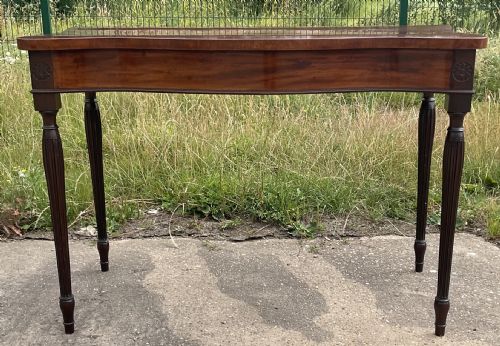
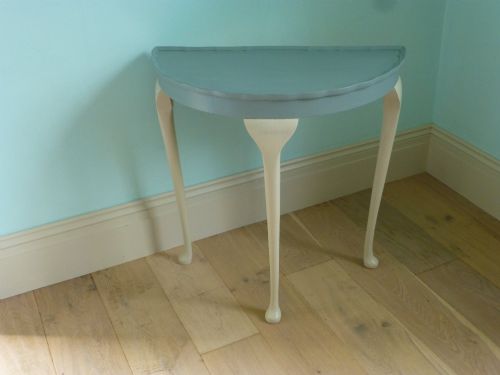
When searching for a georgian style entry table, buyers encounter console tables, side tables, and demi-lune forms designed for narrow spaces and hallways. These pieces draw on eighteenth-century proportions, often featuring serpentine or bow fronts intended to sit flat against a wall.
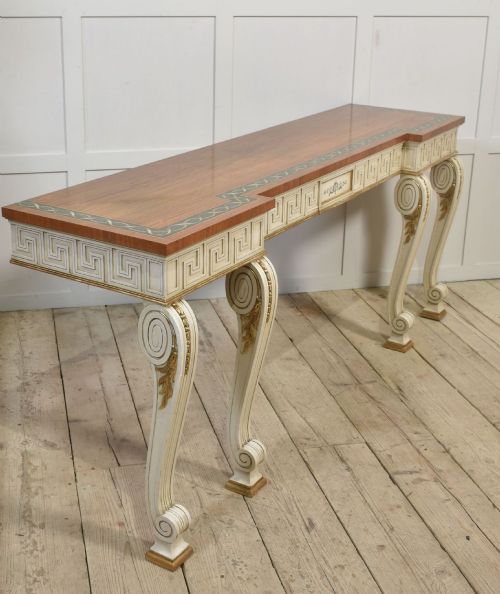
The selection ranges from genuine eighteenth-century pieces to revival pieces made across the nineteenth and early twentieth centuries. Mahogany and burr walnut dominate the forms, frequently paired with satinwood inlay or painted finishes.
Buyers are most likely to meet twentieth-century revival pieces alongside Victorian examples, reflecting sustained interest in neoclassical and Georgian design through subsequent decades.
Materials and construction
Cabinet makers relied primarily on solid mahogany and burr walnut, often applying figured veneers over secondary timbers to create patterned surfaces on table tops and friezes. Satinwood and padoukwood provided contrasting banding and detailed inlay work.
Painted and gilt finishes appear across specific regional and revival examples, utilising base coats of paint decorated with hand-applied motifs. Brass hardware, including handles and campaign mounts, complements the dark timbers and polished surfaces.
Listings span the eighteenth, nineteenth, and early twentieth centuries, featuring walnut, mahogany, satinwood, and painted finishes across console and demi-lune formats.
Markers of quality
Quality rests in the selection of timber veneers and the crispness of carved details such as acanthus foliage or reeded legs. Superior pieces demonstrate precise joinery in drawer linings and carcass construction, ensuring stability in slender forms.
The integration of secondary woods, the depth of hand-polished finishes, and the restraint of inlay work distinguish standard production furniture from high-workshop execution.
Maple and Co.·Gillows
The Georgian Style Entry Table Glossary
- Console table
- A table designed to be fixed against a wall, frequently supported by brackets or front legs. These pieces form the primary category within this search.
- Demi-lune
- A half-moon shape used for table tops and commodes, allowing the furniture to stand flush against a wall in narrow entryways.
- Serpentine front
- A curved furniture front featuring a convex centre flanked by concave wings. This contour requires skilled carpentry to shape timber accurately.
- Satinwood
- A durable, lustrous yellow timber imported from tropical regions, frequently utilised for decorative banding and inlaid veneers during the eighteenth and nineteenth centuries.
- Burr walnut
- Timber taken from a walnut tree growth, yielding intricate, swirling grain patterns highly prized for table tops and cabinet doors.
Georgian Style Entry Table: Frequently Asked Questions
Where should an entry table be placed?
An entry table sits against a hallway or reception room wall where depth is limited. Demi-lune and console forms suit narrow corridors because their flat backs align closely with the plasterwork.
Positioning the table beneath a mirror or painting creates a focal point upon entering the home, while leaving adequate clearance for household movement.
How do I distinguish eighteenth-century pieces from later revivals?
Eighteenth-century tables display construction methods specific to their period, such as hand-cut dovetails in drawer construction and timber shrinkage appropriate to age. Revival pieces from the Victorian and Edwardian eras often utilise machine-sawn elements and standardised fixings.
Examining the secondary woods underneath and inside the table reveals the manufacturing era and workshop practices.
What is the difference between a console and a side table?
A console table is specifically designed to stand against a wall, historically fixed to the architectural structure or balanced on front legs. Side tables are free-standing items of furniture that can be moved around a room as needed.
In modern usage, the terms often overlap, particularly within Georgian revival pieces intended for hallways.
How do I maintain polished mahogany surfaces?
Polished mahogany requires dusting with a soft, dry cloth to prevent the accumulation of abrasive particles. Avoid placing tables in direct sunlight or near heat sources to prevent timber splitting and veneer lifting.
Occasional application of appropriate wax polish preserves the sheen without building up excessive residue on the grain.