
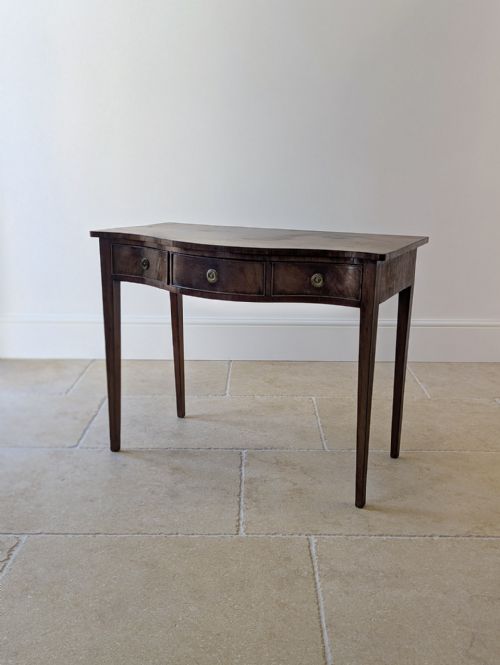
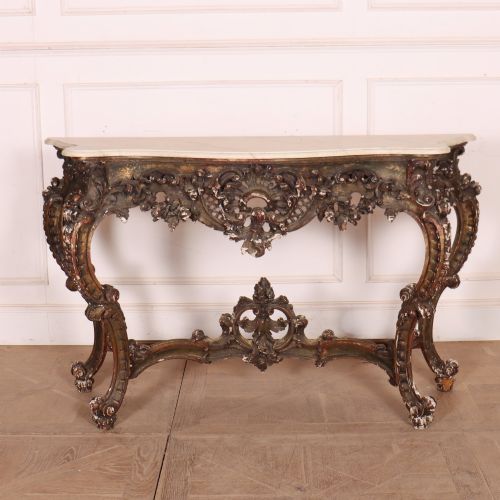
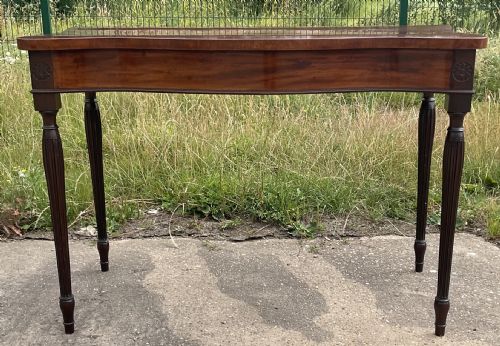
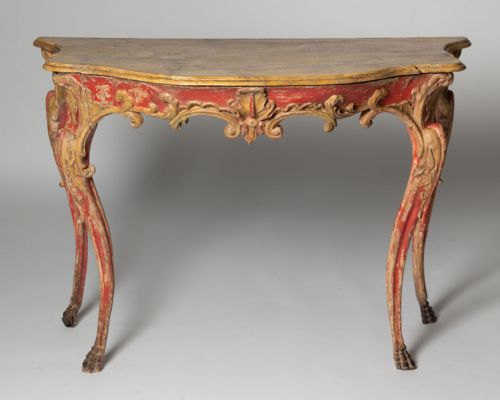
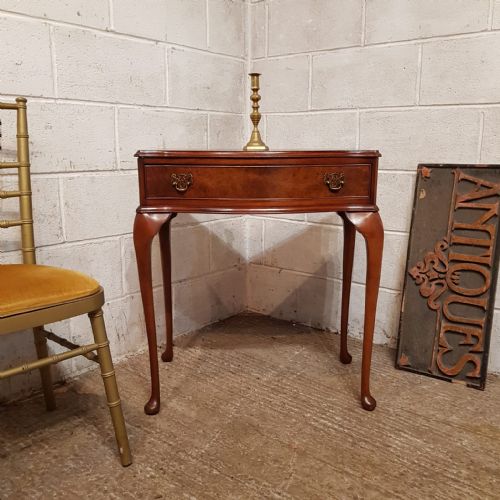


Serpentine Front Entry Table
These serpentine front entry tables curve with grace and presence, offering narrow footprints and striking silhouettes for hallways and passages.
Serpentine Front Entry Table
A serpentine front entry table sits narrow against a wall while offering a flowing, undulating outline to the room. These pieces function as console and side tables placed in hallways, entryways, and reception spaces where floor space is tight.
The versions met most frequently on this page date from the Georgian period through the nineteenth century and into the early twentieth century. Makers fashioned them in mahogany, walnut, satinwood, and carved wood, sometimes paired with marble tops.
Stylistic influences span Georgian, Victorian, French Rococo, Italian Rococo, and revival movements such as Sheraton and Queen Anne. Their outlines alternate between concave and convex curves, creating movement along the frontage.
How they were made
Cabinetmakers constructed these tables using solid hardwoods like mahogany and walnut, frequently applying fine veneers such as satinwood across the curved surfaces. Inlaid details accentuate the undulating lines of the timber.
Carved wood, gesso, and giltwood appear on pieces influenced by continental Rococo styles, adding rich texture and ornamentation to the frames. Brass fittings and marble slabs integrate into the design of specific console variants.
The inventory spans the Georgian era through Victorian revivals and into the nineteen-twenties, incorporating Italian and French Rococo aesthetic influences.
What varies in quality
The execution of the curved timber frontage dictates the primary tier of craftsmanship in these tables. Superior examples display seamless continuity along the serpentine sweep, where the grain of the mahogany or walnut follows the contour without disruption.
Surface embellishments reveal the hand of the maker, from precise inlaid banding to crisply carved wood and giltwork. Tables that combine structural integrity with sophisticated styling represent the higher end of the range.
The Serpentine Front Entry Table Glossary
- Serpentine front
- A furniture frontage characterised by a concave central section flanked by two convex ends, or the reverse. This undulating curve creates visual depth and elegance.
- Console table
- A table designed to be fixed against a wall, traditionally supported by two or four legs or brackets. These pieces are intended for entryways and reception rooms.
- Satinwood
- A durable, yellowish timber prized for its lustrous grain and decorative use as a veneer. Cabinetmakers utilised it extensively in revival and late nineteenth-century pieces.
- Giltwood
- Wood that has been coated with gold leaf or a gold-coloured substance. This finish appears frequently on pieces influenced by continental Rococo styles.
Serpentine Front Entry Table: Frequently Asked Questions
Where should I place a serpentine front entry table?
These tables suit narrow hallways, landings, and reception spaces where a shallow depth is essential. Their curved frontages soften rigid architectural lines in an interior.
Position them against a flat wall beneath a mirror or painting to create a formal focal point upon entering a home.
How do I care for mahogany and walnut surfaces?
Maintain timber surfaces by dusting regularly with a soft, dry cloth to prevent particulate accumulation. Avoid placing antique wood in direct sunlight or near heat sources to protect the polish.
Apply a quality beeswax periodically to nourish the grain and preserve the historic patina of the timber.
What is the difference between a console and a side table?
Console tables historically relied upon wall brackets or legs at the front, designed specifically to stand against a vertical surface. Side tables are generally freestanding pieces with four independent legs finished on all sides.
In modern usage, the terms often overlap when describing narrow tables placed against hallway walls.
How can I identify a Georgian style piece?
Georgian and revival pieces often feature dense timbers like mahogany, restrained carving, and precise geometric proportions. Look for classic design markers such as tapered legs, inlaid stringing, and balanced joinery.
Later revival iterations replicate these eighteenth-century motifs using the manufacturing techniques of their own era.