
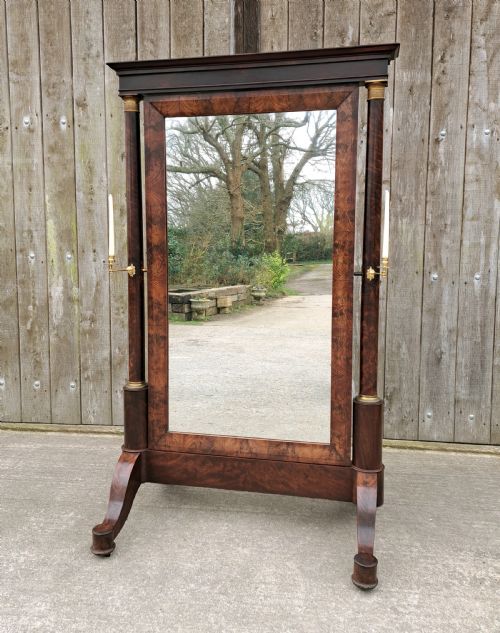
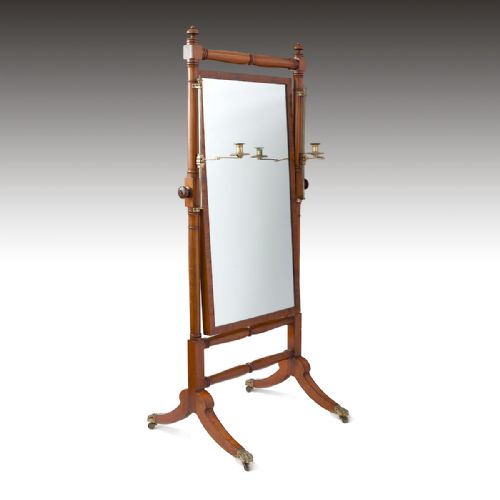
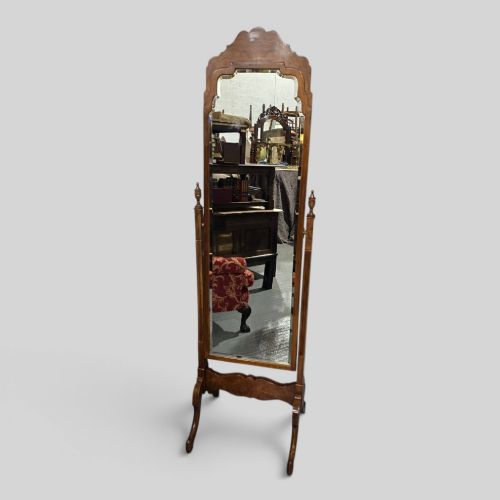
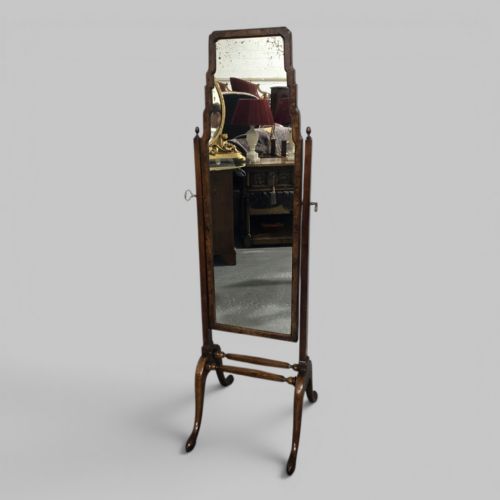





Georgian Style Cheval Glass
A georgian style cheval glass is a freestanding floor mirror designed for full-length reflection, offering adjustable swing movement that suits both period and modern bedrooms.
Georgian Style Cheval Glass
A georgian style cheval glass stands tall on a vertical frame, mounted on a sturdy floor-standing base with four legs or a trestle design. These mirrors allow the glass panel to tilt freely between upright posts, giving a full-length view for dressing.
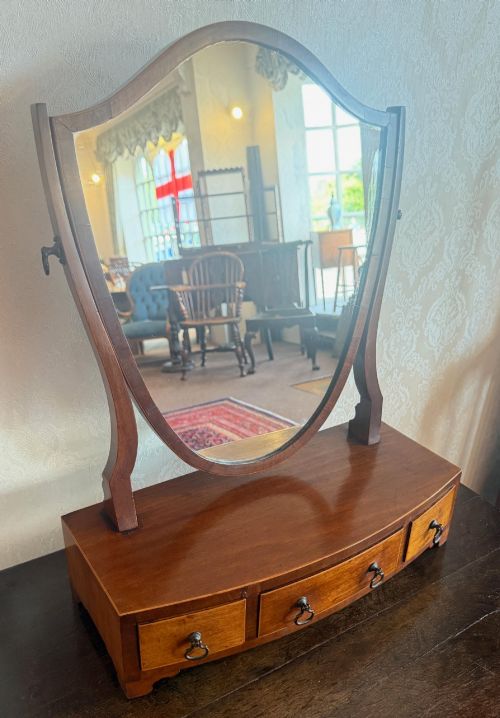
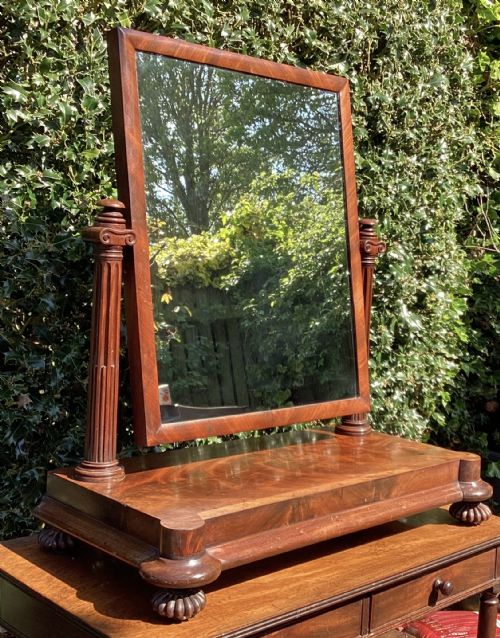
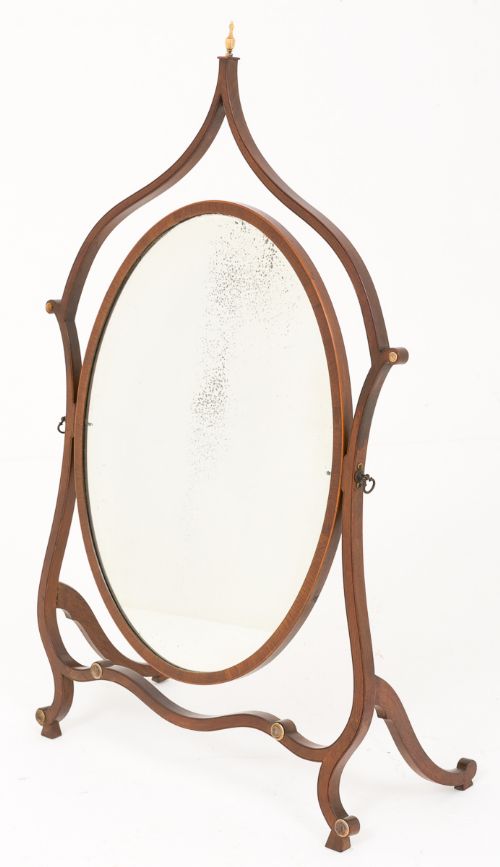
The pieces on this page span several eras and interpretations, ranging from genuine Regency and George III originals to later Victorian, Edwardian, and 1920s revivals. Mahogany remains the most common timber, often enriched with satinwood inlay, burr walnut, or Dutch marquetry.
Makers drew on established classical vocabularies, producing everything from simple swing frames to grand country house robing mirrors. Buyers frequently encounter both large freestanding cheval mirrors and smaller table-top dressing mirrors sharing similar stylistic traits.
How they were made
Cabinet makers utilised solid timbers such as mahogany and walnut, frequently applying fine veneers and decorative satinwood inlay to the main frame and base. Timber selection governed the overall weight and stability of the swinging mirror frame.
Brass fittings, including pivot screws, candle sconces, and decorative bracket mounts, allowed the mirror glass to tilt securely at various angles. Silvered mirror glass sat within rebated frames, backed by wooden panels to protect the reflective surface.
Listings feature mahogany, walnut, burr walnut, and satinwood inlay across pieces dated from the Georgian period through to the 1920s.
What varies in quality
Construction methods and timber selection set apart standard production pieces from fine workshop creations. Dense, well-figured mahogany and intricate marquetry demonstrate a higher standard of cabinet work than plain secondary woods.
The robustness of the pivoting mechanism and the quality of the original brass hardware determine how well the swinging frame holds its position over time. Proportion, balance, and clean joinery distinguish superior standing frames from heavier, less refined examples.
The Georgian Style Cheval Glass Glossary
- Cheval glass
- A large freestanding full-length mirror mounted on a pivoted frame. The word derives from the French for horse, referring to the four-legged support structure.
- Swing mirror
- A mirror plate hung on pivot screws between two upright posts. This mechanism allows the user to tilt the glass angle.
- Marquetry
- Decorative veneer work created by fitting together small pieces of different woods, shell, or ivory to form pictorial designs. It appears frequently on cabinet frames and dressing mirrors.
- Satinwood
- A durable, light yellow timber native to India and Ceylon, prized for its lustrous grain. Cabinet makers used it extensively for contrasting inlay work.
- Robing mirror
- A tall freestanding mirror designed specifically for viewing complete outfits. These larger variants often incorporate substantial wooden stands.
Georgian Style Cheval Glass: Frequently Asked Questions
How do I date a cheval glass?
Dating relies upon examining the secondary woods, construction joints, and the style of the base supports. Earlier pieces often display hand-cut joinery and native timbers, whereas revival pieces from later centuries mimic these historical traits.
Hardware details also offer clues, as original brass pivot screws and backboards differ significantly between the Georgian era and later Victorian or 1920s reproductions.
Are these mirrors heavy to move?
Solid mahogany and walnut frames with glass panels carry substantial weight and require two people to relocate safely. The central swing frame lifts out of most support stands to make moving easier.
Placing the mirror on a level floor ensures the standing base remains stable and prevents twisting in the vertical posts.
Can the mirror angle be adjusted?
Side pivot screws tighten or loosen by hand to control the resistance of the swinging mirror frame. This mechanism lets the glass stay fixed at the preferred viewing angle.
Regular use may cause the pivot fittings to loosen, requiring minor adjustment to keep the glass balanced.
What is the difference between a cheval and toilet mirror?
Cheval mirrors stand tall on the floor to provide a full-length reflection for dressing. Toilet mirrors are much smaller versions designed to sit on top of a dressing table or chest.
Both types utilise similar swinging frames and period stylistic details, but serve entirely different spatial requirements.