
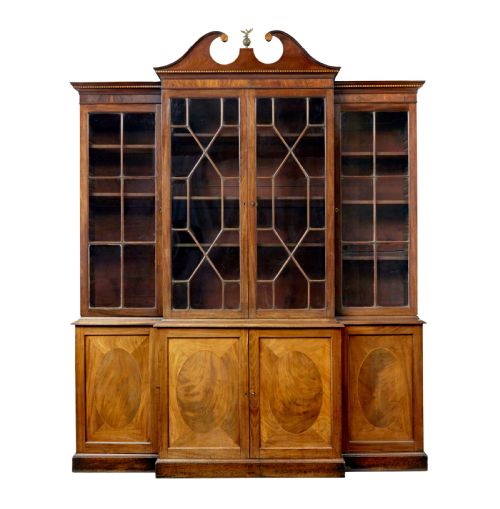


Georgian Style Breakfront Bookcase
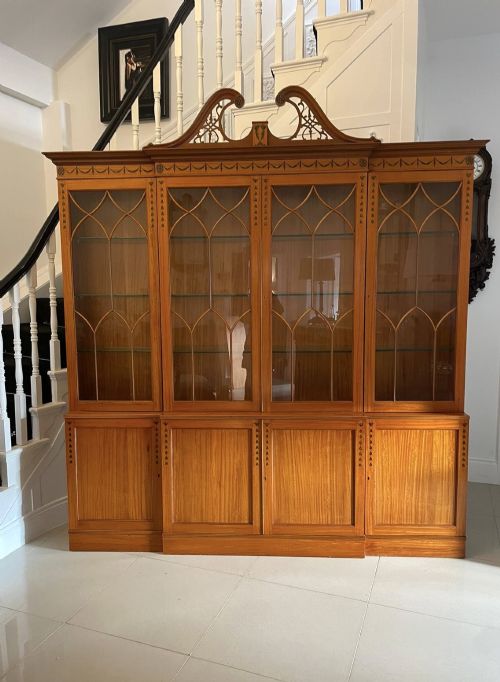
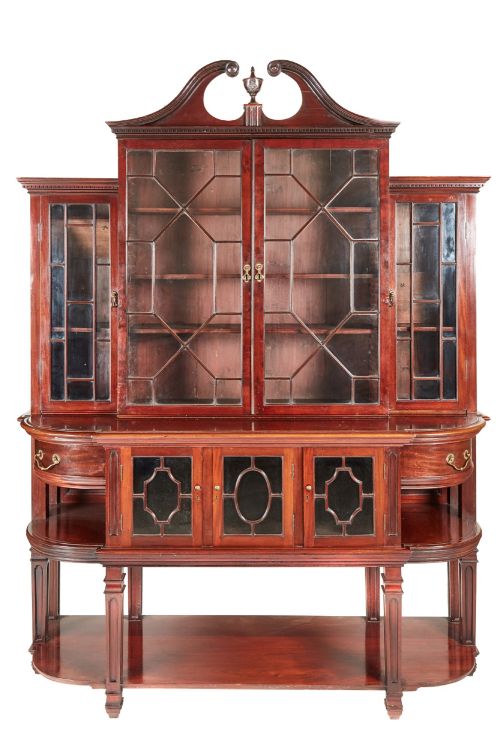
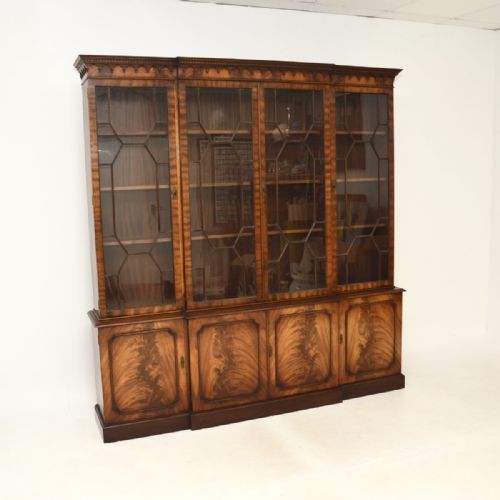
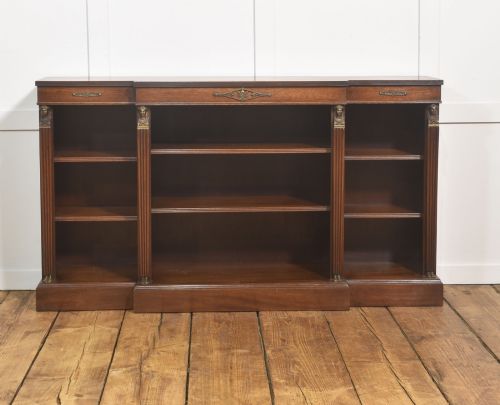
A georgian style breakfront bookcase is a grand architectural storage piece designed with a projecting centre section, offering commanding presence and refined display capacity.
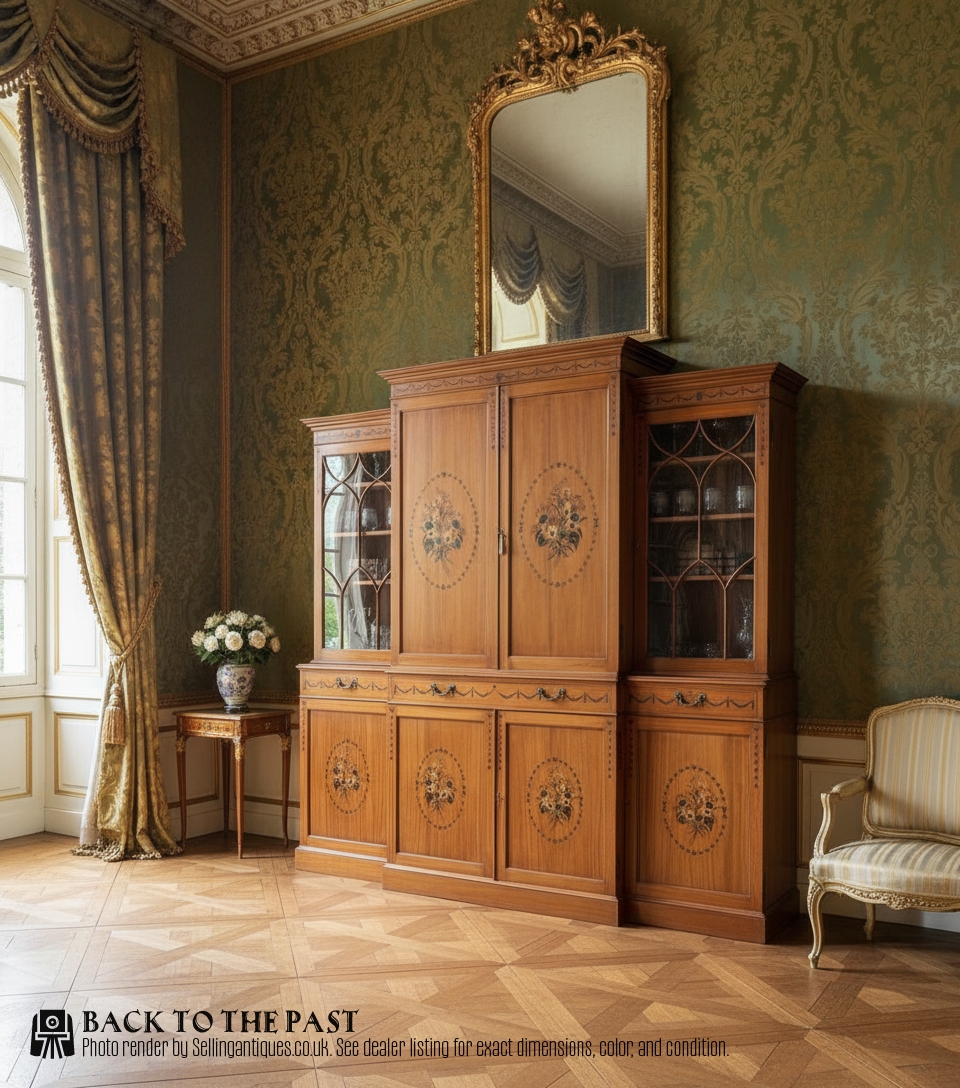
Georgian Style Breakfront Bookcase
A georgian style breakfront bookcase brings strong architectural proportions to a room, defined by a multi-section cabinet where the central section projects forward from the flanking wings. Most examples encountered here date from the nineteenth and early twentieth centuries, spanning Victorian, Edwardian, and revival periods.
The form functions primarily as a library or display piece, often combining glazed upper doors with panelled lower cupboards. Variations range from monumental timber library cabinets to diminutive satinwood display pieces and open shelving formats.
Makers drew heavily on earlier eighteenth-century designs, producing pieces that emulate Georgian, Regency, and Sheraton principles. Buyers will find significant stylistic crossover, with many late nineteenth and twentieth-century interpretations bearing classical astragal glazing and subtle string inlay.
Materials and construction
Mahogany serves as the primary timber across the majority of these pieces, frequently enhanced by figured flame mahogany veneers or intricate satinwood and brass detailing. Cabinetmakers utilised solid hardwoods for structural framing while applying choice veneers to large flat surfaces to create visual depth.
Glazing represents a major technical component, utilising individual wooden bars to form astragal patterns that hold numerous glass panes securely. Carved wooden ornamentation, hand-painted decorations, and parcel gilt highlights appear on select pieces, demonstrating diverse surface treatments employed by period workshops.
Georgian Style Breakfront Bookcase Retail Price Guide 2026
Typical asking prices for georgian style breakfront bookcase among the pieces listed under this phrase on Sellingantiques today, from the lower quarter to the upper quarter. They describe what is for sale here now, not the wider market.
Period assignments span from the eighteenth century through the Edwardian era and 1930s revival workshops.
Differentiating quality
The standard of timber selection and veneer matching defines the upper tier of these pieces, where cabinetmakers arranged grain patterns to achieve symmetrical balance across the expansive breakfront facade. Superior examples display crisp, finely carved mouldings and precise joinery that remains tight through decades of use.
Glass quality and glazing bar delicacy also separate workshop standards, with finer pieces featuring hand-drawn glass panes and slender, elegant astragal divisions rather than heavy, utilitarian framing.
Maple and Co·Edwards and Roberts
The Georgian Style Breakfront Bookcase Glossary
- Breakfront
- An architectural cabinet design where the central section projects forward from the two side sections.
- Astragal
- A moulding profile used to divide glass panes within a door frame into smaller geometric sections.
- Satinwood
- A durable, lustrous yellow timber utilised extensively for fine veneers and decorative inlay work.
- Flame Mahogany
- A highly figured wood veneer displaying characteristic flame-like patterns derived from branch forks.
Georgian Style Breakfront Bookcase: Frequently Asked Questions
What is a breakfront bookcase?
A breakfront bookcase is a large cabinet featuring a stepped facade where the middle section extends further forward than the left and right wings.
This architectural arrangement creates visual depth and helps break up the long horizontal line of a large library wall.
How do I date a bookcase?
Dating relies on examining the secondary timbers, construction methods, hardware, and stylistic revival markers present in the piece.
Earlier eighteenth-century origins contrast with nineteenth-century Victorian adaptations and later twentieth-century revival interpretations.
Are the shelves adjustable?
Many library bookcases incorporate adjustable shelving systems using traditional wooden rackwork or metal pins.
Older formats often feature fixed shelving built directly into the structural carcass to support heavy volumes.
How do I care for mahogany?
Mahogany requires stable room humidity away from direct heat sources to prevent timber movement and veneer splitting.
Regular dusting with a dry lint-free cloth and occasional application of appropriate wax preserves the polished surface sheen.