
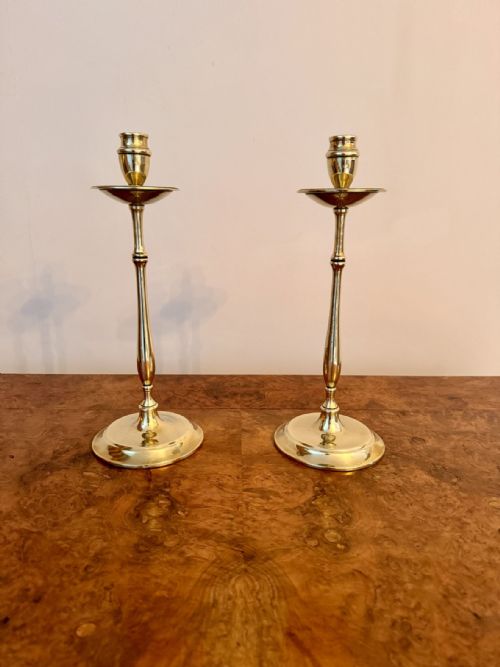
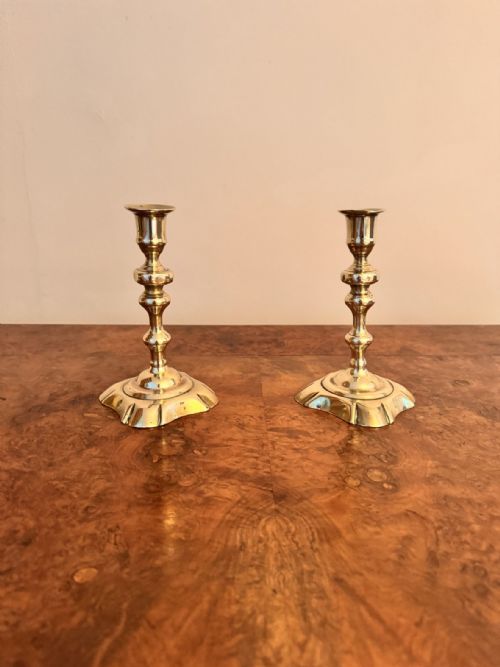


Georgian Style Brass Candlesticks
Georgian style brass candlesticks bring formal symmetry and warm metal tones to a room, offering the classic illumination of past centuries.
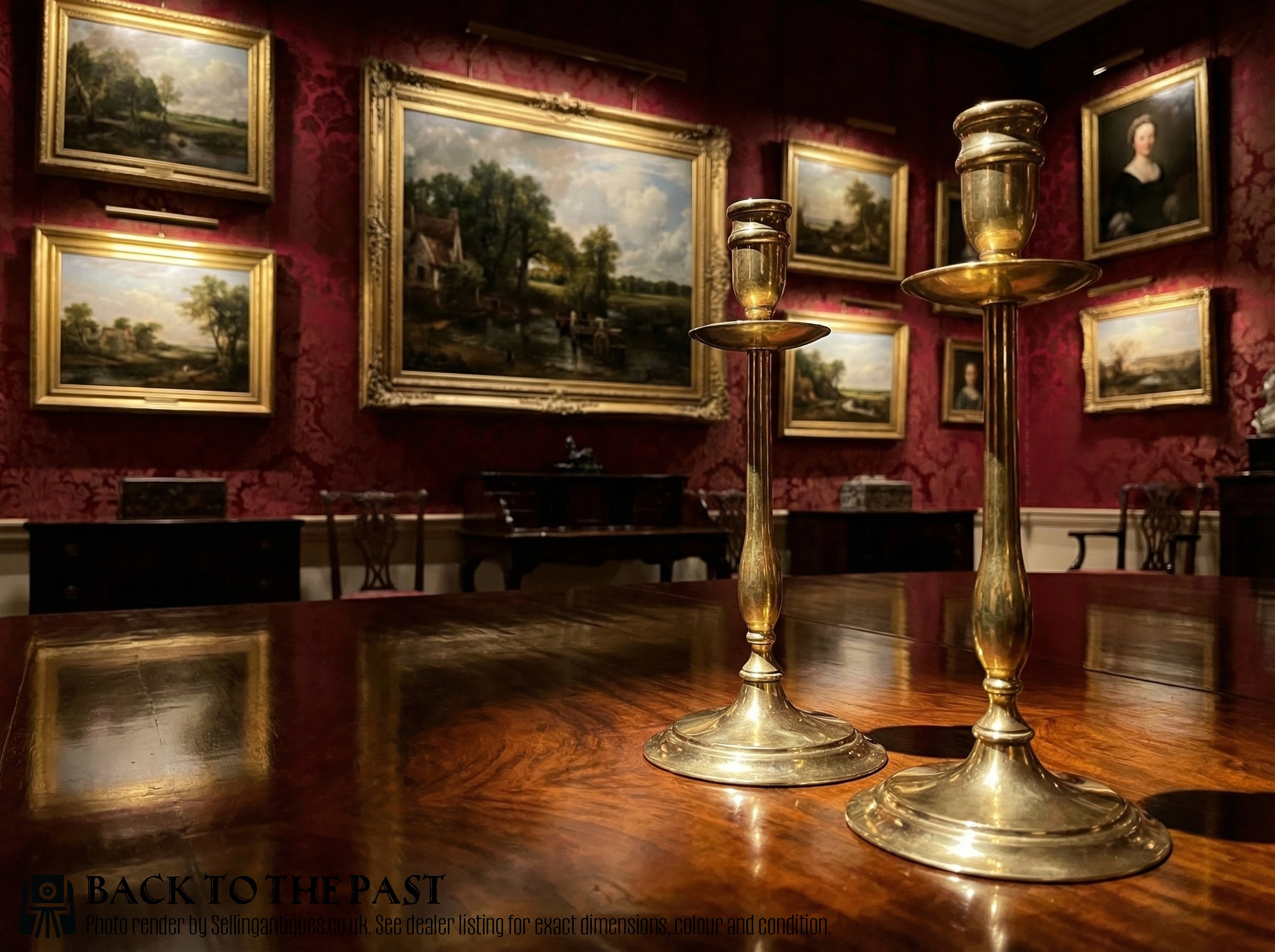
Georgian Style Brass Candlesticks
When you search for georgian style brass candlesticks, you look at pairs designed to hold tapers upon tables, surfaces and sideboards. The pieces on this page span the nineteenth century, the Edwardian era, and the Regency period, drawing on George III style and Adam's style.
Most examples you meet here take the form of paired candlesticks, though table lamps and mahogany hybrid forms also appear. These objects replicate the restrained elegance and formal proportions associated with eighteenth-century domestic lighting.
Makers and manufacturers produced these items in traditional brass and mixed them occasionally with mahogany to satisfy nineteenth-century and later demand for period revival interiors. They range from plain column designs to ornate cast versions with shaped bases.
How they were made
Foundry workers shaped these items primarily in brass, casting components individually before turning or finishing them by hand. The metal provides a durable and reflective body that develops a rich patina over decades of handling and cleaning.
Makers occasionally combined brass with mahogany, turning rich timber into shafts and columns while mounting brass sconces at the top to catch the dripping wax. This combination of wood and metal required precise carpentry and metalfitting to join the disparate materials securely.
Georgian Style Brass Candlesticks Retail Price Guide 2026
Typical asking prices for georgian style brass candlesticks among the pieces listed under this phrase on Sellingantiques today, from the lower quarter to the upper quarter. They describe what is for sale here now, not the wider market.
Listings feature items spanning the nineteenth century, Regency period, and Edwardian era, utilising both solid brass and mahogany.
What varies in quality
The distinction between ordinary and superior pairs rests on the crispness of the casting and the weight of the metal used. Heavier brass gives a solid presence on the table and allows for sharper mouldings along the base and column.
Design complexity also separates standard pieces from the finest examples, particularly where makers added ornate detailing or combined turned mahogany with quality brass sconces. Maker marks, such as those by J.T. & Co., indicate workshop provenance that elevates a pair beyond anonymous production.
J.T. & Co
The Georgian Style Brass Candlesticks Glossary
- Sconce
- The metal cup or nozzle at the top of a candlestick designed to catch melted wax and hold the taper steady. It is often removable for easier cleaning.
- Regency
- A British design period spanning the early nineteenth century defined by classical restraint, Greco-Roman influence, and clean architectural lines. Pieces from this era often feature refined classical proportions.
- Edwardian
- The period covering the reign of Edward VII, noted in these listings for the continued production of traditional revival brassware. Makers during this time frequently looked back to earlier Georgian aesthetics.
- George III style
- An aesthetic reflecting the furniture and decorative arts produced during the lengthy reign of George III, characterised by symmetry and neoclassical detail. Reproductions in this style were widely made in subsequent decades.
- Mahogany
- A dense tropical hardwood prized for its reddish-brown colour and fine grain, utilised alongside brass in several listed hybrid candlesticks and lamp bases.
Georgian Style Brass Candlesticks: Frequently Asked Questions
What are georgian style brass candlesticks?
These pieces are decorative lighting accessories modelled on the formal designs popular during the eighteenth century. They are typically encountered as matched pairs designed to hold wax tapers.
They reflect revival tastes from the nineteenth century and the Edwardian era, incorporating traditional brass casting techniques and occasionally mahogany elements.
How were they used?
People placed them on dining tables, mantelpieces, and sideboards to provide portable illumination before the invention of electric lighting. Servants carried them through hallways and bedchambers.
Today, buyers use them in domestic interiors to create ambient lighting and introduce historical character to a room.
How do you date them?
Dating relies on examining the manufacturing techniques, metal composition, and stylistic cues found across the piece. Stylistic markers include Regency proportions, Adam's style ornamentation, and George III revival forms.
Materials also help establish age, as nineteenth-century workshops blended traditional brass casting with turned mahogany shafts to create period-appropriate lighting.
How do you live with them?
Living with these objects involves displaying them on sideboards, mantels, or dining tables where their polished brass and warm mahogany tones can be appreciated. They require minimal upkeep beyond occasional dusting.
Many buyers pair them with matching tapers to recreate historical dining atmospheres or use adapted table lamp versions for everyday illumination.