

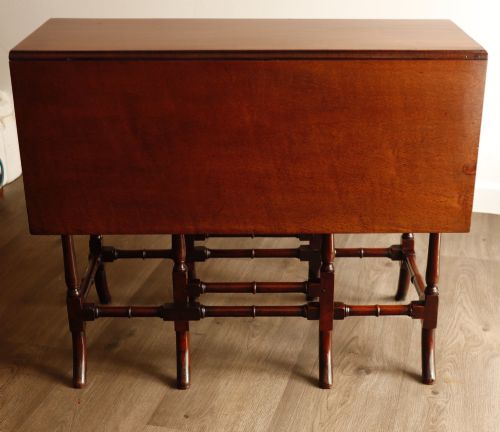
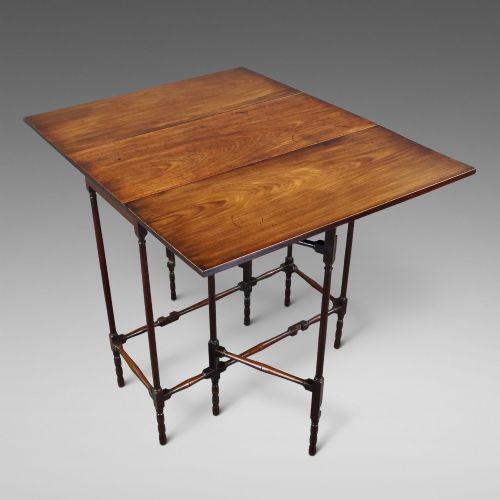


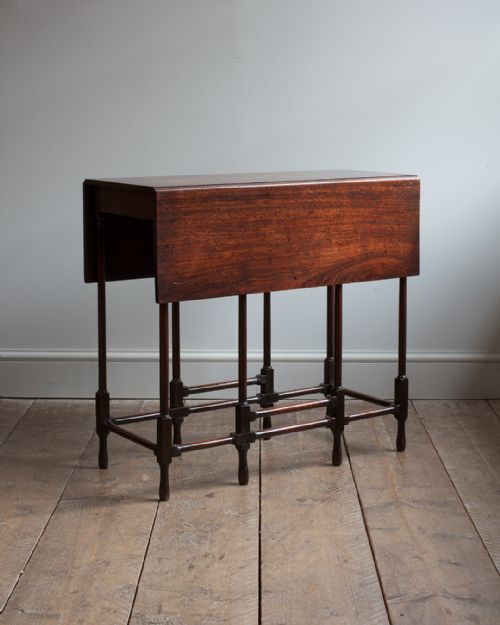


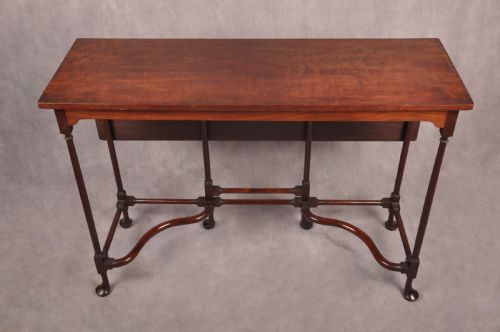


Georgian Spider Leg Side Table
A georgian spider leg side table offers slender grace and sturdy utility, prized for delicate turning and compact drop-leaf forms.
Georgian Spider Leg Side Table
A georgian spider leg side table is primarily encountered in mahogany from the eighteenth century, often taking the form of a drop leaf table, tea table, or occasional table. These lightweight pieces provide convenient surfaces without cluttering a room.
Most examples date to the eighteenth century or the George III and Chippendale periods, though later Edwardian revivals and Victorian pieces also appear. The distinctive slender supports give these tables their characteristic name.
How they were made
Makers utilised solid mahogany for its strength, allowing legs to be turned to extreme thinness while supporting the top. Brass hardware frequently appears on drop leaf mechanisms and hinges.
Joinery relied on traditional gateleg and drop-leaf engineering to permit the leaves to fold down neatly when not in use.
Despite having legs thinner than a broom handle, these little tables have survived centuries of tea parties.
What varies in quality
The refinement of the leg turnings dictates much of the visual appeal, separating simple utilitarian pieces from finer cabinet work. Crisp detailing in the woodwork and timber selection also mark the difference.
Proportion and stability matter greatly, as slender turned supports can suffer from wobble or improper repairs over centuries of use.
The Georgian Spider Leg Side Table Glossary
- Spider leg
- A term describing tables with exceptionally slender, delicate turned uprights and stretchers. This construction creates a light profile while maintaining structural support.
- Drop leaf
- A table top with hinged flaps that fold down to reduce the footprint. These sections are supported by swing-out legs or gates.
- Gateleg
- A table with hinged legs that swing outward to support the raised leaves. This framework provides stability for the folding flaps.
- Pembroke
- A small rectangular table featuring two hinged drop leaves on opposing sides. They often include a single drawer.
- Occasional table
- A small, movable table intended for specific, temporary use around a room. They serve various functions from tea serving to lamp placement.
Georgian Spider Leg Side Table: Frequently Asked Questions
What is a spider leg table?
A spider leg table is a slender, lightweight table characterised by very thin turned wooden legs and stretchers.
These pieces typically feature drop leaves, making them easy to fold and tuck away against a wall when not in use.
How were these tables used?
Original uses included serving tea, holding lamps, or providing a small temporary surface for writing and reading.
Their compact size allowed servants to move them easily around eighteenth-century drawing rooms.
Are all spider leg tables eighteenth century?
While many originate in the eighteenth century during the Georgian and Chippendale periods, Edwardian and Victorian makers also produced them.
Later examples often mimic earlier George III styling while using slightly different timber finishing techniques.
How do I care for mahogany?
Keep mahogany tables away from direct heat sources and strong sunlight to prevent the timber from drying out or fading.
Regular dusting with a soft cloth and occasional waxing help maintain the polished surface.