


Georgian Silver Candlestick Holders
Georgian silver candlestick holders bring illumination and classical proportion to a room, spanning pairs and suites designed for dining tables or writing desks.
Georgian Silver Candlestick Holders
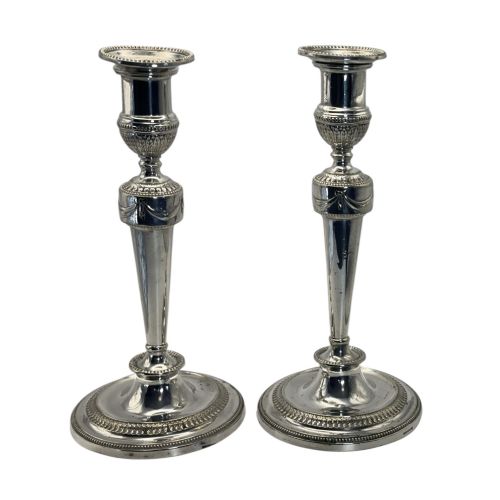
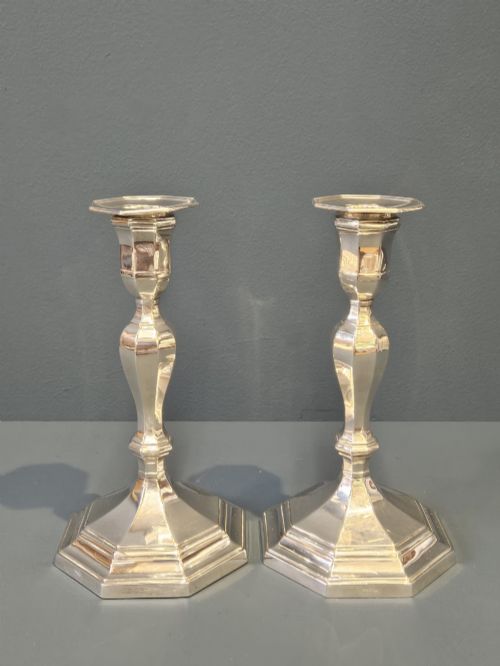
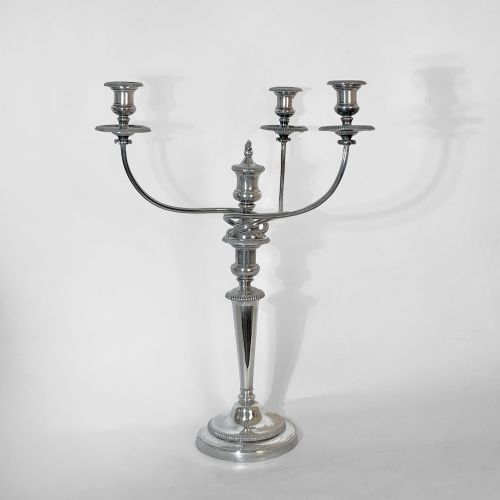
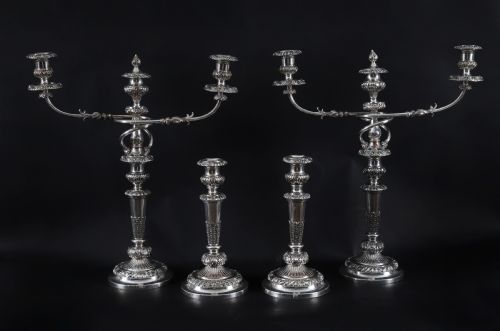
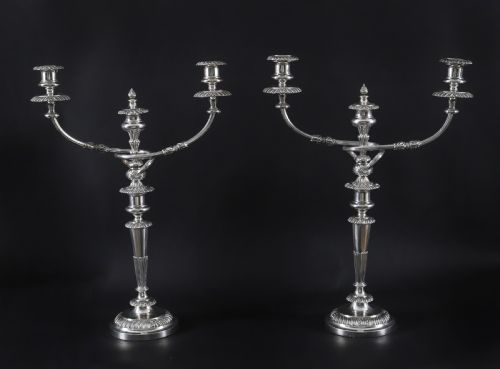
When you search for georgian silver candlestick holders, you encounter items designed for domestic lighting, spanning simple single-stem shafts to multi-light candelabra, chambersticks, and desk sets. The selection here leans heavily toward pairs formed in the eighteenth and nineteenth centuries, alongside later revivals mimicking earlier forms.
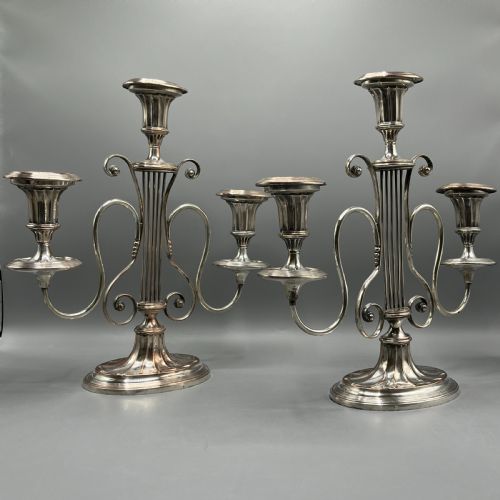
Makers utilised various configurations, from telescopic extending shafts to pieces fitted with removable sconces. Forms range from column designs and circular bases to lyre-shaped structures, reflecting the shifting domestic requirements for portable and table lighting over successive decades.
Materials and Construction
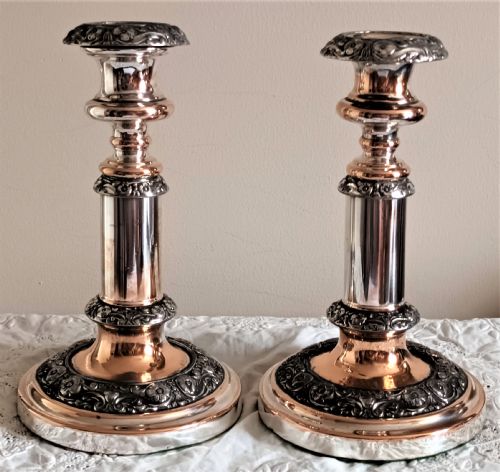
The material evidence on this page covers sterling silver, silver plate, Old Sheffield plate, copper, paktong, and bell metal. Old Sheffield plate involved fusing a thin layer of silver onto a copper core, a technique visible in many eighteenth- and nineteenth-century items.
Solid sterling examples display hallmarks indicating assay offices and dates, while plated or base metal pieces rely on the durability of their fused coatings and structural joints. Items often incorporate weighted bases or distinct internal components to provide stability for upright candles.
Listings feature items spanning the eighteenth century through to the 1960s, executed in sterling silver, Sheffield plate, copper, and paktong.
Design and Execution
Quality rests in the crispness of the chased or cast ornament, the integrity of the silver layer over base metals, and the balance of the proportions. Early examples by known silversmiths exhibit sharper detailing in neoclassical or rococo motifs compared to later mass-produced interpretations.
The survival of original components, such as detachable nozzle sconces or matching drip pans, distinguishes superior pieces from incomplete or heavily restored assemblies.
Matthew Boulton·John Cafe·Mappin & Webb·Marson & Jones·Thomas Bradbury & Sons Ltd·Barker Ellis·James Dixon & Sons
The Georgian Silver Candlestick Holders Glossary
- Old Sheffield plate
- A composite material made by fusing a thin sheet of silver to a thick copper ingot under heat. This method creates characteristic warm tones where the base metal shows through wear.
- Candelabra
- A branched lighting fixture holding multiple candles upon a single central shaft. These often feature detachable arms allowing conversion back to standard candlesticks.
- Chamberstick
- A low, portable candlestick fitted with a handle and a small drip pan saucer. These were carried around houses before electric lighting.
- Sconce
- The detachable top nozzle inserted into the socket of a candlestick to catch melting wax. Original matching pairs retain these vulnerable components.
- Paktong
- A copper, nickel, and zinc alloy originating from China, utilised in the eighteenth century for casting heavy metal candlesticks with a bright metallic sheen.
Georgian Silver Candlestick Holders: Frequently Asked Questions
What is Old Sheffield plate?
Old Sheffield plate is an early fusing technique where a sheet of silver is bonded to a copper core rather than deposited by electricity. This creates a distinct material structure visible on edges and underside joins.
Items made this way date predominantly to the eighteenth and early nineteenth centuries before electroplating took over.
How do I spot telescopic candlesticks?
Telescopic candlesticks feature sliding inner shafts designed to adjust the overall height of the holder for different settings. You operate them by gently pulling the upper section upward.
This mechanism required precise engineering to hold position securely without slipping during use.
What are chambersticks used for?
Chambersticks served as portable bedroom lights, featuring a low saucer base to catch wax and a loop handle for carrying. They often included a small conical extinguisher resting in the tray.
Households used them for navigating dark corridors before retiring for the evening.
Are removable sconces important?
Removable sconces are the small insert cups sitting at the top of the socket to catch dripping wax. Finding them intact adds significantly to the completeness of an antique piece.
Many lost these detachable parts over centuries of cleaning and polishing.