
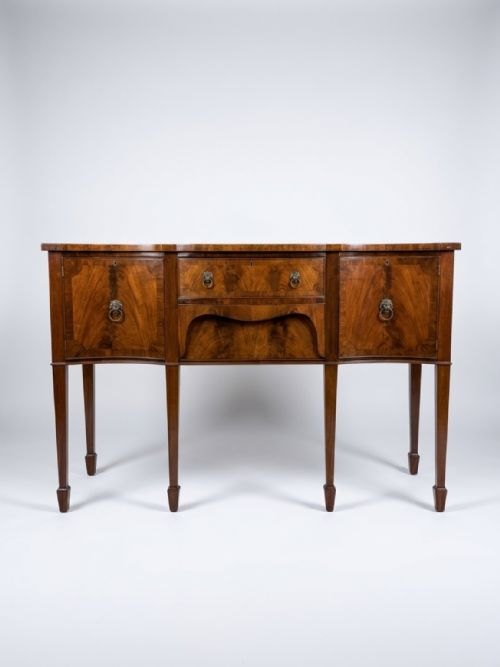
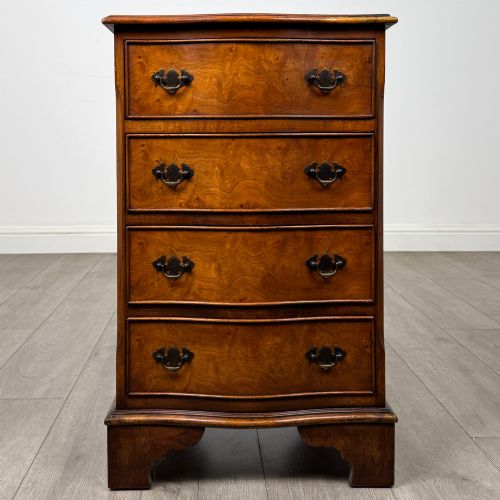
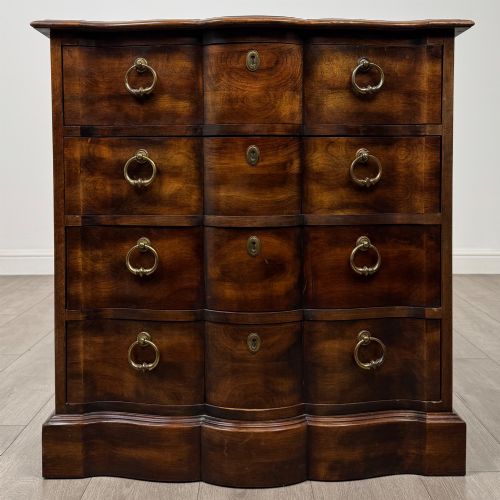
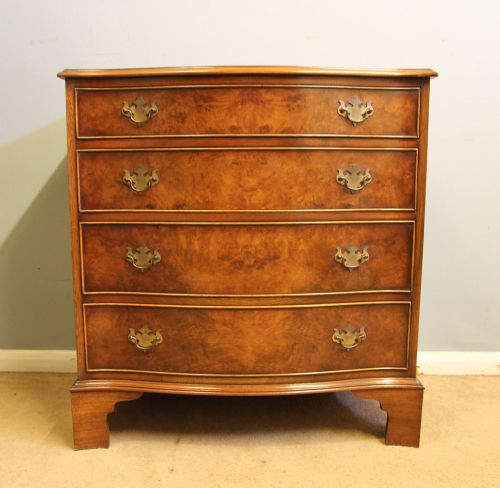

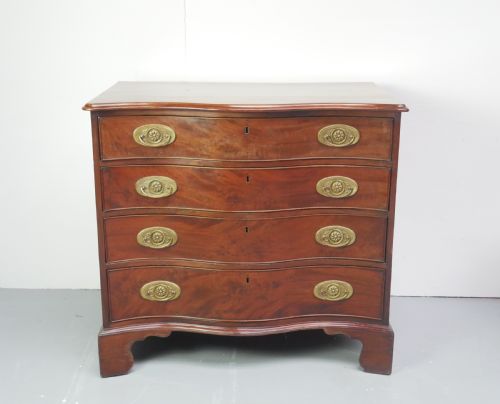

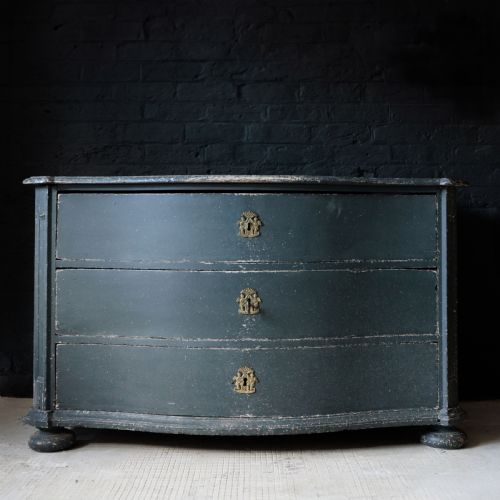
Georgian Serpentine Front Dresser
A georgian serpentine front dresser brings together curved cabinetwork and figured timbers from the eighteenth century and later revivals.
Georgian Serpentine Front Dresser
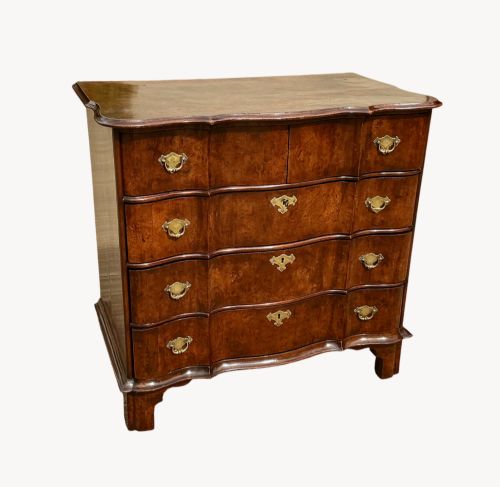
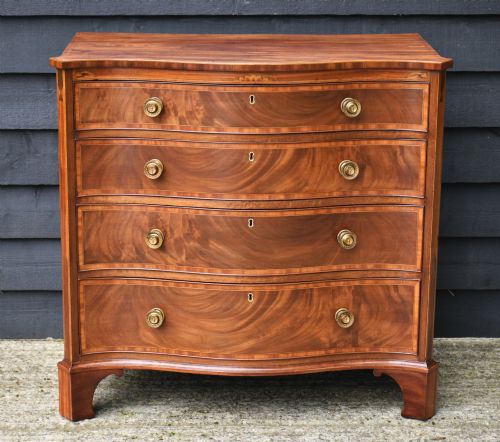
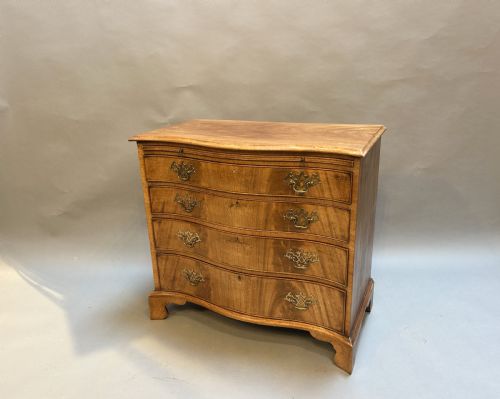
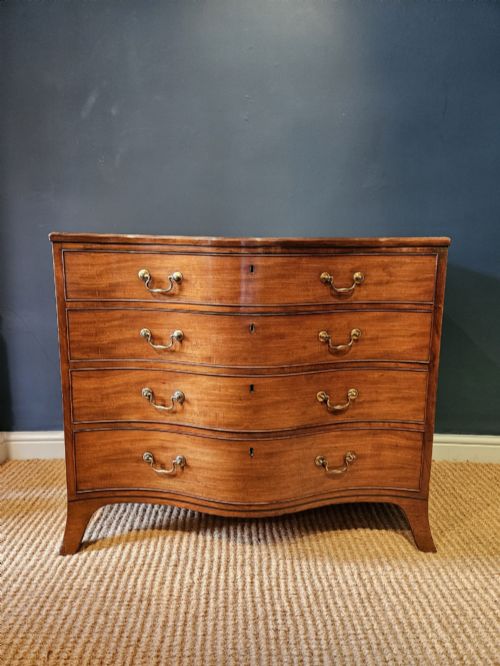
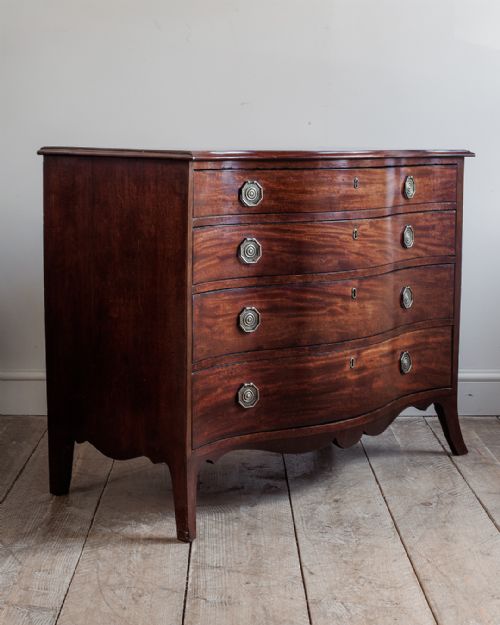
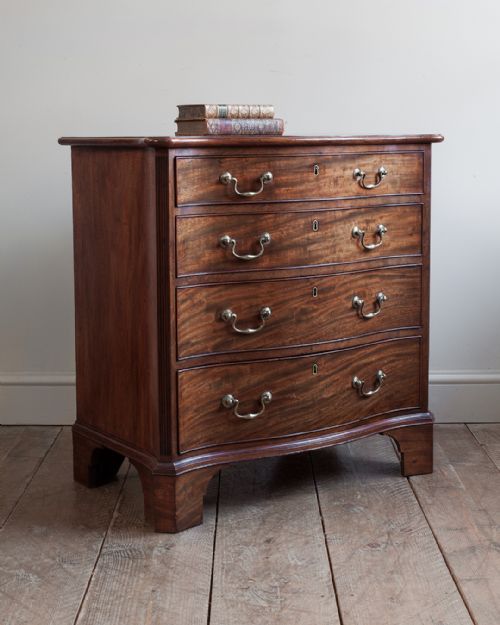
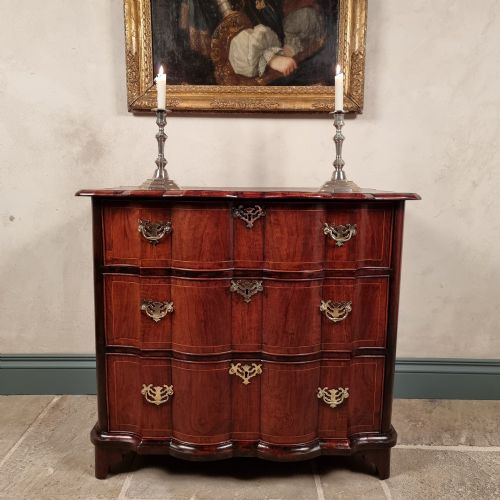
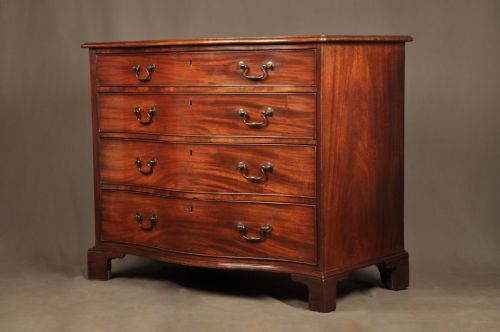
A georgian serpentine front dresser typically takes the form of a chest of drawers or sideboard shaped with a convex centre flanked by concave curves. The pieces gathered under this description span genuine eighteenth-century examples from the Georgian and George III periods alongside later Edwardian and twentieth-century revivals.
Makers working in these styles built chests with four graduated drawers, commodes, and larger dining room sideboards. Timber choice ranges from plain and figured mahogany to burr walnut, satinwood, and Dutch elm.
Period examples sit alongside pieces labelled as Georgian style, George III style, and Chippendale style. Buyers meet both grand proportions intended for formal reception rooms and smaller bedroom chests.
Materials and construction methods
Cabinetmakers constructed these pieces primarily using solid and veneered mahogany, burr walnut, and oak, frequently adding boxwood inlay and marquetry for surface ornament. The curving serpentine facade required careful timber selection so that grain patterns followed the complex contours without splitting.
Drawer fronts were shaped from thick timber or built up with veneers laid over secondary woods, fitted with brass handles and escutcheons. Joinery relied on traditional hand-cut dovetails for the drawer construction and sturdy carcases designed to support heavy figured top boards.
Some cabinetmakers even coaxed stubborn Dutch elm into flowing serpentine curves.
Distinguishing quality in curved cabinetry
The standard of a piece rests upon the crispness of the curved serpentine moulding and the symmetry of the wood grain across the drawer fronts. Superior examples display carefully matched figured mahogany or burr walnut that wraps continuously across the facade.
Internal construction, including the dovetailing of the drawer linings and the retention of original brass hardware, separates master cabinetwork from later commercial reproductions. The thickness and depth of the secondary timbers used inside the carcase also signal the level of workshop care.
The Georgian Serpentine Front Dresser Glossary
- Serpentine
- A front contour characterised by a convex central section flanked by two concave curves. This shaping demands advanced cabinetmaking skill to execute cleanly in solid timber or veneer.
- Commode
- A decorative set of drawers or a low cabinet, frequently used in eighteenth-century formal interiors. The term often describes French or Dutch influenced serpentine pieces.
- Marquetry
- Decorative patterns formed by inserting thin pieces of wood, ivory, or shell into a veneered surface. It appears on satinwood and walnut revival pieces.
- Fiddleback
- A type of figured mahogany with a wavy grain resembling the wood used for the back of a violin. This figuring creates an optical shimmer under light.
- Dovetail
- A joint formed by interlocking wedge-shaped fingers, used to connect drawer sides to drawer fronts. Hand-cut dovetails indicate traditional pre-industrial construction.
Georgian Serpentine Front Dresser: Frequently Asked Questions
Where should I place a serpentine chest?
These pieces suit entrance halls, bedrooms, and drawing rooms where the curved front adds visual movement to flat walls. Their finished sides and backs generally allow them to stand against principal walls rather than tightly enclosed corners.
Because the top surface offers useful display space, they work well beneath mirrors or artwork. Measure the clearance around the drawers carefully so the curved pulls do not obstruct adjacent furniture.
How do I spot an eighteenth-century original?
Examine the secondary woods inside the drawers, such as oak or pine, alongside the hand-cut dovetails and timber shrinkage patterns. Eighteenth-century pieces exhibit natural oxidation and timber movement appropriate to age.
Revival pieces from the Edwardian or later twentieth-century periods often feature more uniform machine-sawn components and brighter internal finishes. Comparing the timber grain continuity across the curved drawer fronts also reveals the period of manufacture.
How do I care for mahogany and walnut veneers?
Keep these items away from direct sunlight and heat sources to prevent the burr walnut or mahogany veneers from drying and lifting. Dust them regularly with a dry cloth and apply occasional specialist wax.
Avoid excessive moisture and heavy chemical polishes that can degrade nineteenth-century or earlier french polish surfaces. Proper indoor humidity levels protect both the solid carcase and the delicate marquetry inlay.
What is the difference between a chest and a sideboard?
Chests of drawers generally provide taller storage with three to four graduated drawers intended for clothing and linens. Sideboards are longer and lower formats designed primarily for dining rooms to hold serving ware.
Both categories utilise the serpentine front profile, but sideboards often incorporate cupboards or larger proportions suited to entertaining.