



Georgian Satinwood Caddy
A georgian satinwood caddy brings luminous golden timber and refined neoclassical geometry into a room, designed to store valuable tea securely.
Georgian Satinwood Caddy
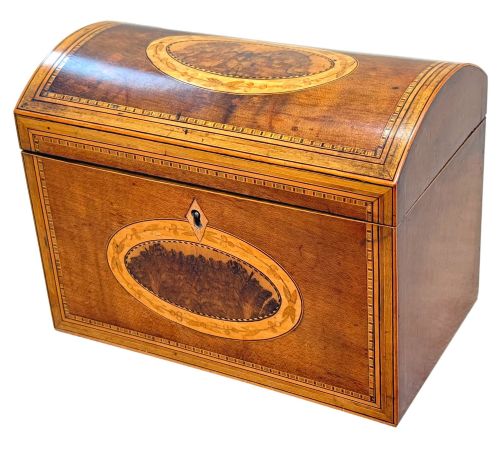
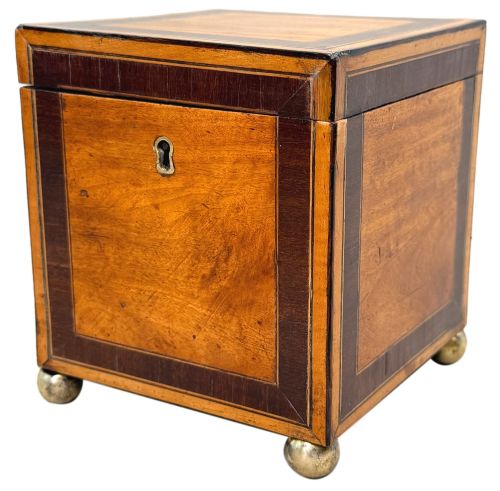
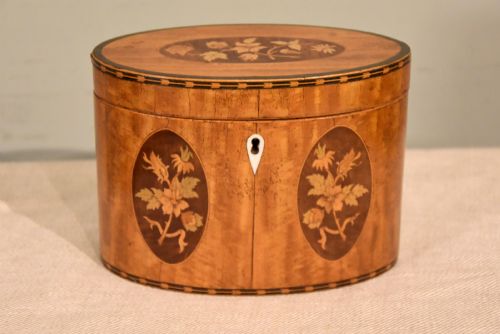
A georgian satinwood caddy takes several distinct geometric shapes, with oval, octagonal and rectangular boxes dominating the selection alongside occasional sarcophagus forms. These pieces originated during the eighteenth and early nineteenth centuries when tea was an expensive commodity requiring secure storage under lock and key.
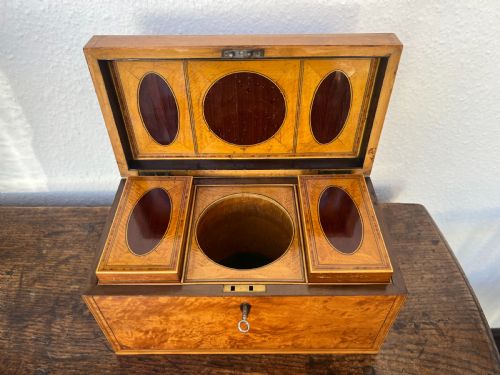
The version most commonly encountered on this page is the George III oval or octagonal tea caddy, frequently decorated with contrasting wood inlay or shell motifs. Makers constructed these lidded boxes to sit on the dining table or sideboard, sometimes incorporating internal compartments or original glass mixing bowls.
Beyond standard tea storage, related forms appear in the listings including larger decorative boxes, needlework chests, stationery boxes and occasional furniture pieces like cheverets or small chests of drawers utilising the same timbers.
Quality and Construction
The distinction between ordinary and superior pieces rests upon the selection of the satinwood veneer and the precision of the marquetry work. Finer examples display deeply figured, chatoyant timber matched symmetrically across the lid and panels, accompanied by crisp, finely executed shell or butterfly inlays without gaps or filler.
Original interior fittings elevate a piece significantly, particularly surviving compartment lids, bone escutcheons, and original glass mixing bowls or mixing sticks. The integrity of the construction, including tight mitred joints and the presence of working locks with original keys, separates standard utilitarian boxes from superior cabinetmaking.
Georgian Satinwood Caddy Retail Price Guide 2026
Typical asking prices for georgian satinwood caddy among the pieces listed under this phrase on Sellingantiques today, from the lower quarter to the upper quarter. They describe what is for sale here now, not the wider market.
Listings demonstrate that satinwood caddies frequently incorporate contrasting woods such as ebony, harewood, mahogany and boxwood for decorative stringing and inlaid panels.
The Georgian Satinwood Caddy Glossary
- Satinwood
- A lustrous, hard timber native to Ceylon and the West Indies, highly prized in the eighteenth century for its golden colour and reflective grain. It takes a high polish and serves as the primary veneer for neoclassical furniture and decorative boxes.
- Harewood
- Sycamore timber that has been stained grey using chemical processes, creating a cool, greenish-brown tone. It appears frequently in Sheraton period marquetry alongside satinwood for tonal contrast.
- Marquetry
- The art of forming decorative patterns by fitting together thin veneers of various coloured woods. Craftsmen cut these complex pictorial designs to adorn the lids and fronts of tea caddies.
- Stringing
- Thin lines of contrasting wood inlay set into channels around the edges of panels or drawers. This linear detailing defines the geometric boundaries on federal and Georgian case pieces.
- Teapoy
- A small stand or table fitted with a caddy or internal canisters for holding tea. These pieces often feature a central pillar supported by tripod legs.
Georgian Satinwood Caddy: Frequently Asked Questions
How do I date a satinwood box?
Dating relies on examining the construction methods, carcass timbers, and prevailing design styles such as Sheraton neoclassical or Regency sarcophagus forms. Eighteenth-century pieces typically feature hand-cut dovetails, secondary softwoods like pine, and delicate shell or butterfly marquetry.
Later Victorian and Edwardian revivals often display machine-sawn elements, heavier brass hardware, or different interior lining materials.
How were tea caddies used?
In the eighteenth century, tea was a costly luxury strictly controlled by the head of the household. The caddy remained locked on the sideboard, and the homeowner measured out the leaves for each sitting.
The central mixing bowl, when present, served to blend different teas or dilute the brew with water before serving.
How do I care for satinwood furniture?
Satinwood requires stable indoor humidity away from direct sunlight, which can fade the golden tones and dry out the underlying veneer. Regular dusting with a soft, dry cloth maintains the surface.
Occasional applications of microcrystalline wax help protect the polish without building up sticky residues or darkening the pale grain.