





Georgian Revival Tray
These georgian revival tray pieces bridge classic eighteenth-century forms with Edwardian and later craftsmanship, offering practical surfaces built for modern rooms.
Georgian Revival Tray
When you search for georgian revival tray, you encounter serving trays, butlers trays, and tray-top tables produced during the Edwardian era and the early twentieth century. These items emulate the proportions and ornamentation of earlier centuries while serving contemporary domestic needs.
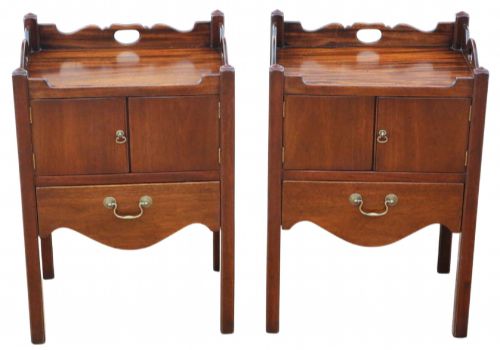
The selection here encompasses standalone serving platters as well as sturdy tray tables on stands, alongside related occasional furniture such as bedside cabinets and side tables finished in the Georgian style.
How they were made
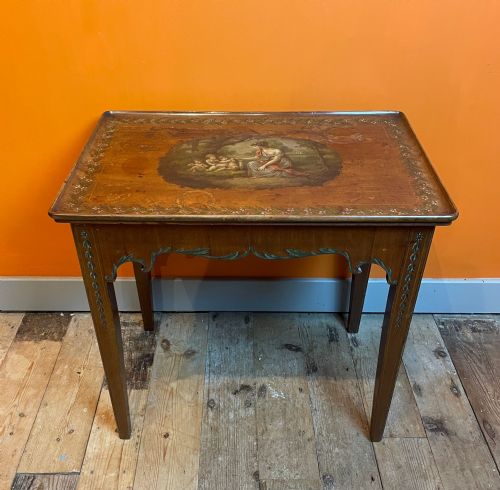
Cabinetmakers utilised rich timber veneers including mahogany, walnut, and satinwood, often applying intricate marquetry and hand-painted detailing to achieve the desired Neo-Classical aesthetic.
Metal elements incorporate cast brass handles and mounts, alongside silver plate and copper, while traditional joinery secures the raised edges and gallery rails characteristic of the form.
Mahogany and satinwood appear frequently across these listings alongside hand-painted detailing.
What varies in quality
The distinction between standard utility items and finer examples rests upon the crispness of the cabinetwork and the selection of timber veneers. Superior pieces display thoughtful grain matching and tightly fitted joints along the tray borders.
Decorative treatment also separates the grades, where hand-painted Neo-Classical scenes or precise marquetry inlays demonstrate greater artisan skill than simpler, unadorned surfaces.
The Georgian Revival Tray Glossary
- Georgian Revival
- A design movement looking back to the eighteenth-century reigns of the Georges for inspiration. Makers adopted classic proportions and ornament for twentieth-century homes.
- Butlers Tray
- A portable serving surface featuring raised folding sides, frequently mounted on a folding wooden stand. It allowed domestic staff to transport refreshments easily between rooms.
- Salver
- A flat metal plate or tray used for serving drinks or presenting cards. These pieces often rest on small feet and show silver plate over a base metal.
- Marquetry
- The art of applying thin slices of wood veneer to a structure to form decorative patterns. Craftsmen combined contrasting timbers like satinwood and walnut to create pictorial designs.
Georgian Revival Tray: Frequently Asked Questions
What is a georgian revival tray?
A georgian revival tray is a serving piece or tray-top table manufactured well after the original eighteenth-century period, typically during the Edwardian era or the early twentieth century. These pieces adopt the classic forms, timbers, and decorative motifs of earlier decades.
They function as both decorative accessories and practical furniture, appearing as standalone servers or mounted upon dedicated wooden stands for use as coffee tables or side tables.
How do I use a butlers tray table?
A butlers tray table pairs a removable wooden tray with a folding X-frame stand, designed originally for easy storage and transport. In modern spaces, these serve effectively as low occasional tables or compact coffee tables.
The raised edges prevent items from sliding off, making them practical for holding drinks, books, or decorative objects while adding historic character to a room.
What materials are common in these trays?
Timbers such as mahogany, walnut, and satinwood form the primary structure of wooden trays and tray tables. Makers frequently enhanced these woods with marquetry inlays, painted Neo-Classical scenes, or hand-painted detailing.
Metal versions utilise brass, copper, and silver plate, particularly on salvers and serving platters designed for display or formal entertaining.
How do I date an Edwardian tray?
Dating these items relies on examining the timber construction, secondary woods, and hardware style. Edwardian and early twentieth-century pieces often combine machine-prepared lumber with hand-finished decorative veneers.
Comparing the specific revival style, such as Chippendale or Sheraton influences, against known production periods helps narrow down the decade of manufacture.