

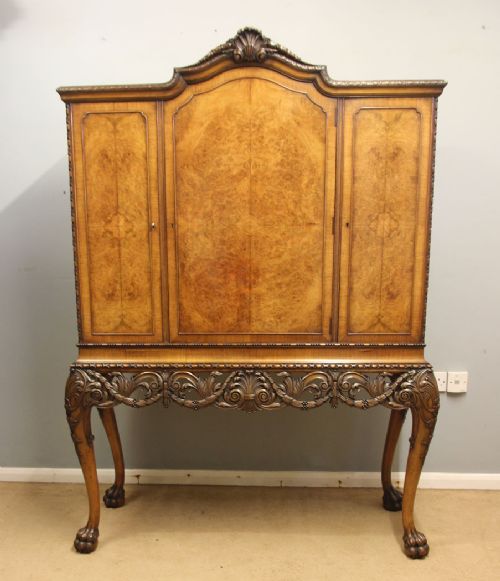
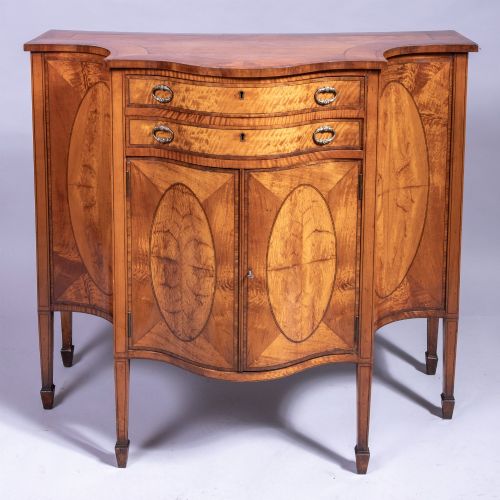
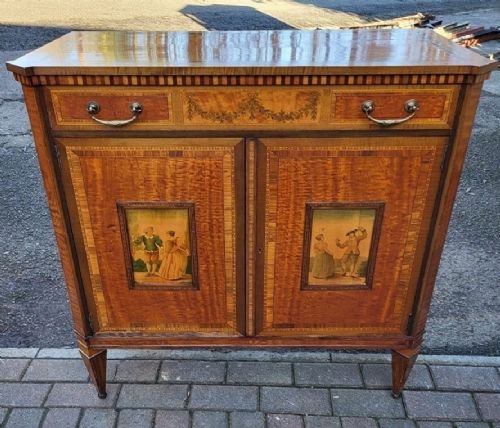


Georgian Revival Side Cabinet
A georgian revival side cabinet brings classical proportions and figured timbers to a room without the heavier scale of earlier centuries.
Georgian Revival Side Cabinet
A georgian revival side cabinet takes its design cues from eighteenth-century originals while suiting the room layouts of the nineteenth and early twentieth centuries. These pieces appear in forms ranging from compact bedside units to serpentine-fronted display cabinets and larger three-door side cabinets.
The selections recorded here span periods from the early nineteenth century through to the Edwardian era and the nineteen-twenties. Revival styles mirror earlier tastes such as Sheraton, Chippendale, Adam, and Gothic, reinterpreted by later cabinet makers.
Buyers frequently encounter satinwood and mahogany versions alongside walnut and burr walnut examples. Many incorporate glazed doors, brass mounts, hand-painted detailing, or inlaid stringing to echo the refinement of the georgian period.
How they were made
Makers utilised solid timbers alongside finely figured veneers, laying flame mahogany and burr walnut across panelled doors and curved fronts. These veneers were selected for grain pattern and book-matched to create symmetrical decorative surfaces.
Inlay and stringing work employed contrasting woods like satinwood, boxwood, and ebony, occasionally accompanied by hand-painted motifs. Brass hardware, from drop handles to escutcheons, was fitted to drawers and cabinet doors.
Construction methods relied on traditional joinery techniques, ensuring stability for carcases that often featured complex serpentine or demi-lune curves.
Listings demonstrate a preference for satinwood and mahogany timbers, paired with revival styles referencing Sheraton, Adam, and Chippendale aesthetics.
What varies in quality
The quality of a piece rests principally on the choice of timber and the precision of its veneers. Highly figured burr walnut or carefully selected satinwood elevate a cabinet, particularly when the grain flows continuously across drawer fronts and doors.
Execution of decorative details marks the distinction between standard production and superior craftsmanship. Hand-painted flourishes, crisp stringing inlay, and substantial brass mounts demonstrate a higher standard of workshop output.
Proportion and structural integrity dictate the overall success of the piece. Cabinets that retain their original feet, glass panes, and locks demonstrate greater fidelity to the period they emulate.
Maple and Co
The Georgian Revival Side Cabinet Glossary
- Satinwood
- A hard, durable timber with a natural golden sheen that takes a fine polish. It was frequently used for marquetry and as a primary veneer in revival furniture.
- Serpentine front
- A cabinet front featuring a concave centre flanked by two convex ends, or the reverse. This curved profile requires considerable skill in veneering and joinery.
- Stringing
- Narrow lines of contrasting wood inlaid flush into the surface of a panel or drawer front. It outlines geometric shapes and panels to frame the primary timber.
- Demi-lune
- Half-moon in shape, describing tables and cabinets with a flat back and a curved front. These pieces fit neatly against a wall.
- Marquetry
- Decorative patterns formed by fitting together small pieces of veneer into wooden panels. It permits elaborate floral or geometric designs.
Georgian Revival Side Cabinet: Frequently Asked Questions
What is a georgian revival side cabinet?
A georgian revival side cabinet is a piece of furniture made in the nineteenth or twentieth century that adopts the architectural lines, veneers, and decorative motifs of eighteenth-century English design. These cabinets were built to serve practical storage and display functions in domestic interiors.
They draw on specific historical aesthetics, including the work associated with Thomas Chippendale, George Hepplewhite, and Robert Adam, adapted to suit contemporary room proportions.
How do I tell different revival styles apart?
Revival styles are distinguished by their decorative vocabulary and cabinetwork details. Sheraton and Adam revivals frequently employ satinwood, delicate painted panels, and symmetrical inlay, whereas Chippendale revivals often favour solid mahogany with carved mouldings and bracket feet.
Gothic revival pieces incorporate pointed arch motifs and tracery within the glazing bars of the cabinet doors.
Where were these cabinets placed in a home?
These cabinets served multiple rooms depending on their scale and form. Larger three-door or serpentine cabinets stood in dining rooms and drawing rooms to hold china, linen, or silver.
Smaller bedside cabinets and tray-top tables were designed for bedrooms, providing enclosed storage alongside sleeping quarters.
How do I care for inlaid and veneered surfaces?
Inlaid and veneered cabinets benefit from stable indoor environments away from direct sunlight and strong heat sources. Maintaining consistent humidity prevents the wood beneath from expanding and causing lifting in delicate stringing or veneer.
Regular dusting with a soft, dry cloth preserves the polish without introducing moisture to sensitive joints.