



Georgian Revival Dining Table
A georgian revival dining table brings the architectural symmetry and refined timberwork of the eighteenth century into a larger modern room.
Georgian Revival Dining Table
The search phrase georgian revival dining table directs attention towards nineteenth and early twentieth-century interpretations of earlier classical forms. These pieces look back to the proportions and decorative vocabulary associated with Georgian design, often drawing specific inspiration from Sheraton or Regency styles.
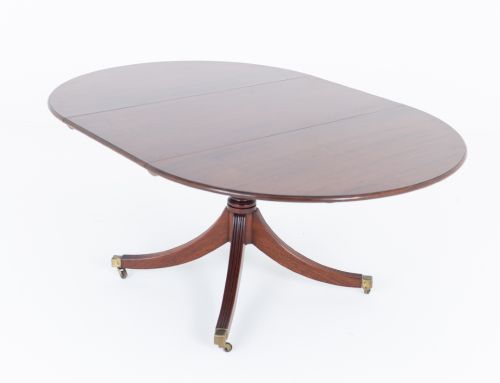
The versions most commonly met on this page date from the late nineteenth century through to the Edwardian period and the 1920s. They typically take the form of pedestal tables or extending dining tables constructed in mahogany, reflecting the revivalist enthusiasm of their respective decades.
Materials and construction
Construction relies heavily on solid mahogany and mahogany veneers, selected for strength and deep reddish-brown grain. Workshops frequently incorporated contrasting timbers such as satinwood and boxwood for inlay work, alongside subtle cross-banding to frame table tops and board edges.
Pedestal formats utilise solid timber columns supported by splayed legs, occasionally fitted with brass castors to allow smooth movement. Joinery techniques from the period ensure stability across large extending surfaces while maintaining slender profiles.
Several tables come with hidden mechanisms designed to expand dining capacity quietly before guests arrive.
Distinctions in quality
Quality reveals itself in the selection of timber figures and the crispness of any inlay work. Finer examples display carefully matched grain patterns across extending leaves and meticulously cut cross-banding that follows the contours of the timber.
The weight and stability of the pedestal bases, together with the precision of the mechanical extension systems, set apart standard production from more ambitious cabinet work. Attention to detail in the edge moulding and the finish of the timber indicates the standard of the original workshop.
Waring and Gillow·Howard And Sons·Waring
The Georgian Revival Dining Table Glossary
- Cross-banding
- A narrow strip of veneer laid across the grain of the main surface to form a contrasting border. This technique frames the top of a table and adds visual depth.
- Pedestal table
- A table supported by one or more central columns rather than four corner legs. This configuration allows greater legroom for diners seated around the perimeter.
- Sheraton revival
- A design movement drawing inspiration from the late eighteenth-century furniture maker Thomas Sheraton. It is characterised by restrained classical ornament, satinwood inlay, and tapered legs.
- Extending table
- A dining table designed with a mechanism and removable leaves to increase its overall length. This allows the surface to accommodate larger gatherings when required.
- Inlay
- A decorative technique where pieces of contrasting wood or other materials are inserted into recessed portions of a base timber. It creates flat patterns and linear borders.
Georgian Revival Dining Table: Frequently Asked Questions
How do I date a georgian revival dining table?
Dating relies on observing construction methods, timber choices, and stylistic cues present in the piece. Pieces often reflect the manufacturing traits of the late nineteenth or early twentieth century rather than the eighteenth century.
Examine the underside of the table top, the mechanism for extending leaves, and the style of any brass castors. These elements help place the table within the Edwardian or Victorian revival eras.
Are these tables suitable for everyday dining?
These tables are built from robust timbers like mahogany designed to withstand regular domestic use. Their sturdy pedestal and leg constructions provide reliable support for daily meals.
Protecting the surface with heat mats and promptly wiping away spills helps preserve the polish and timber grain over years of use.
How do pedestal and leg tables differ in seating?
Pedestal tables position central columns underneath the surface, which removes corner legs that might otherwise obstruct diner's legs. This arrangement allows flexibility in how chairs are arranged around the perimeter.
Tables with traditional corner legs offer a different visual balance and structural layout. The choice depends on room dimensions and seating capacity preferences.
What is the difference between Georgian and revival pieces?
Original Georgian furniture was made during the reigns of the first four Georges, spanning the eighteenth and early nineteenth centuries. Revival pieces were produced later, often around 1900, copying those earlier aesthetic models.
Revival furniture utilises the forms, proportions, and decorative motifs of the Georgian period while bearing the manufacturing signatures of a later workshop era.