


Georgian Portable Desk
A georgian portable desk is a hinged wooden box designed for travel, housing writing materials for life on the move.
Georgian Portable Desk
The pieces appearing here span the eighteenth and nineteenth centuries, including George III, George IV, and Regency examples alongside later Victorian interpretations. Formats range from tabletop writing slopes to folding travelling desks and occasional tables.
Makers designed these objects to pack into luggage or carry on journeys, often incorporating compartments for inkwells, pens, and paper. Elm, mahogany, rosewood, and satinwood form the primary bodies of these travelling pieces.
Materials and construction
Makers constructed these writing boxes from durable timbers such as mahogany, rosewood, satinwood, and elm to withstand the rigours of travel. These woods were chosen for stability and finished to highlight natural grain patterns.
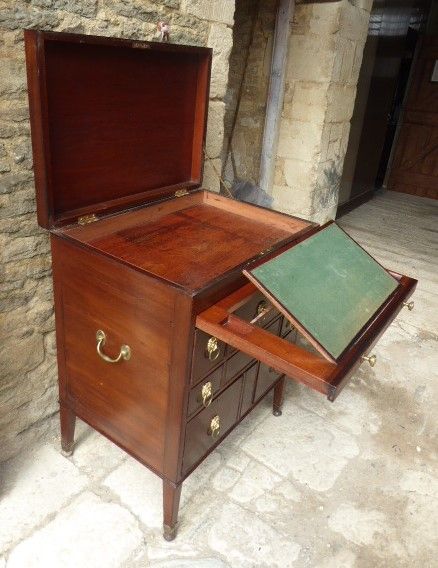
Metalwork played a structural role alongside timber, utilising brass for corner mounts, binding strips, and carrying handles to protect joints during transit. Interiors frequently integrated leather or baize writing surfaces alongside fitted compartments for stationery.
Some travel desks include secret compartments hidden behind false drawer backs, designed to keep private letters safe from prying eyes on the road.
Assessing quality and execution
Quality in a georgian portable desk rests on the precision of the joinery and the integration of brass hardware. Superior examples demonstrate tight dovetail joints, flush-fitting brass bindings, and well-balanced folding mechanisms that operate smoothly.
Internal complexity separates standard boxes from finer iterations, particularly where secret drawers, integrated candle sconces, or silver-gilt ink wells are present. The selection of figured timber veneers and the condition of original leather or baize surfaces further distinguish high-grade pieces.
The Georgian Portable Desk Glossary
- Writing slope
- A portable box with a slanted lid that folds down to create an inclined writing surface. Inside compartments store paper and writing implements.
- Campaign desk
- Furniture designed for military officers on active service, typically featuring brass bindings and folding mechanisms for ease of transport.
- Cheveret
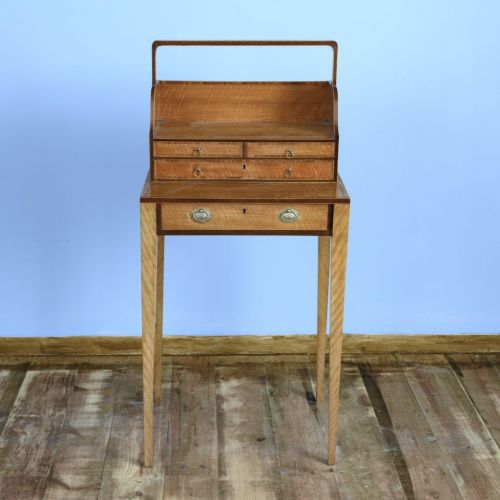
- A small freestanding writing table or writing stand featuring drawers and a removable bookstand or letter rack on top.
- Baize
- A coarse woolen material resembling felt, traditionally used to line the writing flaps and interior compartments of writing boxes.
- Stationery box
- A desk accessory designed to hold envelopes, paper, and correspondence upright within partitioned interior sections.
Georgian Portable Desk: Frequently Asked Questions
What is a georgian portable desk?
A georgian portable desk is a folding wooden box built to contain writing equipment for travel during the eighteenth and nineteenth centuries.
These pieces typically open to reveal a sloping writing surface lined with leather or baize, alongside pigeonholes and inkwells.
How were these desks used?
Travellers, officers on military campaigns, and writers used these desks to maintain correspondence while away from permanent home furniture.
The box sat upon a table or lap, opening into a functional writing station that packed away securely when journeys resumed.
How do I identify a George III desk?
George III pieces date from the reign spanning the late eighteenth to early nineteenth century, characterised by dense mahogany and brass corner mounts.
Construction details like hand-cut dovetails and traditional interior layouts help separate these pieces from later Victorian adaptations.
Can I use an antique writing box daily?
These boxes function well for modern letter writing and desktop organisation when handled with care for their age and materials.
Placing modern stationery inside preserves the historical interior while putting the traditional compartments to practical use.