
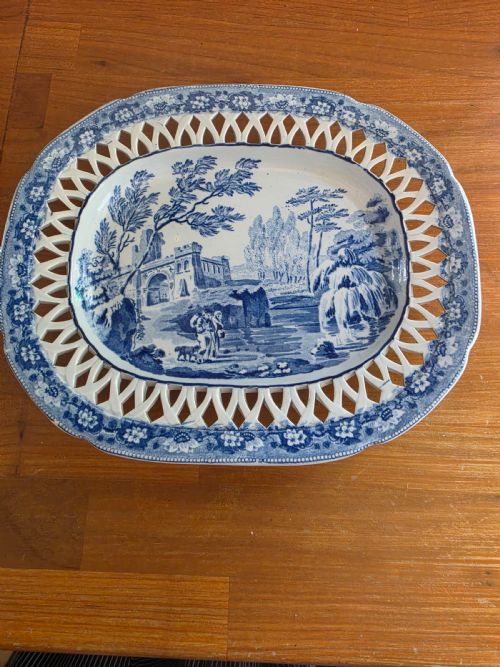
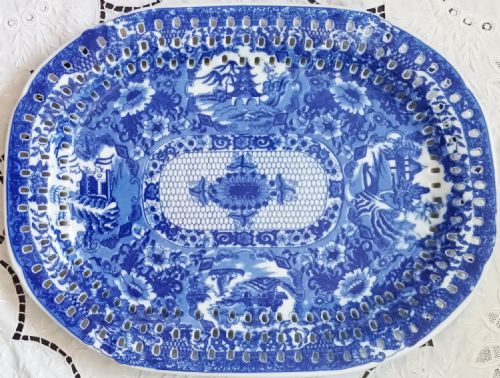


Georgian Pearlware Platter
A georgian pearlware platter brings bold blue transfer-printed scenes to the table, offering a durable earthenware surface that collectors prize for its rich cobalt detail.
Georgian Pearlware Platter
A georgian pearlware platter combines functional serving ware with early transfer-printed artistry, taking forms such as large serving platters, pierced serving dishes, and bread stands. These pieces emerge primarily from the Georgian, Regency, and early nineteenth-century periods, capturing scenes from English landscapes to Chinoiserie motifs.
Buyers will most frequently encounter blue and white earthenware examples displaying transfer-printed patterns like the Net pattern, Willow pattern, or scenic topographical views. These larger serving dishes and chargers anchor a table or collection with deep cobalt pigments applied beneath a characteristic translucent glaze.
How they were made
Potters shaped these vessels in earthenware and pearlware bodies, applying cobalt pigment to create intricate blue and white transfer-printed designs. The application of a subtle bluish glaze over the ceramic body softened the underlying cream tint of the earthenware to mimic Chinese porcelain.
Many serving dishes incorporate specialised techniques such as pierced rims and integrated drainers to handle heavy joints of meat at the table. Kiln firing fixed the cobalt pigments permanently beneath the glaze, ensuring lasting durability across centuries of use.
Elephants, buffalo, and classical ruins wander across these platters, proving that early Staffordshire potters possessed very vivid imaginations.
What varies in quality
The clarity and depth of the transfer print dictate much of the visual success, separating sharp, well-registered cobalt applications from blurred or smudged impressions. Early examples show crisp lines in complex patterns like classical ruins or exotic animals.
Form and scale also separate standard plates from impressive serving vessels, particularly pieces featuring pierced borders, reticulated galleries, or matched sauce tureen stands. The refinement of the ceramic body and the smoothness of the glaze determine the overall tactile appeal.
Davenport·Spode·Thomas Lakin·Brameld and Co·John Rogers and Son
The Georgian Pearlware Platter Glossary
- Pearlware
- A refined earthenware developed in the late eighteenth century featuring a subtle bluish glaze that pooled in recesses, designed to resemble Chinese export porcelain.
- Transfer printing
- A decoration technique where an engraved copper plate transfers a printed design onto tissue paper, which is then applied to the ceramic biscuit before glazing.
- Cobalt pigment
- A metallic oxide used under the glaze to produce a vibrant and stable blue colour that withstood high kiln temperatures without fading.
- Pierced pattern
- A decorative technique involving cut-through openings in the rim of a dish or platter, often seen in net and trellis designs.
- Chinoiserie
- A European artistic style reflecting Chinese motifs and landscapes, frequently adapted onto early nineteenth-century ceramics.
Georgian Pearlware Platter: Frequently Asked Questions
Can I use these platters for food?
While these serving dishes were originally made for dining tables, nineteenth-century earthenware is porous and may have aged over time. Many collectors prefer to display them safely on walls or stands rather than serving greasy foods.
If you do use them for dry foods, inspect the surface first to ensure the glaze remains intact and stable.
How do I date a pearlware dish?
Examine the blue colour tone, the weight of the ceramic body, and any maker marks stamped or printed on the reverse. Early pieces from the Georgian era often display a distinct bluish tint in the glaze pools.
Comparing the transfer pattern against known maker timelines helps narrow down the production decade.
What is the difference between pearlware and ironstone?
Pearlware is a refined earthenware developed to look whiter by using a tinted glaze over a cream-coloured ceramic body. Ironstone is a much denser, heavier, and more robust vitrified material introduced later in the nineteenth century.
Pearlware platters often exhibit the characteristic blue-tinted pooling glaze, whereas ironstone tends towards a whiter, sturdier finish.