
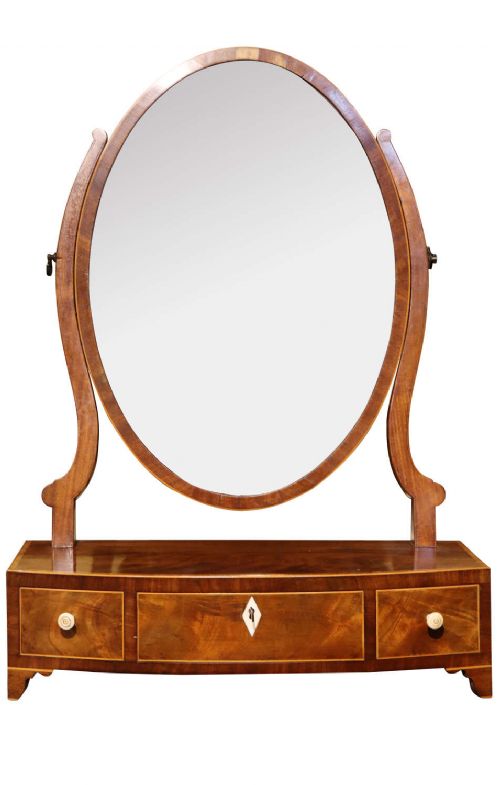


Georgian Oval Swing Mirror
A georgian oval swing mirror sits on the dressing table to catch the morning light, bringing warm mahogany and glass into a bedroom.
Georgian Oval Swing Mirror
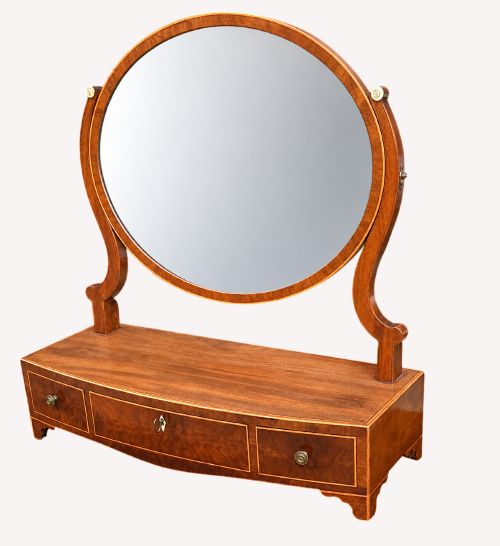
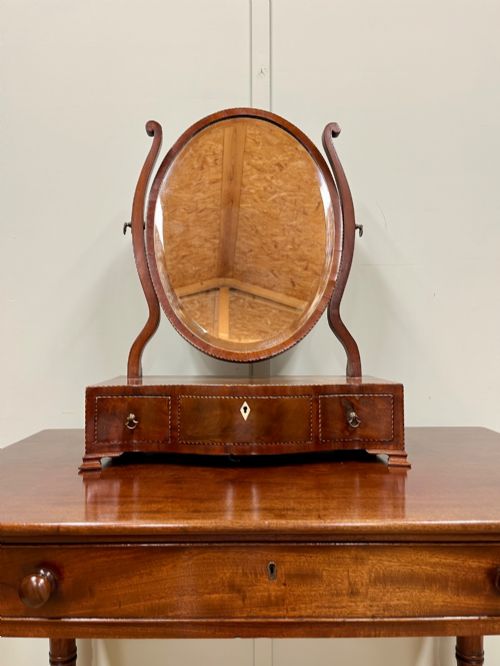
A georgian oval swing mirror stands on a small wooden frame fitted with drawers for small items. These tabletop dressing mirrors belong to the eighteenth and nineteenth centuries, spanning Georgian, Sheraton, and Hepplewhite styles.
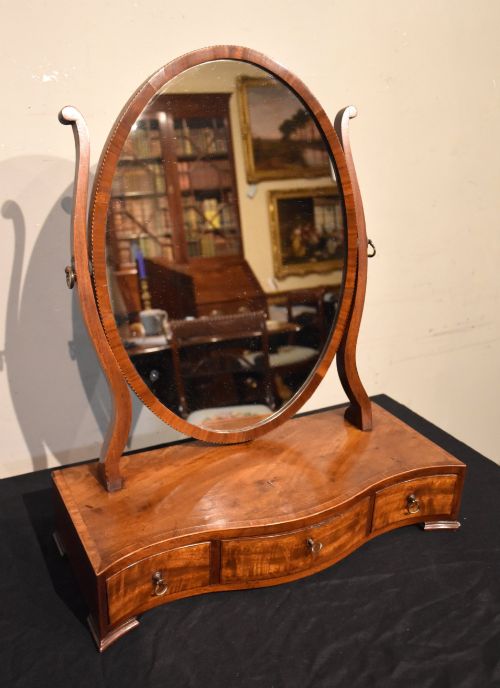
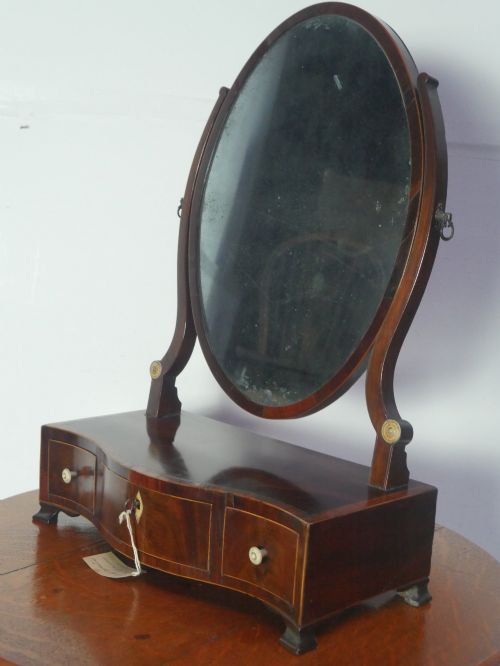
The oval glass tilts within upright arms mounted on a box base. Most examples on this page feature mahogany, often enhanced by satinwood inlay or crossbanding, with serpentine and bow-front shapes appearing frequently.
How they were made
Cabinet makers constructed these mirrors primarily from solid mahogany and flame mahogany, sometimes using boxwood inlay for delicate borders. Brass fittings secure the pivoting frame, while bone often forms the tiny escutcheons around keyholes.
The mirror plates are held in slender wooden frames supported by shaped arms. Drawers within the serpentine or bow-fronted bases utilise traditional dovetail joints to withstand daily use.
Tiny bone escutcheons guard the keyholes of these mirrors, offering a miniature white accent against rich brown mahogany.
What varies in quality
The refinement of the timber and the subtlety of the serpentine curve distinguish finer examples from simpler ones. Figured flame mahogany and precise satinwood inlay elevate the visual weight of the base.
Proportion matters immensely in these mirrors, particularly the balance between the oval glass and the storage box below. Quality shows in the crispness of the mouldings and the gentle sweep of the drawer fronts.
The Georgian Oval Swing Mirror Glossary
- Serpentine front
- A furniture front curving inward centrally and outward at the ends, creating a graceful wave shape. This contour adds considerable complexity to the drawer construction.
- Crossbanding
- A border of veneer laid around the main surface with the grain running at right angles to the centre. It creates a neat framing effect on tabletop mirror bases.
- Cheval mirror
- A full-length dressing glass suspended in a standing frame that allows the entire mirror to swing. These taller pieces differ from the smaller tabletop versions.
- Satinwood
- A pale, lustrous hardwood native to the tropics, frequently used for contrasting stringing and inlay. Its golden hue contrasts warmly against dark mahogany.
Georgian Oval Swing Mirror: Frequently Asked Questions
Where should I place a dressing mirror?
These mirrors suit a chest of drawers, a low sideboard, or a dedicated dressing table. Their compact tabletop footprint allows them to sit comfortably in bedrooms and living spaces alike.
Ensure the surface is level and stable so the swinging glass operates smoothly without tipping the base.
How do I date an antique mirror?
Examine the timber species, the style of the base, and the construction methods used on the drawers. Eighteenth-century pieces often display hand-cut dovetails and simpler mouldings compared to later nineteenth-century revivals.
The shape of the mirror plate and the presence of crossbanding or bone escutcheons also offer clues to the period.
Are these mirrors meant to be used daily?
They were originally built for daily grooming and retain full mechanical function for pivoting and storage. The brass pivots allow the glass angle to adjust easily throughout the day.
Treat the older wood and glass with gentle care to preserve the finish during regular use.
What is the difference between a toilet mirror and a dressing mirror?
These terms generally describe the same tabletop form, historically used on a dressing table or toilet table for grooming. Both types feature a pivoting glass mounted above small storage drawers.
Variations in the title simply reflect regional or period terminology rather than a distinct functional difference.