

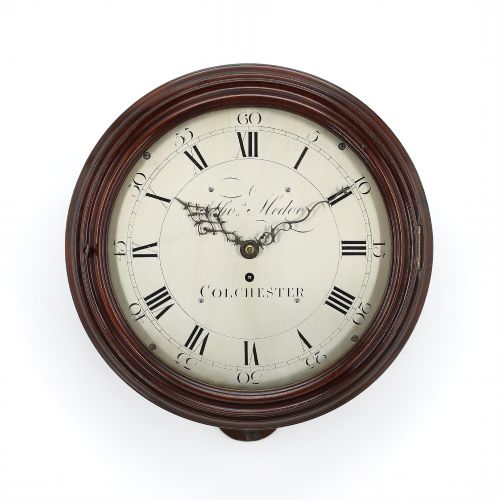


Georgian Mahogany Wall Clock
A georgian mahogany wall clock brings the dependable presence of eighteenth and nineteenth-century horology directly into a room.
Georgian Mahogany Wall Clock
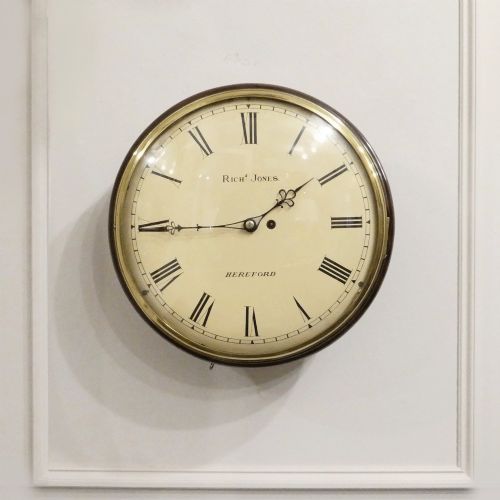
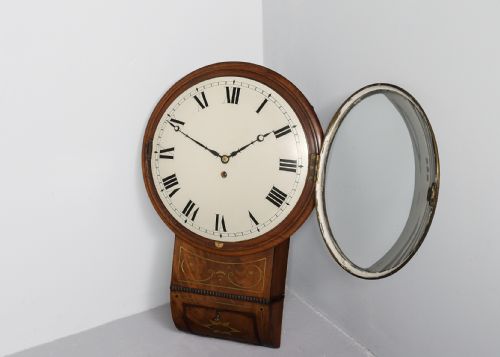
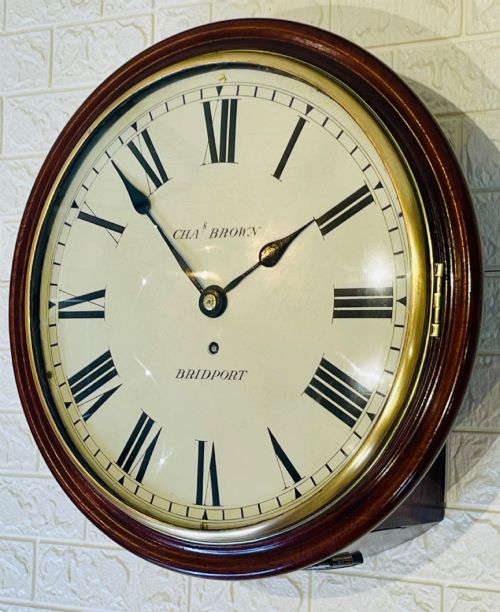
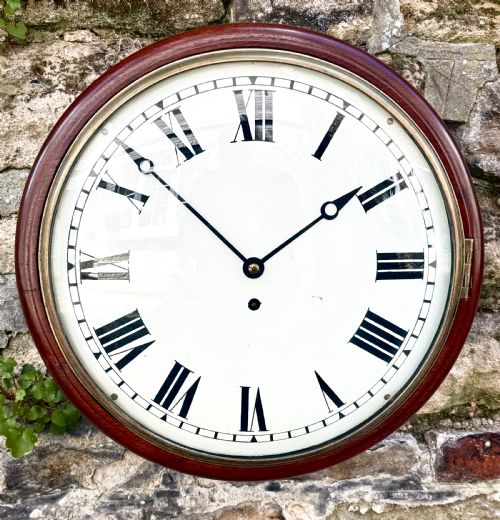
When you search for a georgian mahogany wall clock, you are looking at timepieces designed to hang securely in domestic, commercial or public spaces. The examples on this page span the Georgian, Regency, and Victorian periods, often taking the form of round dial wall clocks or drop-dial Tavern clocks housed in timber cases.
Makers produced these pieces in various sizes, ranging from small ten-inch dial formats to larger thirteen-inch variants and tall drop-dial configurations. Many incorporate wooden dials, convex painted metal faces, and brass inlay around the bezel or case edge.
Materials and Construction
Craftsmen built the cases primarily from solid mahogany or flame mahogany veneer, enclosing the movement and protecting the dial behind glass set into a hinged brass or wooden bezel. Iron, steel, and brass components make up the mechanical works inside.
The movements rely on fusee mechanisms to maintain steady tension on the gear train as the mainspring unwinds, delivering consistent power to the escapement for accurate timekeeping.
Listings here feature mahogany, brass, glass, steel, and painted iron materials across Georgian, Regency, and Victorian periods.
Distinctions in Quality
The level of execution in the dial painting and the crispness of the timber moulding separate standard domestic clocks from higher-tier pieces. Signed dials bearing the names of skilled provincial or London makers add significant interest to a piece.
Retaining the original wooden or convex painted dial alongside an untouched fusee movement elevates a clock's standing, whereas replaced parts or poorly executed dial restorations alter the integrity of the object.
Richard Jones of Hereford·Joseph Bird of Stroud·Thomas Hedge of Colchester·Francis Perigal London·John Thwaites·Robert Salmon
The Georgian Mahogany Wall Clock Glossary
- Fusee
- A conical pulley used with a cord or chain to equalize the torque of the mainspring as it runs down. This mechanism ensures the driving force remains uniform throughout the winding cycle.
- Drop-dial
- A clock case featuring a circular dial at the top above a short, often tapered wooden trunk or box below. This lower section houses the pendulum and drop.
- Verge
- An early type of escapement that controls the release of the gear train using a crown wheel and pallets. It permits a wide swing of the pendulum.
- Bezel
- The metal or wooden ring that holds the glass door protecting the dial. It usually hinges open to allow for hand-setting and winding.
- Convex dial
- A dial curved outward toward the viewer rather than sitting flat. This design reduces glare from nearby windows and light sources.
Georgian Mahogany Wall Clock: Frequently Asked Questions
How do I wind a fusee wall clock?
Insert the winding key into the aperture on the dial and turn it clockwise until the mechanism comes to a gentle stop. Take care not to overwind the mainspring.
Most fusee wall clocks run for eight days on a single winding, meaning you only need to attend to them once a week.
Where were these clocks originally hung?
These clocks hung in domestic hallways, large kitchens, and formal rooms where households needed to coordinate daily schedules. Tavern clocks also served public houses and coaching inns.
Their robust wall-mounted design kept them safe from busy floor traffic and accessible for regular winding.
How do I distinguish a Georgian dial from a Victorian one?
Georgian dials often feature specific lettering styles, subtle convex curves, and maker signatures from eighteenth-century workshops. Mahogany cases from this period also display distinct timber patination.
Victorian pieces frequently utilise heavier bezels, different painted iron face treatments, and later nineteenth-century movement variations.