
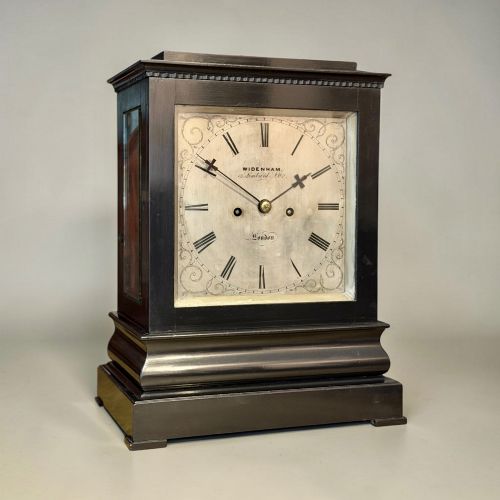
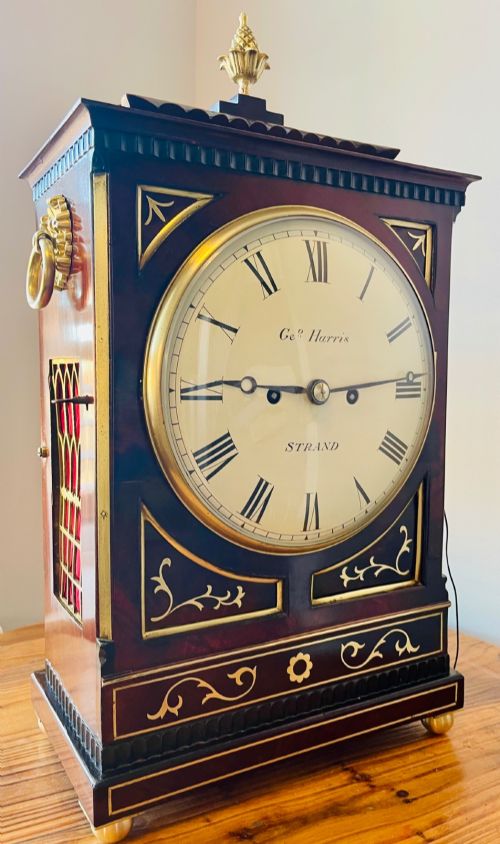
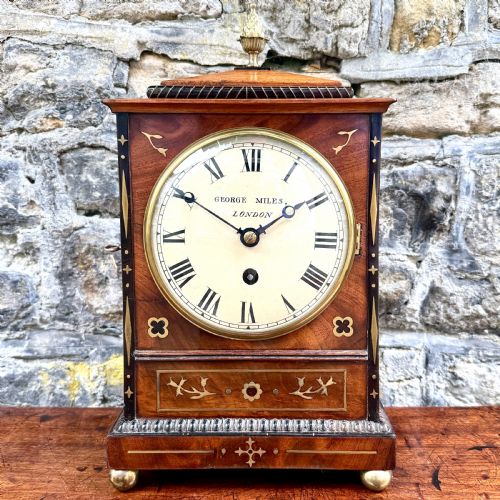
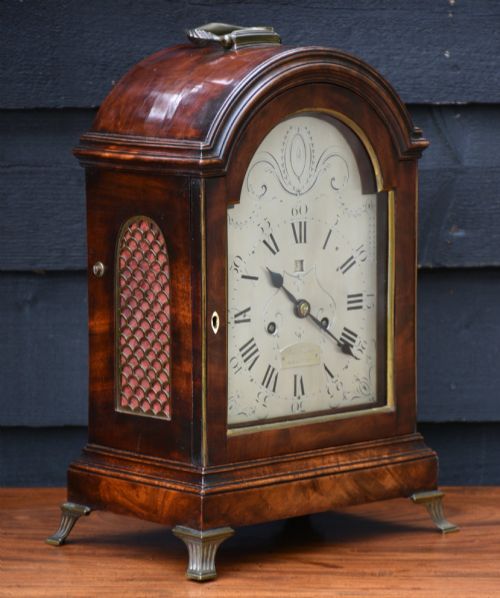
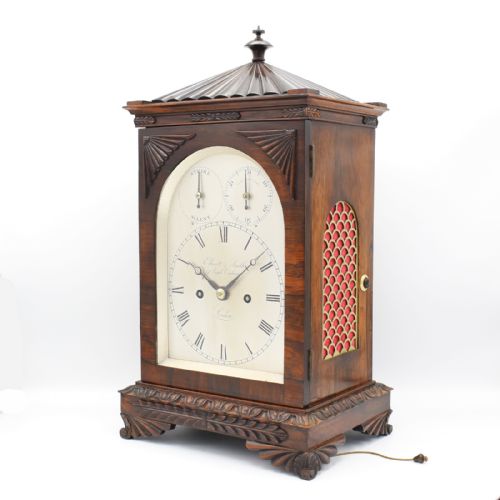
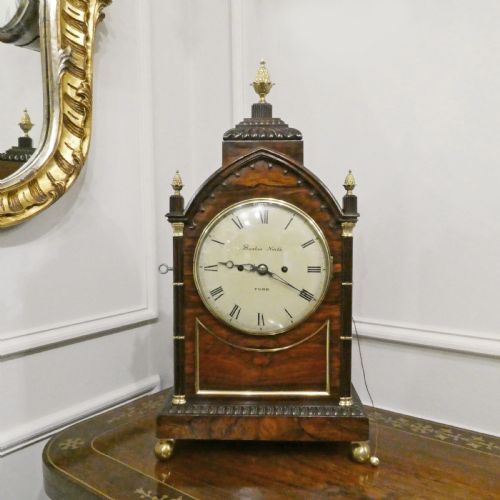
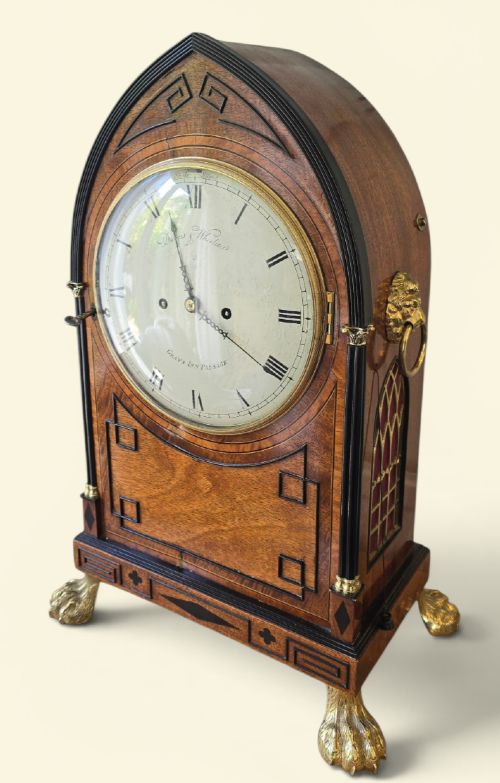


Georgian Fusee Bracket Clock
A georgian fusee bracket clock is a precision timepiece driven by a chain or cord fusee movement, housed in a substantial wooden table case designed for portability.
Georgian Fusee Bracket Clock
A georgian fusee bracket clock is a mechanical portable timepiece built primarily during the eighteenth and nineteenth centuries, spanning the Georgian, Regency, and early Victorian periods. These pieces are predominantly encountered in mahogany, ebonised wood, or rosewood cases of table or mantel proportions.
The objects take various case silhouettes, including single pad top, chamfer top, lancet, and balloon designs. They were originally manufactured to sit on a bracket or table, serving as the central timekeeper for affluent households.
Materials and Movements
Cases are constructed from solid timbers such as mahogany, rosewood, and pollard oak, often accented with brass bezels, carrying handles, and silk-backed sound frets. Dials feature enamelled white chapters or engraved silvered metal plates protected by heavy glass doors.
Mechanisms rely on the fusee drive, a conical pulley that equalises the declining power of the mainspring as it unwinds. Movements range from simple timepieces to striking, repeating, and twin-fusee quarter-chiming configurations.
Several makers operated out of narrow Gray's Inn passageways, building heavy timekeepers designed to be hauled around by brass top handles.
Assessing the Standard
The tier of a clock depends on the architectural integrity of the wooden case and the sophistication of its brass movement. Examples signed by notable metropolitan makers on the dial and backplate command greater attention.
Complications such as twin fusees, musical bells, repeating mechanisms, and automation elevate the piece beyond a standard time-only movement.
Widenham of London·Barwise London·Ellicott Smith·Barber North of York·Desbois Wheeler·Webster Cornhill London·Cording of London·Wilkinson Leicester·Barrett London·Taylor of London·Richard Rooker·Somersall London·Pennington of Camberwell·Frodsham Baker London·Berguer of the Strand·McCabe London·Chater Son London·John Leroux·John McGregor·Plumbly Tupman·Marks of London·Peter Le Gros·Jerimiah Lowman·Thoams Hawley·Brown London
The Georgian Fusee Bracket Clock Glossary
- Fusee
- A conical pulley connected to the mainspring by a chain or cord. This clever device ensures even tension is delivered to the gear train as the spring unwinds.
- Bracket clock
- A portable spring-driven clock intended for placement on a wall bracket or table. Despite the name, many survive without their original matching wall brackets.
- Silvered metal
- A brass dial plate treated with a silver solution to create a matte white metallic finish. The numerals and maker details are then engraved and filled with black wax.
- Pad top
- A raised, domed architectural feature on the upper section of a wooden clock case. It is frequently mounted with brass handles for carrying the heavy piece.
- Striking
- A mechanism that sounds the hours on a bell or gong using a separate gear train. Some movements also feature repeat capability to sound the last hour on demand.
Georgian Fusee Bracket Clock: Frequently Asked Questions
What is a fusee movement?
A fusee is a conical pulley designed to counteract the dropping torque of a mainspring as it loses tension. This mechanism ensures consistent force drives the escapement for accurate timekeeping.
Invented centuries ago, it remains a hallmark of high-grade British horology found in these portable table clocks.
Did these clocks need wall brackets?
They are called bracket clocks because they were originally placed upon matching wooden wall brackets to project sound into the room. Over the centuries, many brackets were separated from their clocks.
Today, most of these timepieces sit securely on mantelpieces, desks, or chests of drawers without a wall mount.
How do I identify a Georgian clock?
Georgian pieces display the characteristic cabinet styles, dial materials, and movement architectures of the eighteenth and early nineteenth centuries. Look for robust mahogany cases, engraved silvered brass dials, and substantial heavy brass fusee movements.
Signatures inscribed on the dial or engraved directly onto the backplate often link the piece to recorded London or provincial makers.
How do I wind a fusee clock?
Winding requires a matching winding key inserted into the dial aperture to tension the mainspring via the chain or cord fusee. Care must be taken not to overwind the movement.
Many surviving examples retain their original or period winding keys alongside pendulum transit locks.