
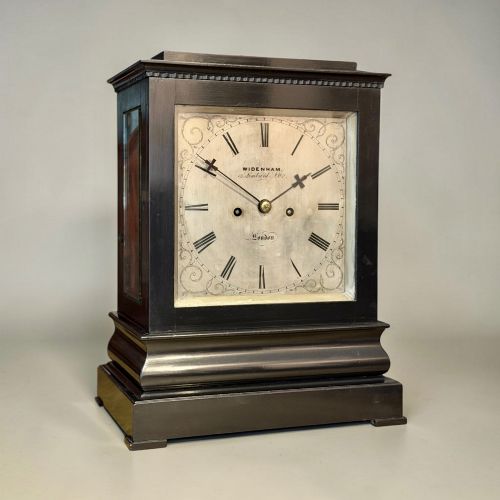
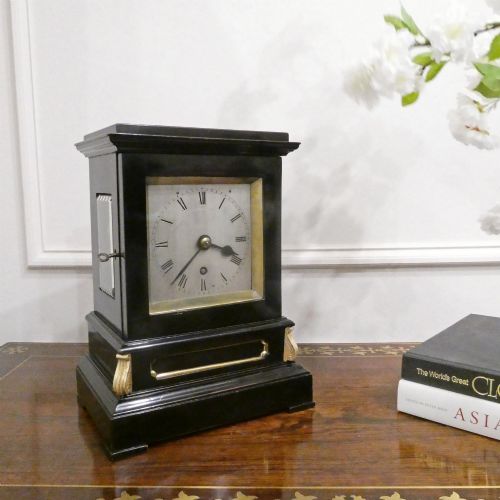


Black Fusee Clock
A black fusee clock is a precision timekeeper driven by a conical pulley and chain, valued for steady accuracy and dark case finishes.
Black Fusee Clock
A black fusee clock combines a dark case of ebonised wood, slate or marble with a specialised mechanical movement. These pieces appear as mantel clocks, wall clocks, library timepieces and bracket clocks spanning the Georgian, Regency and Victorian periods.
The version most commonly met on this page is the ebonised wood or slate mantel clock utilising a single or twin fusee movement. Makers housed these mechanisms in break-arch cases, balloon shapes or architectural bracket forms with brass or enamel dials.
Origins stretch from eighteenth-century workshops in London to nineteenth-century British industrial settings and Black Forest production. Buyers encounter domestic library clocks alongside railway wall pieces and musical bracket examples.
How they were made
Craftsmen built cases using ebonised wood, slate, patinated bronze and gilt ormolu mounts. Glass protected the white enamel or silvered metal dials, while brass formed the intricate gear trains and fusee cones.
Makers cut spiral grooves into the fusee cone to equalise the declining power of the mainspring as it unwound. This mechanical arrangement required skilled hand-fitting of chains, verge escapements and pendulum systems.
Movement types recorded across these items include single, double and triple fusee setups operating bells, musical chimes and standard time displays.
What varies in quality
The distinction between standard domestic pieces and top-tier examples lies in the complexity of the movement and the prestige of the maker. Triple fusee musical mechanisms operating bells or chimes sit far above simple single fusee timepieces.
Case execution also determines standing, with finely cast gilt bronze mounts, figural details and well-proportioned ebonised architectural woodwork separating master workshop production from standard commercial output.
Widenham of London·Phillips Brothers·Richard Rooker·Payne & Co. London·Somersall London·Berguer of the Strand·John Leroux·Desbois & Wheeler·William Smith London·Percy Webster·Barraud & Lund London·Isaac Hurley·Henry Berkeley Square·Beha
The Black Fusee Clock Glossary
- Fusee
- A conical pulley designed to maintain even tension on the clock train as the mainspring unwinds. This device ensures consistent force reaches the escapement for accurate timekeeping.
- Ebonised
- Wood treated with stain and polish to imitate genuine ebony. Makers applied this dark finish extensively to eighteenth and nineteenth-century bracket clock cases.
- Bracket clock
- A portable timepiece originally designed to sit upon a matching wall bracket or furniture surface. These wood and metal pieces often feature intricate dial arrangements and striking trains.
- Verge escapement
- An early mechanical regulating mechanism controlling the release of power in the gear train. It works alongside a pendulum or balance wheel to govern the beat.
- Ormolu
- Gilt bronze ornamentation applied to clock cases for decorative contrast against dark wood or slate. Artisans cast and mercury-gilded these metal mounts by hand.
Black Fusee Clock: Frequently Asked Questions
What is a fusee movement?
A fusee movement uses a conical drum and a chain to regulate the pull of the mainspring. As the spring loses tension, the chain rides higher on the cone to maintain constant torque.
This clever mechanical adjustment compensates for the drop in power, helping the clock maintain a steady and reliable rate over its running period.
How do I wind my clock?
Winding requires inserting the appropriate key into the dial winding square and turning it gently. Single fusee models wind once for time, while twin or triple fusee pieces require separate winding for striking and chiming trains.
Care must be taken not to overwind the mechanism, stopping as soon as resistance increases to protect the chain and mainspring.
How can I tell the period?
Dating relies on stylistic clues in the case design, materials, dial signatures and the evolution of the internal movement. Georgian pieces often show classic architectural lines or bell-tops, while Victorian examples introduce slate, marble and revival styles.
Maker signatures engraved on the backplate or painted on the dial provide further historical context for when the clock left the workshop.
Where should I place a heavy slate clock?
Heavy slate and marble clocks require a sturdy, level surface such as a solid mantelpiece or low piece of furniture. Their substantial weight demands stable support to prevent tipping and to keep the pendulum beating evenly.
Placing the clock away from direct sunlight, drafts and damp areas also protects the ebonised wood, gilt bronze mounts and delicate internal steel components.