



Ebonised Desk Clock
An ebonised desk clock brings dark, striking timber and precise movement to a study, built to command attention from any surface.
Ebonised Desk Clock
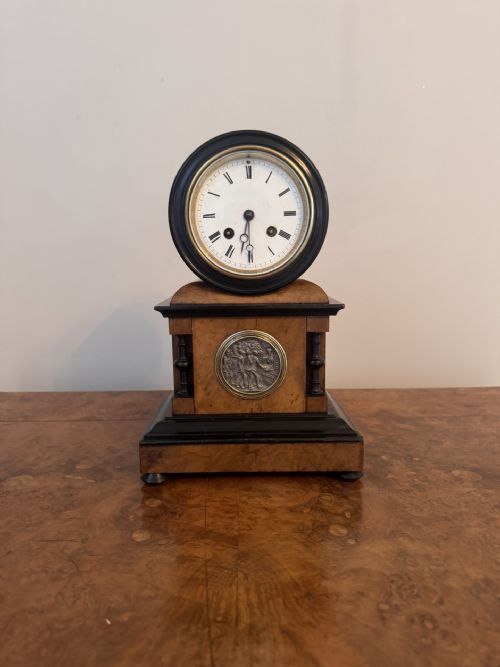
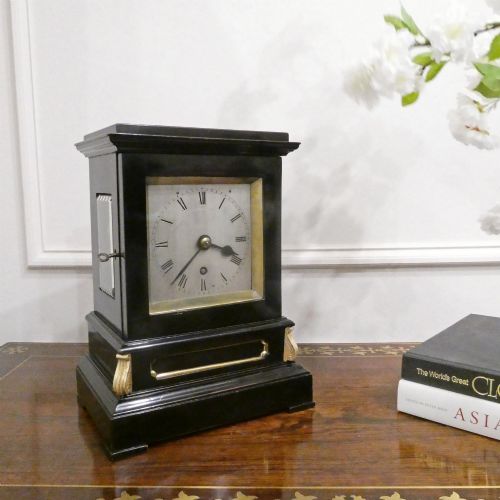
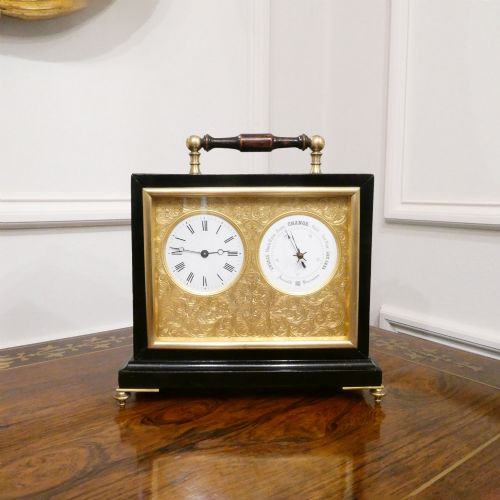
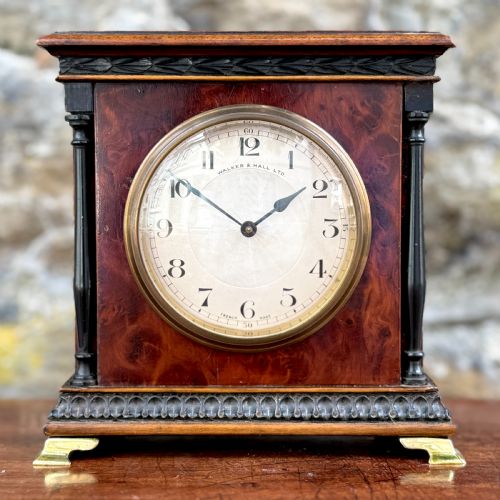
An ebonised desk clock is typically encountered as a Victorian or Edwardian mantel or library timepiece, constructed from timber treated to resemble ebony. These pieces frequently appear alongside brass fittings, enamel dials, and occasionally burr walnut or mahogany accents.
The forms range from compact library clocks and bracket clocks to larger French Neoclassical and Louis XV Revival mantel clocks. They originate across the nineteenth and early twentieth centuries, spanning periods from Regency and Victorian eras through to Edwardian designs.
Materials and construction
The primary visual impact relies on ebonised wood, applied to create a uniform dark finish that highlights contrasting silvered metal or white enamel dials. Artisans combined this dark timber with brass bezels, glass covers, and occasionally gilt bronze or ormolu mounts.
Movements within these cases are driven by mechanical mechanisms, including single fusee trains and bell striking systems. Cabinets also incorporate secondary woods such as burr walnut and mahogany beneath or alongside the ebonised treatment.
Ebonised Desk Clock Retail Price Guide 2026
Typical asking prices for ebonised desk clock among the pieces listed under this phrase on Sellingantiques today, from the lower quarter to the upper quarter. They describe what is for sale here now, not the wider market.
Listings feature pieces spanning the Victorian, Edwardian, and Regency periods, utilising ebonised wood, burr walnut, and gilt bronze.
Markers of distinction
Quality rests upon the crispness of the ebonised finish and the integrity of the underlying timber, distinguishing carefully prepared cases from simpler treatments. Finer examples integrate secondary materials like burr walnut or gilt bronze with a balanced proportion.
The sophistication of the movement and the legibility of the enamel or silvered dial dictate the upper tier of these pieces. Maker attribution and the harmony of revival styles, such as French Neoclassical or Louis XV, further elevate the work.
Walker and Hall·Le Roy·Berguer of the Strand·Baldwin of Loughborough·Henry Marc
The Ebonised Desk Clock Glossary
- Ebonised
- Timber treated with a dark stain or finish to imitate true ebony wood. This technique gained significant popularity during the Victorian period for achieving a formal aesthetic.
- Fusee
- A conical pulley used in clock movements to maintain an even pull as the mainspring unwinds. It ensures consistent timekeeping accuracy.
- Ormolu
- Gilded bronze ornamentation applied to furniture and clock cases. The technique involves a mercury amalgam applied to cast bronze.
- Silvered metal
- A metallic dial face treated with a thin layer of silver to create a luminous, readable surface. It is often engraved with Arabic or Roman numerals.
Ebonised Desk Clock: Frequently Asked Questions
What is an ebonised desk clock?
An ebonised desk clock is a portable timepiece housed in dark, treated wood, designed to sit on a desk, shelf, or mantel. These pieces date primarily from the nineteenth and early twentieth centuries.
They combine mechanical clock movements with decorative cases influenced by various revival styles, featuring materials such as brass, enamel, and glass.
How do I wind my mechanical clock?
Mechanical clocks require a key inserted into the dial to tension the internal springs or weights. Care must be taken not to overwind the mechanism.
Consulting the specific movement type, such as a single fusee train, helps determine the correct winding frequency and direction.
Where should I place a mantel clock?
These clocks suit stable, flat surfaces away from direct sunlight, excessive moisture, and dramatic temperature fluctuations. Desks, mantelpieces, and bookshelves are traditional locations.
Ensuring the surface is level is essential for the proper operation of the pendulum or escapement mechanism.
How do I distinguish Victorian from Edwardian pieces?
Victorian clocks often display ornate revival details like French Neoclassical or Louis XV influences, alongside heavy ebonised wood and gilt bronze mounts. Edwardian pieces tend to show cleaner lines and simpler architectural forms. Nomenclature and stylistic cues within the design help anchor the piece to its specific nineteenth or early twentieth-century decade.