


Georgian Cylinder Writing Table
These Georgian cylinder writing tables offer clever concealed storage and smooth curved actions, bringing refined writing spaces to any study.
Georgian Cylinder Writing Table
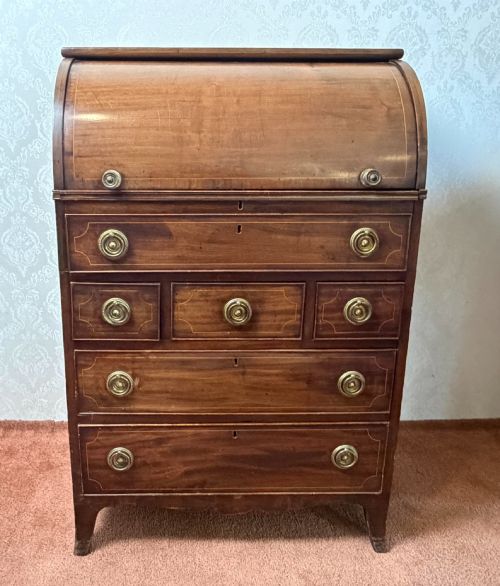
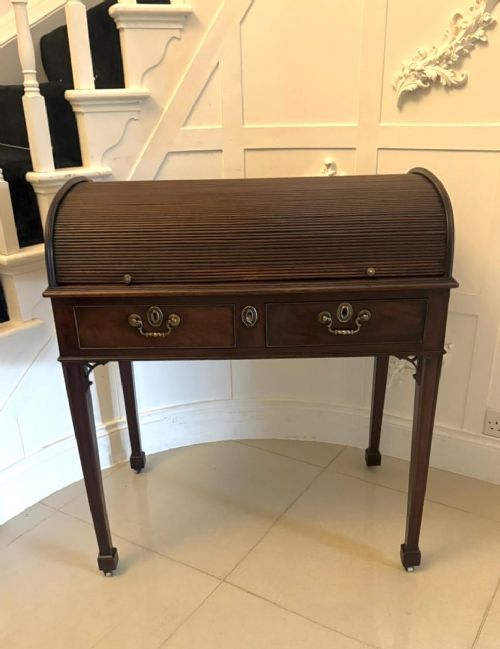
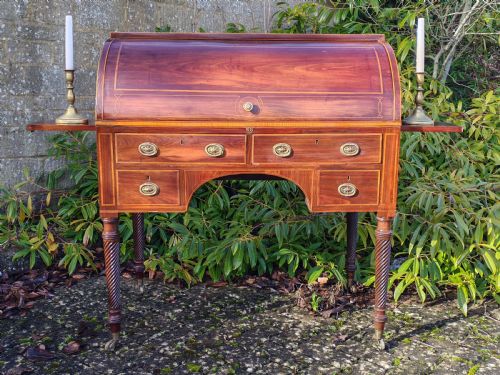
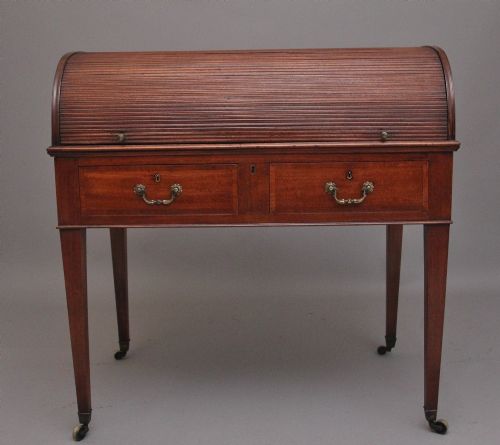
A georgian cylinder writing table provides a covered workspace featuring a curved enclosing shutter that slides back to reveal fitted interior drawers and pigeonholes. These pieces often include pull-out writing slides lined with leather to create a practical writing surface.
Most examples found here date from the late eighteenth century through the early nineteenth century, encompassing Georgian, Regency, and Sheraton styles. Makers utilised classic forms varying from compact ladies desks to larger estate writing desks.
How they were made
Cabinetmakers constructed these desks primarily using solid mahogany and satinwood, frequently employing tambour strips or solid curved cylinders to form the sliding top. Finer examples incorporate contrasting boxwood, ebony, and satinwood inlay to accentuate the architectural lines.
Hardware details such as brass ring handles finish the drawers, while interior compartments showcase meticulous small-scale joinery. Selected pieces utilise exotic timbers like partridgewood alongside traditional cabinet woods.
The selection spans George III, Sheraton, and Regency periods with both compact ladies desks and larger estate formats.
What varies in quality
The sophistication of the timber selection dictates much of the distinction, where highly figured mahogany or intricate satinwood inlay elevates a piece far above plain alternatives. Superior examples display seamless movement in the cylinder mechanism and precise alignment of the internal stationery fittings.
Design pedigree and decorative restraint further separate standard production from exceptional work, particularly in pieces reflecting sophisticated Sheraton or Regency aesthetic principles.
John Mclean
The Georgian Cylinder Writing Table Glossary
- Cylinder top
- A curved wooden shutter that rolls back in tracks to conceal the writing surface and interior fittings. This mechanism protects the desk contents while offering a streamlined silhouette when closed.
- Tambour
- A flexible shutter made from narrow vertical strips of wood glued to a canvas backing. It slides smoothly around a curved track to open and close the desk.
- Writing slide
- A pull-out shelf that extends from the main carcase to provide extra surface area for paperwork. These are frequently lined with leather.
- Satinwood inlay
- Contrasting light-coloured wood veneers set into the primary timber surface to create decorative patterns. It was a favoured technique of late eighteenth-century cabinetmakers.
Georgian Cylinder Writing Table: Frequently Asked Questions
What is a georgian cylinder writing table?
A georgian cylinder writing table is a refined desk featuring a curved rolltop shutter that conceals drawers and pigeonholes when closed. They combine concealed storage with extendable writing surfaces.
These pieces date primarily from the late eighteenth and early nineteenth centuries, reflecting Georgian and Regency design traditions.
How does the cylinder mechanism work?
The curved wooden shutter runs on concealed tracks within the desk carcase, sliding smoothly upward and backward to open. This action typically reveals a fitted interior with small drawers and pigeonholes.
In some variants, pulling out the writing slide automatically operates the cylinder mechanism or unlocks the interior compartments.
What woods were used for these desks?
Cabinetmakers relied heavily on mahogany as the primary structural timber, often enhanced with figured veneers. Satinwood, partridgewood, and ebony appeared frequently for contrasting details and decorative inlay.
Boxwood inlay was also utilised to create sharp geometric borders on drawer fronts and writing surfaces.
How do you style a cylinder desk today?
These desks suit traditional studies and contemporary living spaces alike, serving as functional workspaces with historical character. Keeping the cylinder closed conceals modern stationery and electronics to maintain a tidy room.
Pairing the desk with a low-backed chair allows the curved top to remain visible as a distinct architectural feature.