




Georgian Clock Weights
Georgian clock weights operate the drives of longcase and wall timepieces, offering collectors genuine functional brass components from period horology.
Georgian Clock Weights
When you search for georgian clock weights, you encounter functional components designed to power weight driven timepieces from the eighteenth century and the broader Georgian era. These metal cylinders hang inside longcase clocks, descending slowly as the mechanism runs, and provide the kinetic energy for the movement.
The selections on this page include distinct pairs of brass cased weights alongside complete longcase and wall clock assemblies that house matching drives. These items appear primarily in brass, lead, and iron configurations, reflecting the standard materials utilised by period clockmakers to achieve precise mass.
Collectors meet these items within listings spanning Early Georgian, George III, and Scottish Georgian styles, often associated with traditional cabinet timbers such as mahogany, oak, and walnut. The forms range from heavy longcase cylinders to smaller components built for wall hanging timepieces.
What varies in quality
Quality in these components rests upon the purity of the metal casting and the preservation of the original outer casing, which can show excessive thinning or deep dents from centuries of handling. Superior examples retain their original filling and suspension loops, showing crisp definition without modern structural replacements.
The integrity of a paired set depends on matching dimensions, uniform mass, and consistent surface patination, indicating that the pieces have remained together since their initial manufacture. Lesser examples exhibit mismatched replacements or significant surface pitting that alters the original balance required by the clock movement.
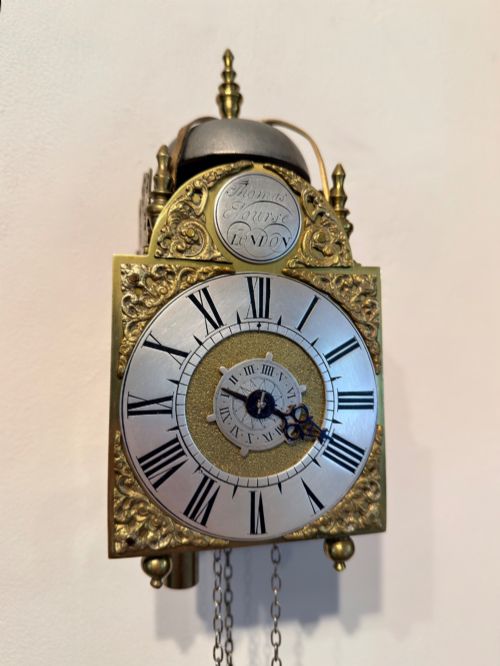
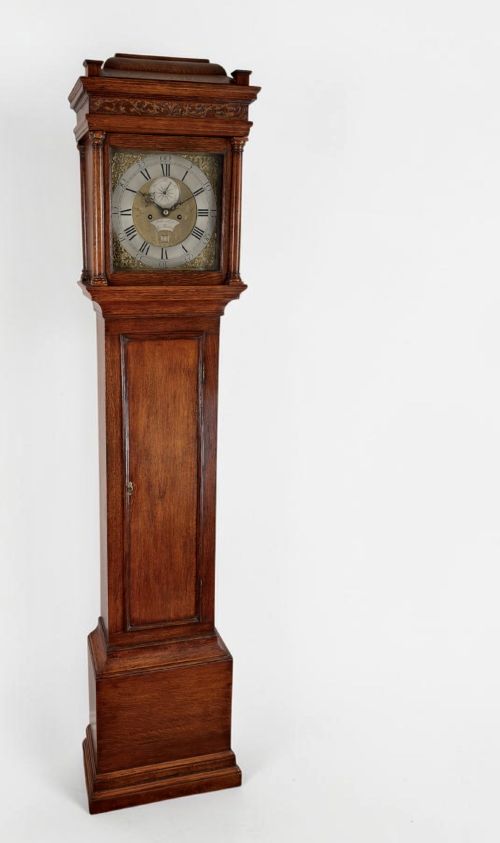
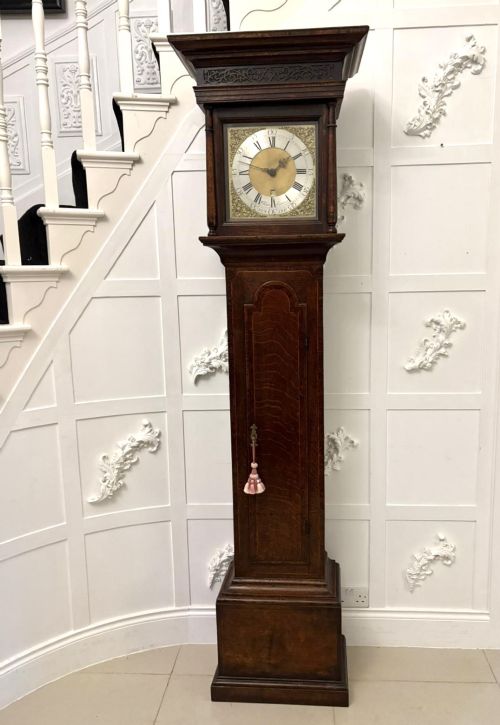
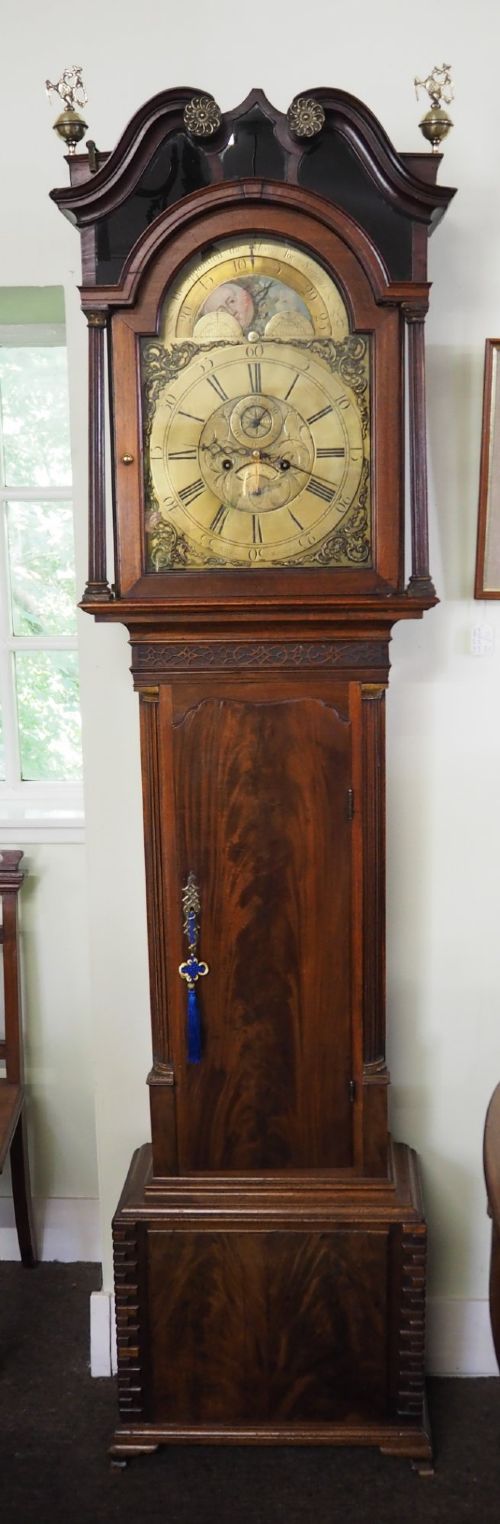
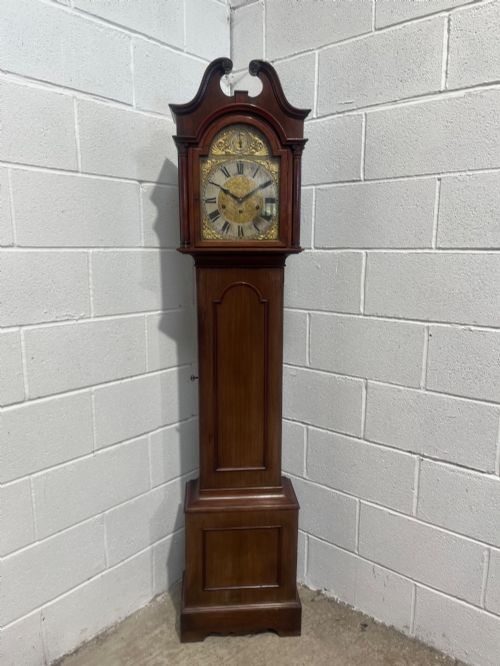
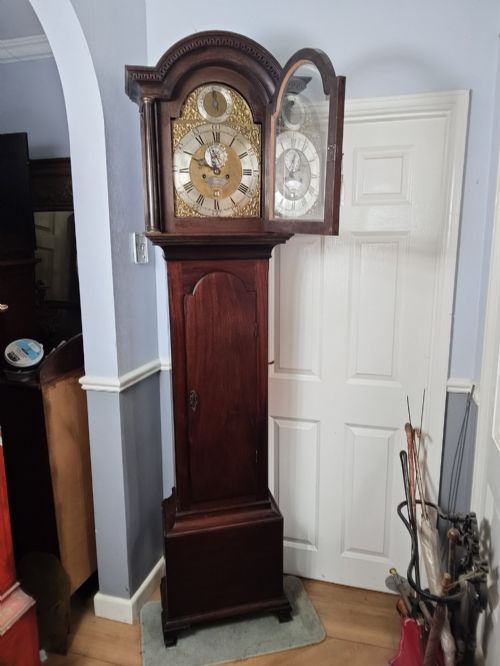
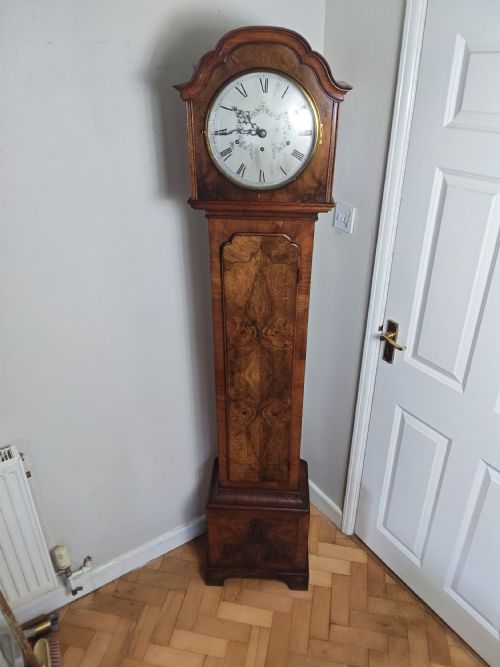
The associated longcase and wall clock entries on this page span the eighteenth and nineteenth centuries, incorporating oak, mahogany, and walnut timbers.
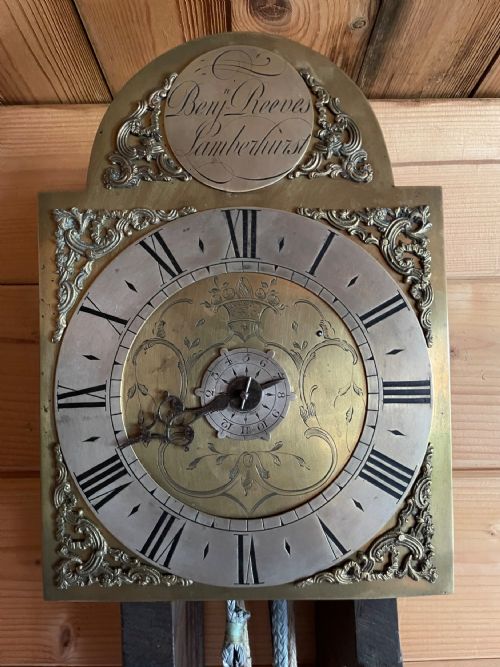
Lee of Great Marlow·Benj Reeves Lamberhurst·Windmills & Bennet London·John Waller of Preston·William Barrow London·Henry Deykin Worcester·Francis Perigal Bond Street·William Wady Twickenham·Lister & Sons·Thomas De Gruchy Jersey·Wm Stanford Great Yarmouth·Benjamin Rogers·Rob Parry Pwllheli·Anthony Marsh London·J Hummel Worcester·Wenham & Son Dereham
The Georgian Clock Weights Glossary
- Longcase clock
- A tall, weight driven timepiece housed in a wooden case designed to stand upright on the floor. These instruments frequently employ two or three weights to power time, strike, and chime trains.
- Brass cased
- Describes a hollow metal shell constructed from yellow alloy, typically filled with lead or iron to provide the requisite mass for a clock drive. This outer sheath protects the denser material within while offering a polished appearance.
- Verge escapement
- An early mechanical regulating device controlling the release of power from the gear train. This mechanism works in conjunction with a bob pendulum or balance to govern the speed of the clock.
- Grandmother clock
- A smaller, scaled down version of the traditional longcase clock, popular in later periods. These shorter cases house compact weight driven movements suited for restricted ceiling heights.
Georgian Clock Weights: Frequently Asked Questions
What do georgian clock weights do?
These heavy metal cylinders suspend from cords or chains inside the trunk of a longcase or wall clock. As gravity pulls them downward, they store and deliver the mechanical energy needed to drive the gear train and keep the movement running.
Matching the correct mass to the specific movement is essential for proper operation. Original pairs ensure the striking and timekeeping trains function at the correct tension without straining the gear teeth.
Are these weights made entirely of solid brass?
Most period examples consist of a hollow brass shell that serves as the outer container. Makers filled these brass casings with denser, cheaper materials such as lead or iron to reach the exact mass required for the clock.
This method economised on expensive non-ferrous metal while providing a clean exterior appearance. Examining the base or top closure reveals the internal filling material used during assembly.
How do I know if a pair matches?
Authentic matching sets share identical outer dimensions, wall thickness, suspension loops, and surface patination. Slight variations in casting marks or wear patterns indicate whether the pieces originated from the same workshop.
Using mismatched components can cause uneven tension on the drum and weight lines. Collectors look for consistent metal colour and identical construction methods across both items.
How should I clean brass clock weights?
Dusting with a dry, soft cloth is normally sufficient to remove surface grime without disturbing the historic patination. Avoid harsh chemical polishes that strip away centuries of oxidation and soften the crisp edges of the metal.
Preserving the natural surface character maintains the authenticity of the components. Heavy cleaning can erase subtle foundry marks that help identify the period and origin.