
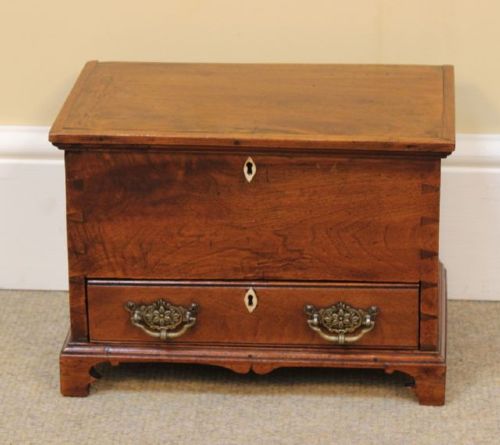
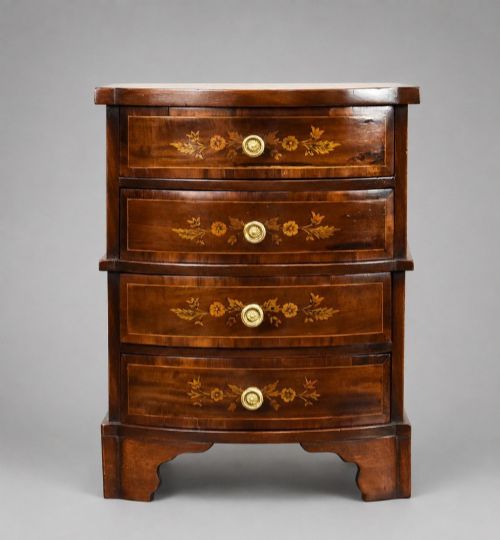
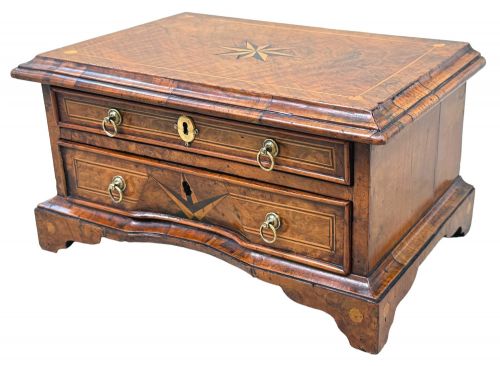
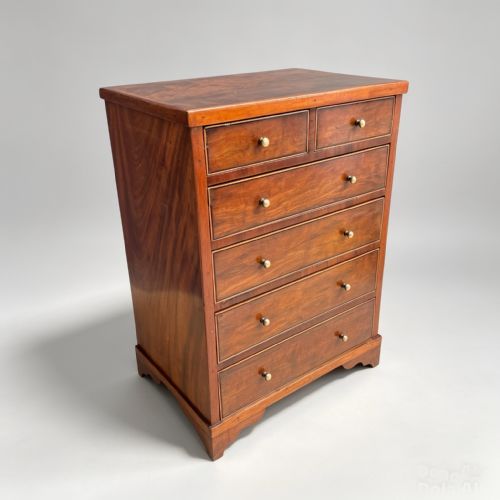
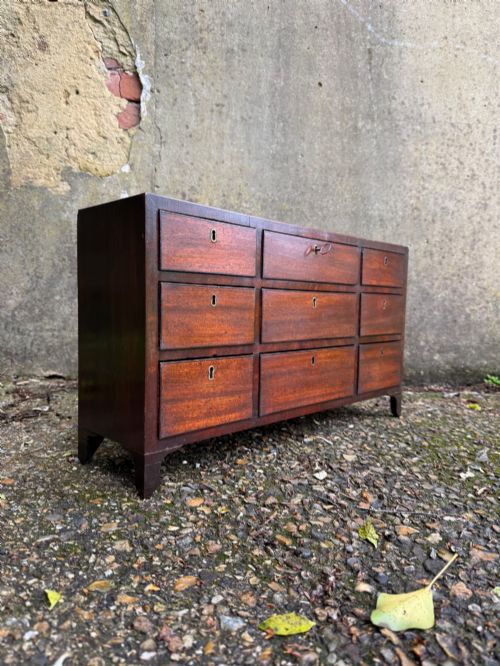


Georgian Apprentice Piece Chest
These small-scale forms known as a georgian apprentice piece chest are miniature expressions of full-size furniture built to demonstrate cabinet-making skill.
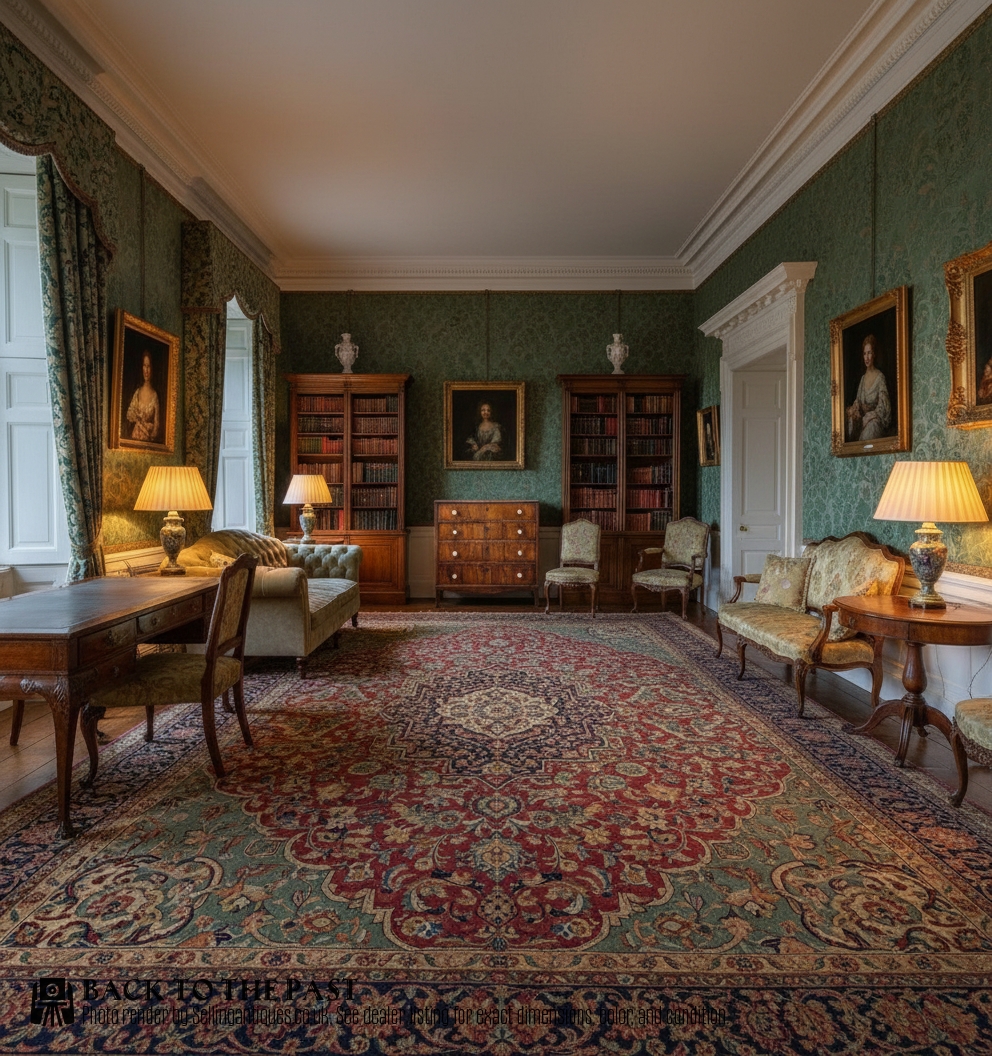
Georgian Apprentice Piece Chest
A georgian apprentice piece chest sits on a table or desk, taking the form of a scaled-down chest of drawers, bureau, or mule chest. Most examples found here belong to the Georgian and Regency periods, though Victorian and Edwardian pieces also appear.
Makers produced these miniature pieces in various regional styles, ranging from plain country workshop oak to sophisticated London mahogany and walnut designs with bow fronts or bracket feet.
The category extends beyond simple chests to include miniature tallboys, kneehole desks, and sideboards, reflecting the full repertoire of the historical cabinet-maker.
Materials and construction
Craftsmen built these items using dense timbers such as mahogany, oak, walnut, and elm, often applying veneers of burr yew, amboyna, or marquetry to the primary surfaces.
Secondary woods like pine commonly appear in drawer linings and carcases, while smaller details utilise brass handles, bone escutcheons, and fine inlay work.
Joinery techniques mirror those of full-scale furniture, employing dovetailed drawer construction and precise panel fitting on a reduced scale.
Some miniature drawers are so small they could barely hold a button, yet still possess fully dovetailed sides.
Distinctions in quality
Quality rests upon the fidelity of proportion and the precision of the miniature joinery, where tight dovetails and flush drawer fronts separate workshop masterpieces from simpler items.
The choice of timber and secondary veneers dictates the refinement of the piece, with figured burr yew and finely matched mahogany indicating higher status production.
Surface finish and patination reveal the age and handling of the wood, showing how well the piece has retained its original timber tones over centuries.
The Georgian Apprentice Piece Chest Glossary
- Apprentice piece
- A small item of furniture created by a craftsman to demonstrate skill for guild admission or training completion. These objects reproduce full-scale furniture with exact proportions.
- Bow front
- A convex curved front on a chest of drawers or cabinet. This style became popular during the Georgian and Regency periods.
- Mule chest
- A traditional coffer featuring one or two drawers at the base beneath the main storage compartment. They appear in oak and walnut across regional workshops.
- Tallboy
- A double chest of drawers where a narrower chest sits atop a wider base. These tower-like miniature pieces demand precise scaling.
- Escutcheon
- A protective plate surrounding a keyhole, frequently made from brass or bone. They accent the drawer fronts of miniature desks and chests.
Georgian Apprentice Piece Chest: Frequently Asked Questions
What is a georgian apprentice piece chest?
These objects are scaled-down versions of full-size chests of drawers made by skilled woodworkers. They served as trade test pieces or display samples.
Craftsmen utilised the same techniques and fine timbers found in domestic furniture to build these miniature items.
How were these miniature chests used?
Cabinet-makers used them to demonstrate proficiency to masters or clients. They also functioned as desktop storage for valuables.
Owners placed them on larger chests or tables within domestic parlours and studies.
How do I date a miniature chest?
Dating relies on timber choice, secondary woods, and stylistic traits like bracket feet or bow fronts. Georgian pieces often feature solid mahogany or oak.
Later Victorian and Edwardian examples introduce different veneers and machine-cut elements.
Are all miniature chests apprentice pieces?
Not every small chest served an apprenticeship role. Some were made as children's play furniture or wealthy dollhouse items.
Others functioned as salesmen's samples for travelling furniture merchants.
How do I care for antique miniature wood?
Keep the wood away from direct sunlight and sudden temperature shifts to prevent timber splitting. Apply traditional beeswax sparingly to maintain the surface.
Avoid modern liquid polishes that can damage the historical patina.