
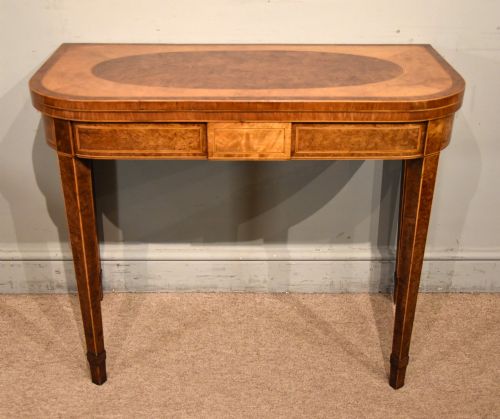
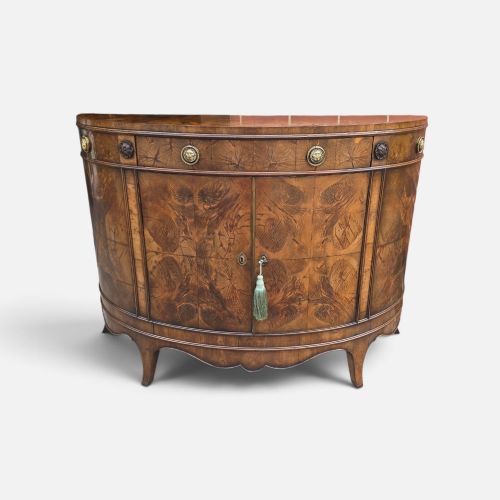
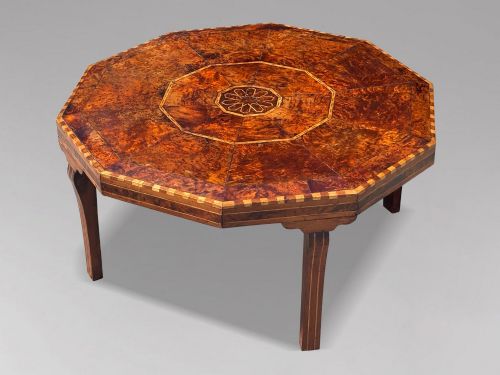


Georgian Burr Yew Furniture
Georgian burr yew furniture offers rich figured timber and compact forms, giving a room warmth and distinct character.
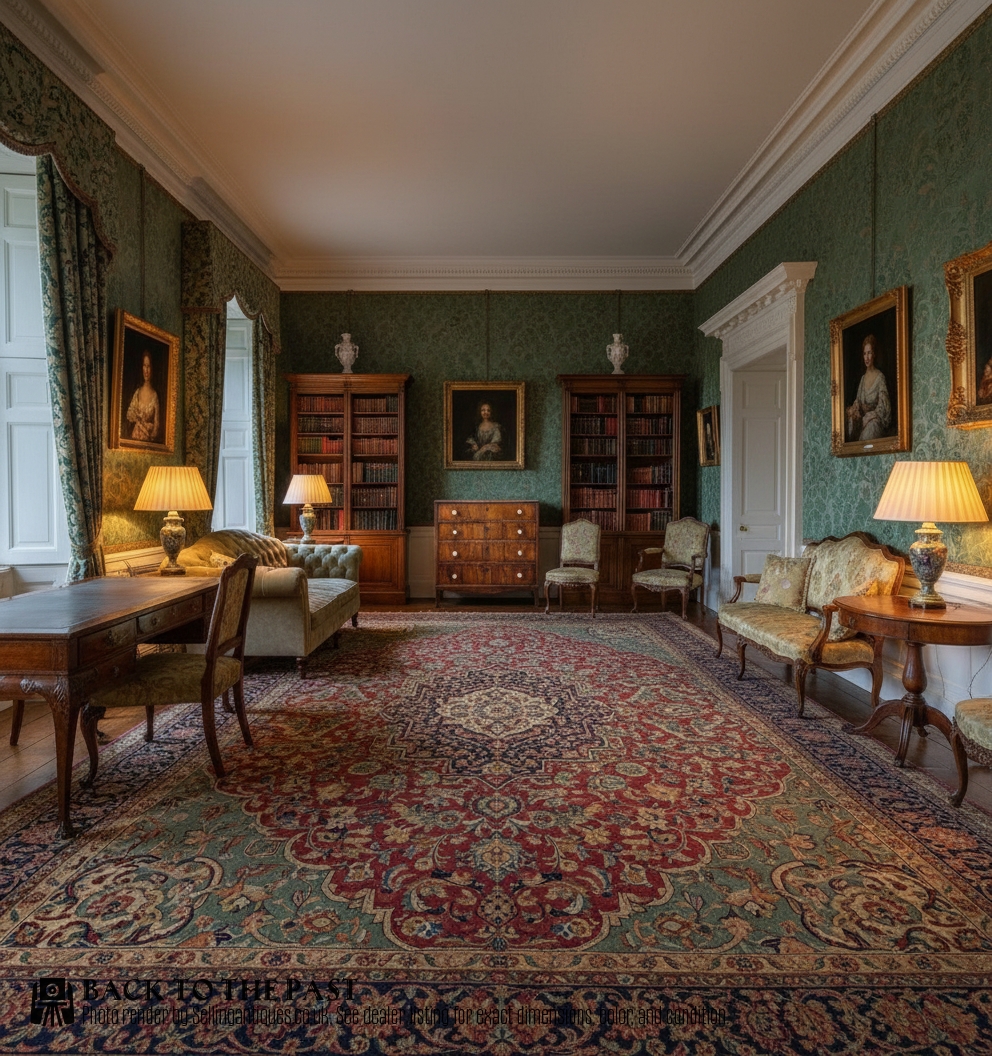
Georgian Burr Yew Furniture
Most items on this page span the Georgian, Regency, and Victorian eras, alongside later pieces from around nineteen-ten. Cabinet makers utilised the knotted growth of the yew tree to create striking decorative surfaces on functional household objects.
Forms range from demi-lune commodes and glazed corner cupboards to low-back Windsor armchairs with burr back splats. These pieces reflect both formal English cabinet-making and regional vernacular traditions.
How they were made
Craftsmen applied thin veneers of burr yew wood over solid secondary timbers, frequently enhancing designs with contrasting stringing in satinwood and boxwood. The distinctive swirling patterns of the wood grain required careful selection and matching by skilled cabinet makers.
Listings feature woods including burr yew, satinwood, boxwood, walnut, and elm across Georgian, Regency, and Victorian periods.
What varies in quality
The visual impact of georgian burr yew furniture depends heavily on the density, contrast, and symmetry of the wood grain across the veneered surfaces. Superior examples display rich, unbroken patterns with harmonious inlay work in satinwood or boxwood.
Proportion and execution set finer pieces apart, particularly in complex forms like demi-lune commodes and miniature chests. The skill required to shape figured timber around curved drawers or tripod bases dictates the refinement of each piece.
The Georgian Burr Yew Furniture Glossary
- Burr
- The deformed growth on a tree trunk that produces highly figured, swirling wood grain when sliced into veneer. Cabinet makers prized this timber for decorative furniture surfaces.
- Demi-lune
- A half-moon shape used for the tops and bodies of side cabinets and commodes. This form allowed furniture to sit flush against a wall while offering display space.
- Stringing
- Thin inlaid lines of contrasting wood, such as satinwood or boxwood, used to outline panels and tabletops. It provides a crisp border to figured veneers.
- Teapoy
- A small stand or box designed to hold tea canisters, often fitted with internal compartments. They became popular household items during the Regency period.
- Windsor chair
- A traditional wooden armchair constructed with turned legs and spindles socketed into a solid carved seat. Burr variations feature figured splats inserted into the stick-back frame.
Georgian Burr Yew Furniture: Frequently Asked Questions
What is burr yew wood?
Burr yew is timber taken from a growth or burl on a yew tree, featuring tightly clustered knots and swirling grain patterns.
Cabinet makers sliced this figured wood into thin veneers to cover the primary surfaces of high-end tables and cabinets.
How do I care for yew furniture?
Keep yew furniture away from direct sunlight and strong heat sources to prevent the wood veneer from drying out or cracking.
Dust regularly with a soft cloth and occasionally apply a quality beeswax to maintain the natural lustre of the timber.
Are miniature pieces apprentice pieces?
Miniature chests of drawers and cabinets were often created as trade samples, cabinet maker demonstrations, or detailed desk ornaments.
While traditionally called apprentice pieces, many were simply high-quality small-scale items made for domestic display.
How do I spot Regency style?
Regency furniture draws inspiration from classical antiquity, featuring clean architectural lines, brass mounts, and tripod pedestals.
Pieces from this era often combine figured timbers like burr yew with dark contrasting wood details and refined geometric proportions.