


Geometric Table Clock
A geometric table clock brings sharp lines and industrial materials into interior spaces, offering a striking centrepiece for a desk or mantel.
Geometric Table Clock
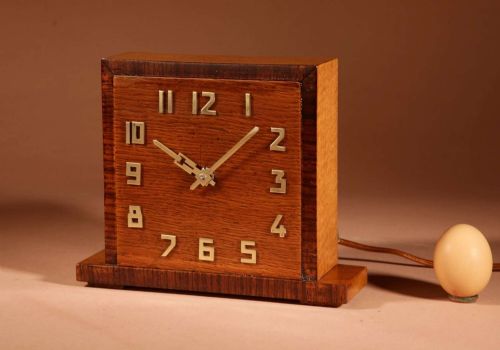
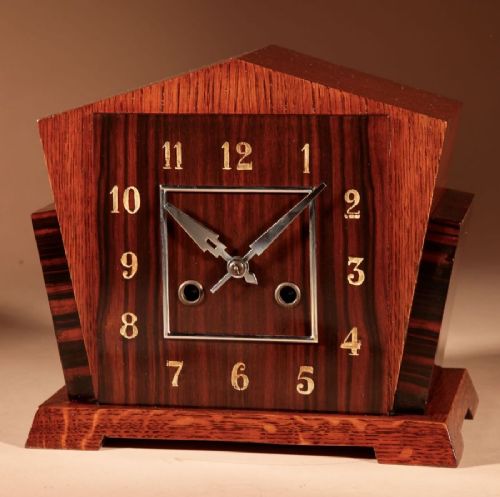
A geometric table clock typically takes the form of a mantel clock, desk clock, or easel clock originating predominantly from the 1920s, 1930s, and 1940s. These pieces embody Art Deco and Amsterdam School Art Deco styles, focusing on bold shapes, architectural silhouettes, and clear numeric dials.
Buyers encountering this selection will frequently find versions executed in oak, walnut, chrome, glass, and bakelite. The designs range from compact desk timepieces to larger chiming mantel clocks that reflect the modernist movements of early twentieth-century Europe.
Materials and Construction
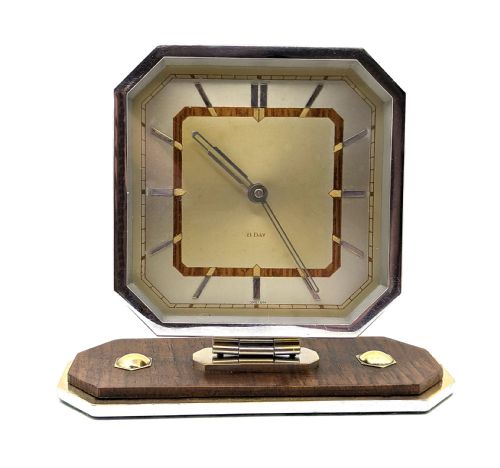
Makers constructed these clocks using a combination of traditional cabinet woods like oak, walnut, macassar ebony, and rosewood alongside contemporary industrial materials such as chrome-plated metal, brass, copper, marble, and mirror glass. Bakelite also emerges frequently as a moulded synthetic material used for vibrant cases.
Movements inside these cases rely on mechanical 8-day systems or early electrical and battery-driven mechanisms, such as Bulle systems, paired with specialised components supplied by dedicated clockmakers.
Geometric Table Clock Retail Price Guide 2026
Typical asking prices for geometric table clock among the pieces listed under this phrase on Sellingantiques today, from the lower quarter to the upper quarter. They describe what is for sale here now, not the wider market.
Listings feature items primarily from the 1920s and 1930s, constructed from oak, walnut, chrome, bakelite, and marble.
Distinctions in Execution
The distinction between standard production items and finer examples lies in the selection of materials, such as the use of contrasting exotic wood veneers like coromandel or macassar ebony against solid oak, and the integration of bevelled glass or heavy cast chrome housings.
Execution also depends on the complexity of the internal movement, whether mechanical 8-day, Westminster chime, or specialised signed electrical systems, alongside the finish of the metalwork and the precision of the geometric woodwork.
Smiths Clockmakers·Mappin & Webb·P.M.Favre·Blangy Clockmakers·Bravingtons Ltd·Asprey·A.L. Davenport·Garrards·Pfeilkreuz Junghans·JAZ·CYMA
The Geometric Table Clock Glossary
- Art Deco
- A design style spanning the 1920s and 1930s characterised by streamlined geometric forms, symmetry, and modern industrial materials. It replaced the flowing curves of earlier decorative movements.
- Bakelite
- An early form of synthetic plastic used extensively in the 1930s for moulded clock cases. It provides a durable, smooth surface often produced in striking colours.
- Amsterdam School
- An architectural and design style originating in the Netherlands during the early twentieth century. It utilises rounded brickwork, expressive forms, and rich timber detailing.
- Westminster Chime
- A melodic sequence of quarter-hour chimes traditionally associated with mantel clocks. Mechanisms featuring this function require multiple trains within the movement.
- Easel clock
- A timepiece supported by a hinged back prop rather than standing on a flat base. These are typically designed for desk or dressing table placement.
Geometric Table Clock: Frequently Asked Questions
What is a geometric table clock?
A geometric table clock is a timepiece designed for flat surfaces, such as desks or mantelpieces, shaped by the architectural and angular principles of the Art Deco and Amsterdam School styles.
These clocks utilise materials like chrome, glass, marble, and exotic woods to create structured, symmetrical forms that double as decorative sculptures.
How do mechanical 8-day movements work?
A mechanical 8-day movement relies on a mainspring that requires manual winding approximately once every week to maintain accurate timekeeping.
These movements drive the gear train and escapement, often including specialist chiming functions or mystery clock dial arrangements.
Where should I place a mantel clock?
Mantel clocks suit prominent flat surfaces where their architectural profiles and materials can be appreciated from multiple angles, such as a living room sideboard, office desk, or shelf.
Ensure the surface is level to keep mechanical pendulums or gravity-driven mechanisms operating correctly.
How do I identify an Art Deco clock?
Art Deco clocks are identified by their distinct geometric shapes, stepped wooden cases, contrasting metal accents, and stylised numeric dials.
They frequently incorporate materials popular in the 1920s and 1930s, such as chrome plating, bakelite, mirrored glass, and walnut veneer.