


Geometric Chrome Clock
A geometric chrome clock brings sharp lines and polished industrial verve into a room, capturing the absolute spirit of the interwar decades.
Geometric Chrome Clock
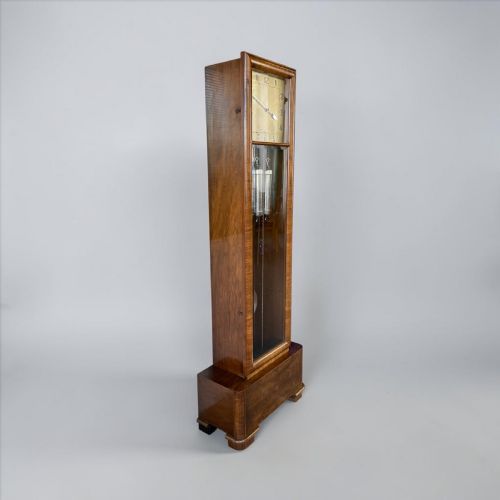
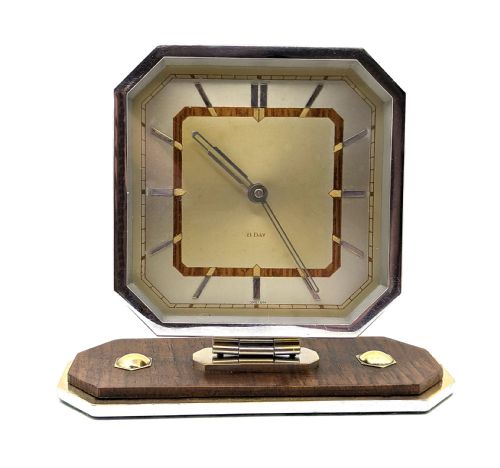
A geometric chrome clock is a timepiece defined by clean angles, metallic finishes, and distinct forms that embody the Art Deco and Modernist movements. When exploring this selection, a buyer encounters desk clocks, mantel clocks, and wall clocks alongside larger grandfather or longcase variations.
These items originate predominantly from the 1920s, 1930s, and 1940s, reflecting English, French, and German craftsmanship. The pieces combine metalwork with contrasting materials like glass, walnut, oak, and bakelite to create striking architectural profiles on a mantelpiece or desk.
Materials and construction
The construction relies heavily on chrome plating applied over base metals, paired with contrasting elements of glass, onyx, marble, and ebonised wood. Cabinetmakers and metalworkers utilised oak and walnut for wooden housings, while early plastics such as bakelite provided smooth, moulded surrounds for dials.
Movements within these timepieces range from eight-day mechanical calibres to electric mechanisms and Westminster chimes. Makers integrated metal bezels and glass faces directly into stepped, skyscraper, or architectural wooden and metallic chassis.
Some models feature transparent glass faces that make the hands appear to float entirely by magic.
Variations in quality
Quality rests in the precision of the geometric casing and the prominence of the maker, with signed pieces by renowned firms commanding greater attention. The crispness of the chrome finish and the integrity of secondary materials like carved onyx or figured walnut set finer examples apart.
The sophistication of the internal movement also dictates standard, moving from standard time-only mechanisms to complex eight-day, chiming, or electric systems. The harmony between the metallic structure and the accompanying wooden or glass body defines the overall execution.
Smiths Clockmakers·Mappin and Webb·Junghans·Asprey·CYMA
The Geometric Chrome Clock Glossary
- Art Deco
- A design style spanning the 1920s and 1930s characterised by streamlined geometric shapes, stylised motifs, and modern industrial materials. It is the dominant aesthetic found across these clock designs.
- Bakelite
- An early form of thermosetting synthetic phenol formaldehyde resin used for moulded clock cases and bezels. It offers a smooth, durable finish typical of the period.
- Skyscraper clock
- A timepiece designed with stepped towers and vertical lines mimicking interwar architecture. This form is particularly sought after in desk and mantel variants.
- Onyx
- A banded variety of chalcedony used for solid, heavy clock bodies and bases. It provides a cool, polished stone surface that contrasts with bright chrome.
Geometric Chrome Clock: Frequently Asked Questions
How do I wind an eight-day clock?
An eight-day clock uses a key inserted into dedicated winding holes on the dial face to tension the mainsprings.
Care should be taken not to overwind the mechanism, turning the key gently until firm resistance is felt.
Where should I place a desk clock?
A desk clock suits a prominent flat surface such as a mantelpiece, office desk, or bookcase where its architectural form remains visible.
Ensure the location is stable and away from excessive moisture or direct sunlight to protect the chrome and wood.
How do I tell an electric clock from a mechanical one?
Electric clocks generally operate via a mains cord or specialised movement without the need for manual spring winding with a key.
Mechanical alternatives require regular winding and often feature visible escapements or mechanical chime trains.