
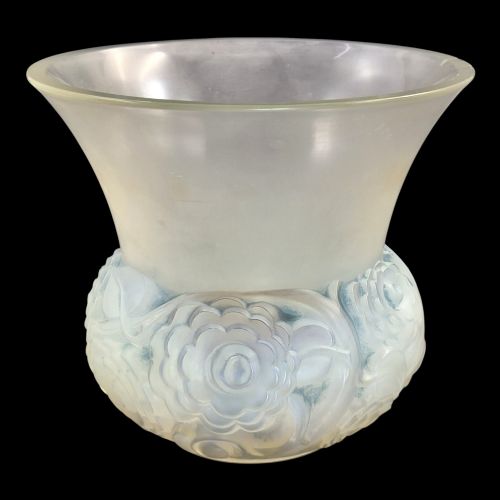
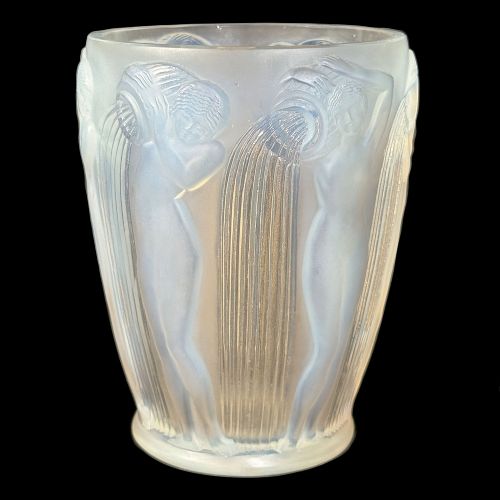


Frosted Opalescent Glass Vessel
A frosted opalescent glass vessel catches the light with shifting blue and milky tones, bringing tactile depth to a room.
Frosted Opalescent Glass Vessel
A frosted opalescent glass vessel combines milky translucency with surface relief, creating a luminous quality that shifts under changing light. Pieces meeting this description typically take the form of decorative bowls or sculptural vases designed during the early decades of the twentieth century.
The selections span distinct creative movements, moving from the organic curves of the Art Nouveau period to the geometric stylisation of Art Deco. Vases and bowls dominate the forms available, often featuring moulded floral or figurative motifs that catch the pale opalescent glow.
Originating largely from French workshops, these items demonstrate how technical innovation in glass production served decorative arts. Collectors encounter works that reflect both the transitional aesthetics of nineteen hundred and the bold modernist lines of the nineteen twenties and thirties.
Materials and methods
Production relies on specialised glass formulations that cool to reveal a characteristic milky opalescence, often paired with frosted sections to create contrast against clear or tinted backgrounds. Techniques such as press moulding allow for intricate relief details, from trailing foliage to human figures.
Cameo glass techniques also appear, involving layered glass acid-etched to produce raised designs in contrasting colours. These physical processes demand precise temperature control during manufacture to achieve the signature translucency and surface texture.
Listings feature works from the Art Nouveau and Art Deco periods, created using opalescent, frosted, pressed and cameo glass techniques.
Assessing quality
Quality rests upon the crispness of the moulded relief and the intensity of the opalescent fire within the glass. Superior examples display subtle shifts in tone from milky white to soft blue when turned in the light, bringing out the depth of the carved or pressed design.
The definition of the motifs, whether floral stems or water carriers, distinguishes finer workshop output from simpler commercial production. Balance in the vessel form and the successful integration of frosted matte surfaces with polished highlights complete the assessment of merit.
René Lalique
The Frosted Opalescent Glass Vessel Glossary
- Opalescent glass
- Glass that exhibits a milky, bluish translucency when lit from the front and a warm amber tone when lit from behind. This optical effect results from the chemical composition and thermal treatment during shaping.
- Frosted glass
- Glass treated to achieve a matte, non-reflective surface texture through acid-etching or sandblasting. It provides visual contrast against polished or translucent areas on decorative vessels.
- Cameo glass
- Glass vessels created by fusing two or more distinct layers of coloured glass and carving away the outer layer to leave a raised design. The method requires great skill to control depth and colour variation.
- Pressed glass
- Molten glass shaped by being pressed into a metal mould using a plunger, enabling complex patterns and high-relief designs to be produced consistently. This technique underpinned much twentieth-century decorative glassware.
- Art Deco
- A design style characterised by sleek geometric lines, stylised natural motifs and modernity, prevalent during the nineteen twenties and thirties. It succeeded the flowing organic forms of the preceding era.
Frosted Opalescent Glass Vessel: Frequently Asked Questions
What is a frosted opalescent glass vessel?
These pieces are decorative glass objects, primarily vases and bowls, made using specialised chemical cooling processes that create milky, light-catching qualities. They emerged strongly during the early twentieth century through the work of prominent French designers.
Buyers seek them for their ability to diffuse light and display intricate moulded or carved surface patterns inspired by nature and modernism.
How do I date these glass vessels?
Dating relies on stylistic markers that separate the flowing, organic motifs of the Art Nouveau period from the sharper, geometric lines characteristic of Art Deco design. Maker signatures, registry marks and known production spans for specific vase models further narrow the timeframe.
Changes in glass technology and colour palettes across the early twentieth century also offer reliable clues to a piece's era of manufacture.
How should I display them at home?
Place these vessels where natural light can pass through or strike the surface, as this activates the milky opalescent glow and highlights the frosted relief details. Open shelving near windows or well-lit tabletops allows the shifting blue and amber tones to be fully appreciated.
Keep them away from direct edges or high-traffic areas to protect their delicate moulded glass bodies from accidental knocks.
What distinguishes Art Nouveau from Art Deco styles?
Art Nouveau works, emerging around nineteen hundred, feature asymmetrical, flowing lines inspired by plant stems, flowers and natural forms. The surfaces often incorporate cameo carving and softer, undulating contours.
Art Deco pieces, dating from the nineteen twenties and thirties, favour symmetry, stylised geometry and bold relief moulding such as ferns, fruit or figurative scenes.